Author: Fritz Loho

  • How do I help my Year 6 student master BODMAS and negative numbers?

    How do I help my Year 6 student master BODMAS and negative numbers?

    Does your Year 6 student know their multiplication tables by heart but freeze the moment they see a negative number or a long string of operations? You are not alone. Parents frequently worry that their children lack “math ability,” but the real issue is rarely intelligence. It is a disconnect in logic.

    In Stage 3 (B) of the NSW curriculum, students transition from simple arithmetic to structural thinking. This is where many students hit a wall. They treat math as a linear race—calculating from left to right without pause. When they encounter negative integers on a number line or complex equations requiring the order of operations (BODMAS), this “left-to-right” habit fails.

    The “Math Isn’t a Race” Mindset

    The biggest mistake parents make is focusing on speed. Speed encourages guessing. Instead, focus on structure. When your child sees a math problem, ask them to identify the “rules of the road” first.

    BODMAS (Brackets, Orders, Division, Multiplication, Addition, Subtraction) is not just a mnemonic; it is a GPS. It tells the student exactly where to turn. Without this roadmap, a problem like 3 + 5 x 2 becomes a guessing game. By teaching students to pause and circle the “Order of Operations” first, you remove the anxiety of the unknown. They stop guessing the answer and start following the logic.

    Negative Numbers are Real-World Concepts

    Negative integers often cause panic because they are abstract. To a student, -10 is just a scary symbol. To a student who thinks of it as “10 degrees below freezing” or “10 meters below sea level,” it is a location.

    When your child struggles with negative numbers, stop writing equations on a napkin. Use visual tools. Draw a vertical number line (like a thermometer or the ocean depth). Let them see that -5 is actually warmer than -10. Physicalizing the number line bridges the gap between abstract symbol and reality.

    Practical Tips for Home

    1. Slow Down to Speed Up: Before solving, ask: “What does BODMAS tell us to do first?” If they can identify the operation (e.g., the multiplication inside the brackets), they have already won half the battle.
    2. Context is King: If the math is about debt, temperature, or depth, it becomes a story. Stories are memorable. Abstract numbers are forgettable.
    3. Use Tools: EinstyAI allows you to input these concepts and generate customized stories that turn these abstract challenges into engaging scenarios.

    Stop battling over rote practice. Build the mental models now, and the results will follow. Start by asking, “What is the order, and where are we on the number line?”

    Practice Questions

    The Deep Sea Explorer Challenge

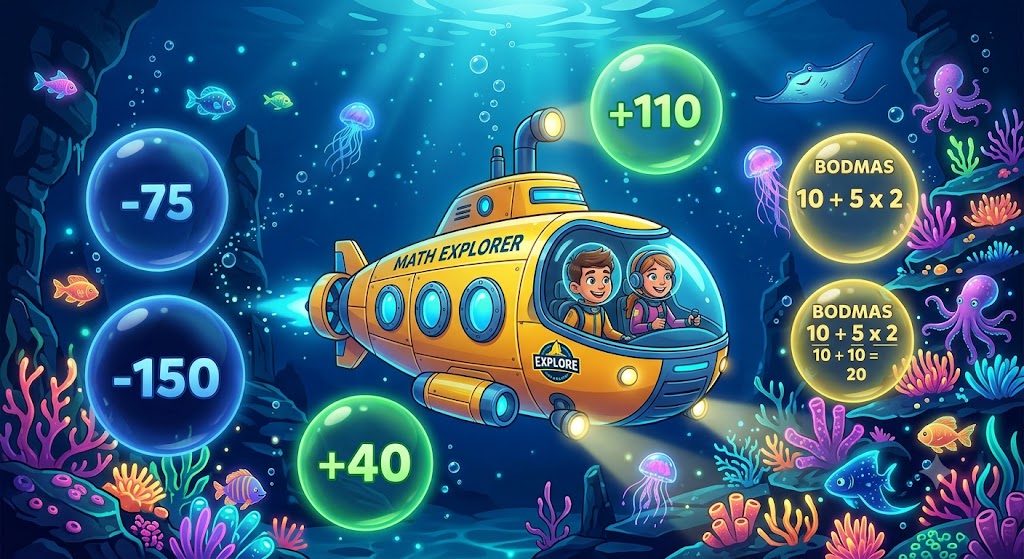
    Welcome, Explorer! You are piloting the Abyss-1 submarine. To navigate the ocean floor safely and manage your oxygen levels, you must master the order of operations and understand your depth.

    Question 1

    Your submarine is at a depth of 150 metres below sea level (-150m). You rise 40 metres to avoid a coral reef. What is your new depth?

    A) -190m

    B) -110m

    C) 110m

    D) 190m

    Question 2

    The ocean temperature at your current depth is 4 degrees. A cold current drops the temperature by 7 degrees. What is the new temperature?

    A) 11 degrees

    B) 3 degrees

    C) -3 degrees

    D) -11 degrees

    Question 3

    Your ship’s computer needs to calculate oxygen pressure. The formula is 10 + 5 x 2. According to BODMAS, what is the correct pressure level?

    A) 30

    B) 20

    C) 15

    D) 25
  • How Can I Help My Year 5 Child Master Numbers Up to Billions and Prime Concepts?

    How Can I Help My Year 5 Child Master Numbers Up to Billions and Prime Concepts?

    Many parents assume that by Year 5, math homework should be a silent, independent battle. We often think, “If they don’t get it by now, they just aren’t math kids.” This is a dangerous myth. Math anxiety isn’t about ability; it’s about context. When students encounter numbers in the billions or complex prime/composite classifications, they freeze because the numbers lack a story.

    Numbers in the billions are abstract. Unless your child is managing a national budget or counting stars in a galaxy, a billion is just a “big number.” To help them, we must bridge the gap between abstract digits and real-world scale.

    The Strategy: Decoding the Math Story

    To tackle Year 5 NESA outcomes in Number and Algebra, your child needs to treat word problems like a detective case. Here are three tricks to teach them:

    • Circle the Constants, Underline the Question: In problems involving billions, students get distracted by the zeroes. Teach them to underline exactly what the question asks for (e.g., “How many billions?” vs. “How many total units?”).
    • The Factor Test: When identifying composite numbers, don’t just guess. Teach them the “Divisibility Rule.” If a number ends in 0, 2, 4, 6, or 8, it is divisible by 2. If the digits add up to a multiple of 3, it is divisible by 3. This saves time and builds confidence.
    • Visualize the Scale: When working with billions, use comparisons. Use distance or population examples. If a local town has 10,000 people, how many towns would it take to reach 1 billion? This makes the number tangible.

    Moving Beyond Homework Battles

    The shift from primary to secondary math requires deeper conceptual understanding. Prime and composite numbers are the “building blocks” of mathematics. When a child understands that a prime number only has two factors (1 and itself), they are learning to see the underlying structure of all numbers.

    Don’t let your child struggle alone. Use tools that translate these concepts into engaging narratives. At EinstyAI, we help students transform dry curriculum outcomes into personalized stories that stick.

    Stop the battle at the kitchen table. Start building their confidence today.

    Practice Questions: The Intergalactic Math Mission

    1. The Fleet Deployment

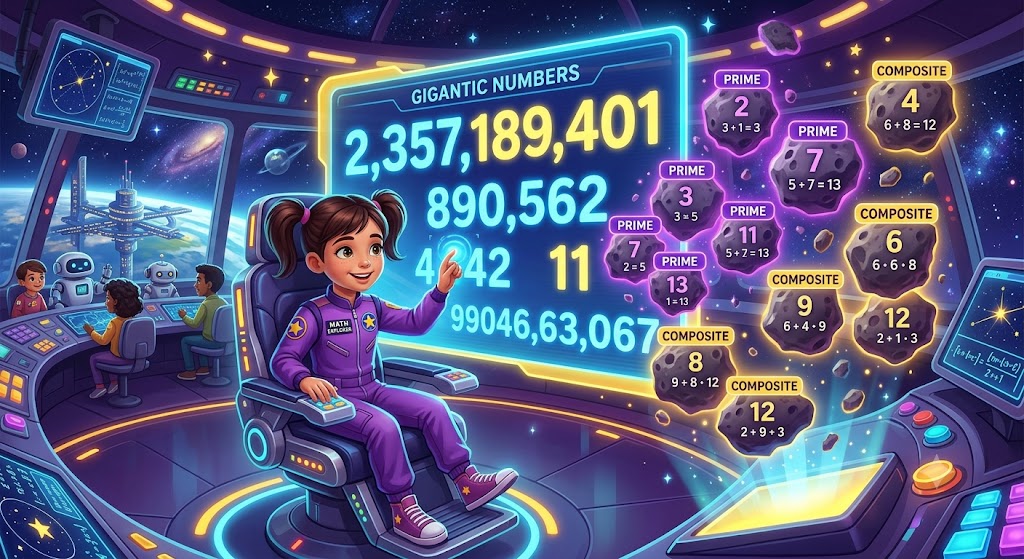
    The Galactic Federation is sending a rescue fleet to the Alpha-7 cluster. They are sending 5,000,000,000 (five billion) light-units of fuel. Which statement correctly identifies the value of the ‘5’ in this number?

    A. Five hundred million

    B. Five billion

    C. Five thousand million

    D. Fifty million

    2. The Asteroid Sorters

    You are sorting asteroids by their density level to clear the space lane. Which of the following numbers is a prime number?

    A. 21

    B. 27

    C. 29

    D. 39

    3. The Colony Budget

    A space colony project has a budget of $2,300,000,000. Another project has a budget of $2,003,000,000. Which inequality symbol correctly compares the two projects?

    A. 2,300,000,000 < 2,003,000,000

    B. 2,300,000,000 > 2,003,000,000

    C. 2,300,000,000 = 2,003,000,000

    D. 2,300,000,000 <= 2,003,000,000

  • Why is Year 1 math homework a battleground and how do you fix it?

    Why is Year 1 math homework a battleground and how do you fix it?

    Does sitting down for math homework with your Year 1 child feel like a daily negotiation? You are not alone. Many parents believe that some children just “aren’t math kids.” This is a myth. The struggle rarely stems from a lack of ability; it stems from a disconnect between how math is taught in the classroom and how it is practiced at home.

    The Australian curriculum has shifted away from rote memorization toward deep conceptual understanding. For Year 1 students, the pivot point is part-part-whole reasoning. If your child struggles with addition and subtraction within 20, they likely haven’t mastered this mental model yet.

    What is Part-Part-Whole Reasoning?

    Think of a number as a “whole” bucket. You can split that bucket into two smaller “parts.” For example, if the whole is 10, the parts could be 6 and 4.

    When children learn to see numbers this way, addition and subtraction become the same relationship viewed from different angles. Addition is putting the two parts together to find the whole. Subtraction is starting with the whole and removing one part to find the other.

    Key Takeaway: Stop teaching your child to “count up” or “count down” on their fingers. Start asking, “What is the whole, and what are the parts?”

    The “Story Problem” Trick for Success

    Children often panic when they see a number sentence like 12 – 5 = ? because it looks abstract. They don’t see the context. The secret to EinstyAI is transforming these dry numbers into meaningful stories.

    When helping your child at home, use the “Visual Story” technique:

    1. Give the numbers a job: Instead of “12 minus 5,” say, “There are 12 koalas in a tree. 5 jump down to get a drink. How many are left in the tree?”
    2. Draw the parts: Encourage your child to draw the 12 koalas. Then, have them circle the 5 that jump away. This creates a visual representation of the “whole” (12) being split into the “part” that left (5) and the “part” remaining (7).
    3. Translate to Math: Only after they solve the story should you write the number sentence (12 – 5 = 7).

    Actionable Strategy: Next time your child gets stuck, stop focusing on the answer. Ask, “What are the parts we know, and what is the whole we are trying to find?” This mindset shift builds confidence because it turns math from a guessing game into a puzzle they can solve.

    Stop battling over rote practice. Help your child build these mental models by using stories that make sense to them. Complete our Year 1 Math Worksheet below to start practicing part-part-whole reasoning today.

    Practice Questions

    The Great Outback Animal Rescue Challenge

    Welcome to the Outback Rescue! You are a Junior Ranger tasked with counting and caring for our native animals. Use your part-part-whole skills to ensure every animal is safe and accounted for.

    Question 1: The Kangaroo Hop

    A group of 14 kangaroos is resting in the shade. 6 kangaroos decide to hop away to find fresh grass. How many kangaroos are left resting in the shade?

    A) 6

    B) 7

    C) 8

    D) 20

    Question 2: The Wombat Burrow

    There are 9 wombats in a big burrow and 5 wombats in a smaller tunnel nearby. How many wombats are there altogether?

    A) 4

    B) 12

    C) 14

    D) 15

    Question 3: The Emu Egg Collection

    A ranger finds a nest with 18 eggs in total. If 9 eggs are in the main nest and the rest are in a hidden patch, how many eggs are in the hidden patch?

    A) 8

    B) 9

    C) 10

    D) 27

  • Why does my Year 2 child struggle with three-digit numbers?

    Why does my Year 2 child struggle with three-digit numbers?

    Does math homework often turn into a battle of tears and frustration at your kitchen table? You aren’t alone, and the problem usually isn’t that your child “isn’t a math kid.” The disconnect often happens because we teach children to memorize isolated steps rather than visualizing numbers as physical objects.

    Many parents assume that math success requires rapid calculation skills. In reality, the ACARA curriculum for Stage 1 (B) emphasizes conceptual fluency over raw speed. When children can partition three-digit numbers and use the jump strategy on empty number lines, they unlock the ability to visualize math instead of guessing.

    What is the “Jump Strategy”?

    The jump strategy is a visual technique for addition where we break numbers apart (partitioning) to make them easier to handle. Instead of trying to add everything in one go, your child starts on a number line and makes “jumps.”

    For a problem like 345 + 123, we partition the second number (123) into 100, 20, and 3. On the empty number line, we start at 345. We jump 100 to reach 445. Then, we jump 20 to reach 465, and finally, we jump 3 to reach the total of 468.

    Why this method works

    Partitioning turns abstract math into a story problem. It allows the brain to process one chunk of the number at a time, reducing the cognitive load. By placing these chunks onto a line, children can actually see the distance they are traveling.

    Key Takeaway: Stop focusing on the “right answer” and start focusing on the “right path.” If your child can explain their jumps, they understand the place value, and the calculation will naturally follow.

    Helping your child at home

    Stop forcing rote memorization of sums. Instead, draw an empty number line on a piece of paper. Ask your child to mark the starting number on the left and show you how they would “jump” toward the answer.

    If they get stuck, help them break the second number down into hundreds, tens, and ones. This builds the foundational number sense needed for higher stages of primary school.

    At EinstyAI, we help children transform these concepts into engaging, custom-tailored, curriculum-aligned stories. When math becomes a story about characters rather than dry equations, the anxiety disappears, and confidence builds.

    Ready to change the way your child learns? Grab a pencil, draw an empty line, and start jumping today.

    Practice Questions

    The Great Outback Animal Rescue: Worksheet

    Join Kiki the Kangaroo and her friends as they help rescue lost animals in the Australian Outback. Solve these number problems using the jump strategy!

    Question 1

    Kiki found 234 lost wallabies. Later, she found 120 more hidden in a cave. Which partition shows how to break down the number 120 to help with the jump strategy?

    A) 100 + 20 + 0

    B) 100 + 2 + 0

    C) 10 + 20 + 0

    D) 120 + 0 + 0

    Question 2

    Emu Eddy is running to find water. He starts at 350 and needs to jump forward by 210. After his first jump of 200, where does he land on the number line?

    A) 500

    B) 550

    C) 450

    D) 650

    Question 3

    A hungry wombat has 425 berries. He collects 142 more from a bush. Using the jump strategy, what is the best sequence of jumps to solve 425 + 142?

    A) Jump 1, then 4, then 2

    B) Jump 100, then 40, then 2

    C) Jump 10, then 40, then 20

    D) Jump 140, then 2, then 0

  • How do I stop my Year 3 student from feeling overwhelmed by multiplication?

    How do I stop my Year 3 student from feeling overwhelmed by multiplication?

    Many parents tell us that math homework has become a nightly battleground. If your child struggles with the jump from basic counting to understanding numbers in the thousands and multiplicative fact families, you are not alone.

    There is a dangerous assumption that “some kids just aren’t math kids.” This is a myth. Math anxiety usually stems from teaching math as a set of rules to memorize, rather than a language to speak. When we introduce Year 3 students to larger numbers and multiplication, we must ground it in their reality—not just abstract grids on a page.

    The Leap to Thousands

    Year 3 represents a significant cognitive shift. Students move from working with simple two-digit numbers to understanding place value into the thousands.

    The strategy: Stop treating “thousands” as a bigger version of “ones.” Use visual models. If they understand that a packet of 10 candies is a “ten,” show them that 10 packets make a “hundred,” and 10 of those boxes make a “thousand.” Connecting the visual quantity to the numeral reduces the fear of large numbers.

    Mastering Fact Families (2, 4, 5, 10)

    Multiplication is just efficient addition. When students struggle with 2, 4, 5, and 10 fact families, they often try to memorize tables by rote. This is exhausting and ineffective.

    Try these tricks to make it stick:

    • The 10s rule: Remind them that multiplying by 10 is simply placing a zero on the end. It is the easiest bridge to understanding place value.
    • Doubling strategy: To multiply by 4, teach them to “double, then double again.” If they know 3 x 2 is 6, then 3 x 4 is just 6 doubled (12).
    • The Story Context: Turn the math into a narrative. If they are calculating how many alien legs there are on a spaceship (multiplied by 2), the math becomes a part of the adventure rather than a chore.

    Transform the Homework Routine

    We believe that learning math should be an engaging story, not a test of endurance. EinstyAI transforms standard curriculum requirements into custom-tailored stories that align with ACARA standards.

    When you replace the “battle” with a “narrative,” the math anxiety fades. Stop focusing on the result and start focusing on the story behind the numbers. If your child can visualize the problem, they can solve the equation.

    Practice Questions (Space Explorer Edition)

    1. The Star-System Count

    Captain Zog is charting a course through the Andromeda sector. His ship’s computer identifies 3,000 stars in Sector A, 400 stars in Sector B, and 50 stars in Sector C. How many total stars did the computer identify?

    A) 3,450

    B) 3,045

    C) 3,405

    D) 345

    2. Alien Legs on the Mothership

    The ship lands on a moon where every creature has 2 legs. If there are 8 creatures waiting to greet the crew, how many legs are there in total?

    A) 10

    B) 16

    C) 12

    D) 18

    3. Moon Rock Collection

    The crew collects moon rocks in bags of 5. If they fill 7 bags, how many moon rocks have they collected?

    A) 30

    B) 45

    C) 35

    D) 25

  • How to Help Your Year 4 Child Master Decimals and Multiplication Without the Tears?

    How to Help Your Year 4 Child Master Decimals and Multiplication Without the Tears?

    Why does Year 4 feel like the moment math becomes “too hard” for so many students? It is a common frustration. Parents often assume their child simply lacks a “math brain,” but the reality is that the curriculum shifts dramatically during this year. Students move from basic arithmetic into the abstract world of decimals to hundredths and complex multiplication facts up to 10×10.

    Math is not a fixed talent; it is a learned language. When children struggle, it is usually because they are trying to memorize disconnected rules rather than understanding the story behind the numbers.

    The “Mental Math” Mindset Shift

    The biggest mistake parents make is focusing on rote memorization. Memorizing tables is useful, but understanding the “why” is transformative.

    For multiplication facts up to 10×10, teach your child to use the distributive property. If they are stuck on 7×6, encourage them to break it down into 7×5 plus 7×1. This simple trick reduces cognitive load and stops the “blank stare” that happens during timed tests.

    Visualizing Decimals to Hundredths

    Decimals often baffle students because they are taught as abstract symbols. Bring them into the real world. Use money (dollars and cents) or length (meters and centimeters) to make the concept of “hundredths” concrete.

    When a child sees 0.45 as 45 cents out of a dollar, they stop seeing decimals as confusing dots and start seeing them as parts of a whole.

    Stop the Homework Battle

    If math homework has become a battleground, stop. Math anxiety stems from high-pressure environments where errors are punished rather than explored.

    Instead of hovering, ask your child to explain the logic they used. If they get the wrong answer, ask, “How did you arrive at that?” instead of “No, that’s wrong.” This shift builds confidence and critical thinking.

    At EinstyAI, we specialize in transforming these dry, academic requirements into engaging, custom-tailored stories that align with the curriculum. You don’t need to be a math expert to support your child; you just need the right tools to turn practice into play.

    Take the first step today: Stop battling, start story-telling.

    Practice Questions

    Math Worksheet: The Deep Space Explorer’s Mission

    Theme: You are a Deep Space Data Analyst. Use your math skills to repair the navigation systems of the Starship Numerator.

    Question 1

    The ship’s scanner detected an asteroid at 0.52 kilometers away. The shield sensors are only active for objects closer than 0.5 kilometers. Is the asteroid inside the danger zone?

    A) Yes, because 0.52 is smaller than 0.5.

    B) No, because 0.52 is greater than 0.5.

    C) Yes, because 52 is a larger number than 5.

    D) No, because 0.5 is equal to 0.50.

    Question 2

    To boost the warp drive, you need to calculate 7×8. You have a “Distributive Shortcut” chip installed. Which of these is the correct way to solve this using your shortcut?

    A) Solve 7×4 and multiply the result by 2.

    B) Solve 7×5 and add 7×3.

    C) Solve 7×10 and subtract 7.

    D) Solve 7×6 and add 7×1.

    Question 3

    The alien fuel pod is currently filled to 0.08 of its total capacity. What is another way to represent this amount?

    A) 8 tenths.

    B) 8 hundredths.

    C) 80 hundredths.

    D) 0.8.

  • Why Does Your Year 2 Math Homework Always End in Tears?

    Why Does Your Year 2 Math Homework Always End in Tears?

    It is the question every parent dreads hearing after school: “Mom, Dad, can you help me with this?” Suddenly, a simple homework assignment turns into a battleground of frustration and confusion. You assume your child just isn’t a “math kid,” but that is rarely the truth. The reality is that traditional worksheets often lack the narrative hook needed to keep a child’s brain engaged.

    The “Math Brain” Myth

    You likely believe that mathematical ability is innate—you either have it, or you don’t. This is false. Math anxiety in Year 2 students is almost always caused by a disconnection between abstract numbers on a page and real-world logic. When math feels like a chore, the brain shuts down. When math feels like a game, the brain switches on.

    The “Grouping” Trick for Success

    In Year 2, the core skill involves understanding repeated addition and modeling simple fractions like halves, quarters, and eighths of collections. The secret to mastering this is the “Story Grouping” technique.

    Don’t let them just look at the numbers. Instead, visualize the quantity as items in a collection. If the question asks for 3 groups of 4, have them draw 3 game avatars, each holding 4 items. By turning equations into tangible stories, students stop guessing and start calculating. This approach aligns perfectly with the current Stage 1 curriculum goals.

    Turn Math into an Adventure

    If your child loves gaming, use that interest as a bridge. Whether they are trading skins, building structures, or counting currency, the math stays the same—only the context changes. EinstyAI specializes in exactly this: transforming dry curriculum requirements into compelling stories. Stop fighting over homework. Start narrating the math.

    Practice Questions (The “Roblox Adventure” Set)

    1. The Avatar Collection

    Your favorite Roblox game gives you 3 avatar skins every time you complete a level. If you complete 4 levels, how many skins do you have in total?

    A) 7

    B) 10

    C) 12

    D) 15

    2. The Block Builder

    You are building a wall. Each row needs 5 blocks. You build 3 rows. How many blocks did you use in total?

    A) 8

    B) 15

    C) 20

    D) 12

    3. Sharing the Loot

    You have 8 rare gems. You want to share them equally with your best friend. How many gems does each person get if you split them in half?

    A) 2

    B) 3

    C) 4

    D) 6

  • How Do You Teach Length Measurement To A Year 1 Student Without A Ruler?

    How Do You Teach Length Measurement To A Year 1 Student Without A Ruler?

    Does your Year 1 child freeze when asked to measure something? Many parents assume their child simply “isn’t a math kid” because they struggle with abstract concepts like rulers or centimeters. The truth is, your child doesn’t lack ability; they likely lack a physical bridge between the physical world and the numbers on a page.

    Math isn’t just numbers on paper; it is a way to describe the world. Before we introduce formal tools like rulers, we must master the concept of informal units. This is where we measure objects using things like blocks, paperclips, or hand spans to understand what “length” actually means.

    Why Informal Units Build Strong Foundations

    When children start with formal units (centimeters/meters), they focus on the tool rather than the concept. By using informal units, students learn the End-to-End Rule. This ensures they understand that length is the total span of an object, not just a guess.

    If your child struggles to measure, they are likely making the “Gap Mistake.” They leave spaces between their measuring units (like gaps between paperclips). To fix this, treat measuring like building a train. Every unit must touch the next one, with no overlaps and no gaps. If there is a gap, the measurement is wrong.

    The Power of Narrative-Based Math

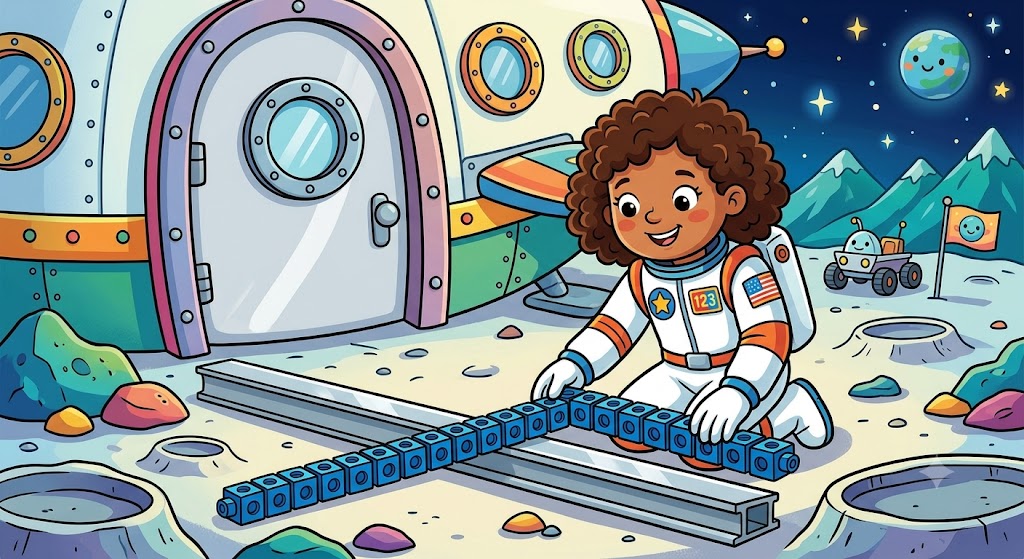
    At EinstyAI, we replace dry drills with story problems because stories provide context. When a child measures a “spaceship wing” using “blocks,” they aren’t just doing math; they are solving a problem for a character they care about. This reduces anxiety and builds persistence.

    Stop telling your child to “just measure it.” Instead, ask them: “If we use these blocks to measure the path for the space rover, how can we make sure the path is exactly the right length?”

    Measurement is about precision. If they learn to align units perfectly now, they will naturally master formal measurement tools later. Start measuring household items today. Grab a handful of LEGO bricks and measure the length of a toy car. Focus on the alignment. Perfect alignment leads to accurate understanding.

    Practice Questions

    Math Mission: The Space Explorer’s Challenge

    Your mission is to help the Space Explorers measure their equipment using “Moon Rocks” (a standard uniform unit) to ensure everything fits inside the storage pod.

    Question 1

    The Space Explorer needs to measure the length of a laser beam. They place Moon Rocks end-to-end to see how long it is. If the laser beam is 5 Moon Rocks long, which picture shows the correct way to measure?

    A) Moon Rocks overlapping each other.

    B) Moon Rocks with large gaps between each one.

    C) Moon Rocks placed neatly end-to-end without gaps.

    D) Moon Rocks scattered randomly around the laser.

    Question 2

    A small robot’s antenna is 4 space-pencils long. The robot starts measuring from the very bottom of the antenna. Where must the robot place the last space-pencil to finish measuring correctly?

    A) It stops exactly at the tip of the antenna.

    B) It places the pencil halfway past the antenna.

    C) It stops before it reaches the top.

    D) It can place the pencil anywhere near the antenna.

    Question 3

    The Explorer is measuring the distance of a crater edge using 6 small toy cubes. If they place them end-to-end and reach the end of the crater exactly, how many cubes long is the crater?

    A) 4 cubes

    B) 6 cubes

    C) 8 cubes

    D) It depends on how big the cubes are.

  • The Paycheck Reality: Why Your Teen Needs Financial Literacy, Not Just Formulas

    The Paycheck Reality: Why Your Teen Needs Financial Literacy, Not Just Formulas

    Does your Year 9 student view their future paycheck as a math problem to be solved, or as their first real ticket to independence?

    Most students treat financial mathematics as a dry, academic exercise—a series of abstract formulas involving tax brackets and interest rates that they assume will disappear the moment they leave the classroom. This is a missed opportunity. Financial literacy is not just a strand of the Year 9 curriculum; it is the fundamental framework for personal freedom. When students fail to connect these calculations to their own future goals, they disengage.

    Financial Math is Life Strategy

    Stop viewing math as a hurdle to jump over. For Year 9 students, the transition to Stage 5 (Core/Path) math is the perfect time to pivot from rote memorization to real-world application. Whether they are calculating earnings including overtime and tax or projecting savings using the simple interest formula, they are actually learning how to manage their future security.

    The “Break and Build” Approach

    Complex financial calculations often overwhelm students because they try to solve too many variables at once. Just as we use the “break and build” trick to simplify multiplication, we can apply the same logic to financial problems.

    • Deconstruct the earnings: When calculating total income, break it into base pay and overtime hours separately before combining them.
    • Isolate the variables: In simple interest problems, identify the Principal (P), rate (r), and time (n) individually before attempting the formula.
    • Contextualize the tax: Frame tax not as a “loss” but as a contribution to the services and infrastructure they use every day.

    Taking Control of the Narrative

    You don’t need to be a finance expert to help your teenager master these skills. The goal is to move beyond the textbook and into their reality. When they see that a solid understanding of interest rates can help them save for their first car or that calculating overtime makes them a more informed employee, the resistance disappears.

    Stop letting math be a battleground in your living room. By anchoring these concepts in stories and practical scenarios, you transform fear into curiosity. Children stop looking for “the answer” and start looking for the logic.

    Ready to make math feel like an adventure rather than a chore? Visit EinstyAI today to transform your child’s math practice into engaging, curriculum-aligned stories.


    Practice Questions

    The Junior Entrepreneur Challenge: Building Your Future

    Mission Briefing: You have just launched your own business, “Tech-Fix Solutions.” To be successful, you must master the numbers behind your earnings and your investments. Use your skills to calculate your way to financial success.

    Question 1: The Hourly Hustle

    You earn a base rate of $20 per hour. Last week, you worked 35 hours. Calculate your total base earnings before tax.

    Question 2: The Overtime Opportunity

    This week, you worked your usual 35 hours plus 5 hours of overtime. Your company pays “time and a half” for overtime. If your base rate is $20 per hour, what is your total pay for the week?

    Question 3: The Tax Reality

    You earned $800 this week. Your employer withholds 15% of your total earnings for tax. How much tax is taken out, and what is your final “take-home” pay?


  • Why Does My Year 5 Child Get Stuck on Multistep Math Word Problems?

    Why Does My Year 5 Child Get Stuck on Multistep Math Word Problems?

    Do you find yourself sitting at the kitchen table, watching your Year 5 student stare blankly at a word problem, only to give up because “it’s too hard”? You aren’t alone. Many parents assume that math ability is fixed—that some children are simply “math kids” and others are not. This is a myth. The reality is that most students don’t struggle with the math itself; they struggle with the language and the multi-layered logic of the question.

    In Stage 3 of the Australian curriculum, the jump in complexity is significant. Students are expected to move from simple arithmetic to solving multistep problems involving percentages. If your child struggles with this, they likely need a strategy to decode the story, not more repetitive drills. At EinstyAI, we help students transform this frustration into confidence by aligning math practice with stories they actually want to read.

    The Secret to Decoding Word Problems

    To help your child succeed with multistep problems—specifically calculating 10%, 25%, and 50%—teach them the “STOP-THINK-SOLVE” method.

    1. Stop and Underline Keywords:

    Ask your child to highlight the important numbers and the specific percentage they need to find. If the problem asks for 10% of a collection, circle “10%.” If it mentions “total” or “remaining,” highlight those. Ignoring keywords is the number one reason for errors.

    2. Think in “Easy Chunks”:

    Before jumping into complex division, use “friendly” percentages.

    • 50% is half: Just divide the number by 2.
    • 25% is half of a half: Divide by 2, then divide by 2 again.
    • 10% is a tenth: Just move the decimal point one place to the left (e.g., 10% of 80 is 8).

    3. Solve the Steps Separately:

    Multistep problems are just a series of small problems chained together. Teach your child to solve one part, write the answer down, and then use that answer to solve the next part. Never try to hold all the numbers in your head at once.

    Changing the Mindset

    Math homework doesn’t have to be a battleground. When you shift the focus from “getting the right answer” to “solving the mystery” within the story, anxiety drops. A Year 5 student who views a word problem as a puzzle to be cracked—rather than a test to be failed—will naturally develop better problem-solving stamina.

    Ready to put these strategies into practice with your child? Scroll down to download our latest story-based worksheet designed to make Stage 3 percentages manageable and fun.

    Practice Questions

    The Great Outback Wildlife Rescue

    Help the ranger team save our native animals! Use your math skills to calculate the supplies needed for the rescue mission.

    Question 1

    The ranger team found 120 injured kangaroos in the bush. They need to give medicine to 25% of them immediately. How many kangaroos need immediate medicine?

    A) 20

    B) 30

    C) 40

    D) 60

    Question 2

    The rescue station has a stockpile of 400kg of eucalyptus leaves for the koalas. The team uses 10% of the stockpile for the morning feed. How much eucalyptus is left for the rest of the day?

    A) 40kg

    B) 300kg

    C) 360kg

    D) 390kg

    Question 3

    The team rescued 80 baby wombats. They decided to transport 50% of them to the main shelter and keep the rest at the field hospital. Later, 25% of the wombats at the field hospital were cleared to go home. How many wombats are still at the field hospital?

    A) 10

    B) 30

    C) 40

    D) 20