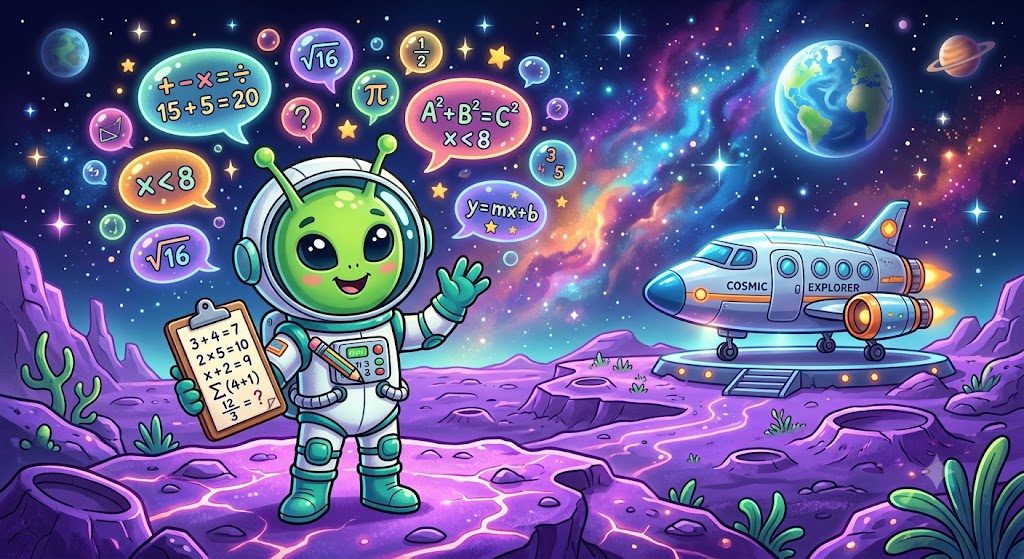
Many parents tell us that math homework has become a nightly battleground. If your child struggles with the jump from basic counting to understanding numbers in the thousands and multiplicative fact families, you are not alone.
There is a dangerous assumption that “some kids just aren’t math kids.” This is a myth. Math anxiety usually stems from teaching math as a set of rules to memorize, rather than a language to speak. When we introduce Year 3 students to larger numbers and multiplication, we must ground it in their reality—not just abstract grids on a page.
The Leap to Thousands
Year 3 represents a significant cognitive shift. Students move from working with simple two-digit numbers to understanding place value into the thousands.
The strategy: Stop treating “thousands” as a bigger version of “ones.” Use visual models. If they understand that a packet of 10 candies is a “ten,” show them that 10 packets make a “hundred,” and 10 of those boxes make a “thousand.” Connecting the visual quantity to the numeral reduces the fear of large numbers.
Mastering Fact Families (2, 4, 5, 10)
Multiplication is just efficient addition. When students struggle with 2, 4, 5, and 10 fact families, they often try to memorize tables by rote. This is exhausting and ineffective.
Try these tricks to make it stick:
- The 10s rule: Remind them that multiplying by 10 is simply placing a zero on the end. It is the easiest bridge to understanding place value.
- Doubling strategy: To multiply by 4, teach them to “double, then double again.” If they know 3 x 2 is 6, then 3 x 4 is just 6 doubled (12).
- The Story Context: Turn the math into a narrative. If they are calculating how many alien legs there are on a spaceship (multiplied by 2), the math becomes a part of the adventure rather than a chore.
Transform the Homework Routine
We believe that learning math should be an engaging story, not a test of endurance. EinstyAI transforms standard curriculum requirements into custom-tailored stories that align with ACARA standards.
When you replace the “battle” with a “narrative,” the math anxiety fades. Stop focusing on the result and start focusing on the story behind the numbers. If your child can visualize the problem, they can solve the equation.
Practice Questions (Space Explorer Edition)
1. The Star-System Count
Captain Zog is charting a course through the Andromeda sector. His ship’s computer identifies 3,000 stars in Sector A, 400 stars in Sector B, and 50 stars in Sector C. How many total stars did the computer identify?
A) 3,450
B) 3,045
C) 3,405
D) 345
2. Alien Legs on the Mothership
The ship lands on a moon where every creature has 2 legs. If there are 8 creatures waiting to greet the crew, how many legs are there in total?
A) 10
B) 16
C) 12
D) 18
3. Moon Rock Collection
The crew collects moon rocks in bags of 5. If they fill 7 bags, how many moon rocks have they collected?
A) 30
B) 45
C) 35
D) 25