Tag: Year 3

  • How the Tally-to-Graph Bridge Helped Mia Turn Puppy Data Into Math Magic

    How the Tally-to-Graph Bridge Helped Mia Turn Puppy Data Into Math Magic

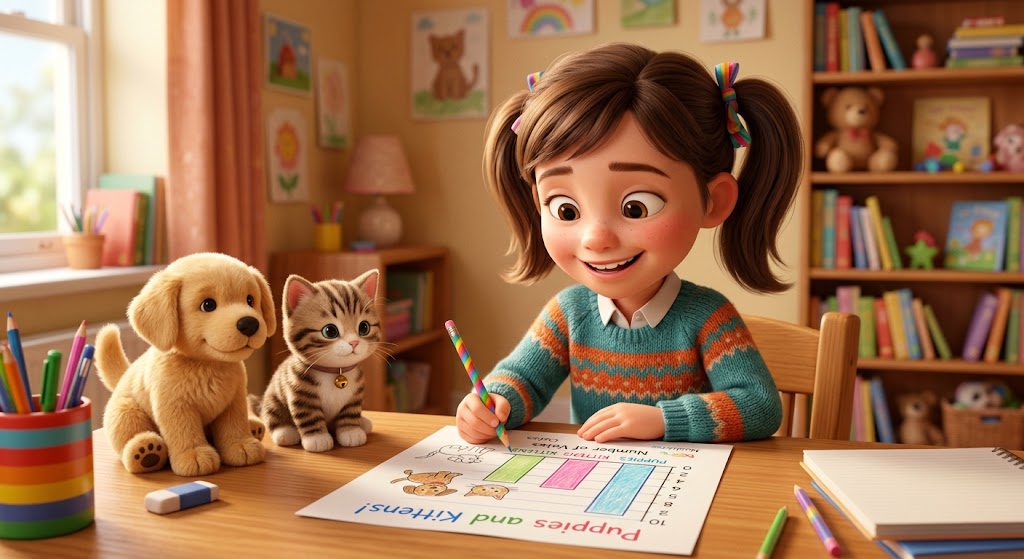
    The kitchen table was quiet, except for the sound of an eraser aggressively rubbing against paper. Mia, a bright Year 3 student, was on the verge of tears. In front of her sat a jumble of raw tally marks for a “Cute Puppies & Kittens” survey. The task was simple: turn the data into a column graph. But for Mia, the numbers felt like a foreign language.

    Her parents watched, feeling that familiar knot of frustration. They knew the drill: homework time was supposed to be a learning moment, but it had turned into a battle of wills, confusion, and paper-tearing exhaustion.

    The Common Mistake

    Most students struggle with graphing because they try to jump directly from a list of words to a finished, pretty graph. They look at the “Puppies” and “Kittens” labels and try to guess the bar height without anchoring the data. When the abstract lines on the graph don’t align with the tangible numbers in their heads, panic sets in. Children aren’t failing at math; they are failing to see the invisible thread connecting the data to the picture.

    The Guide & Magic Tool: The Tally-to-Graph Bridge

    To turn confusion into confidence, we use the “Tally-to-Graph Bridge.” This strategy treats the tally marks not as abstract scratches, but as physical “blocks” that are simply moved from the tally sheet to the graph paper. By counting the tallies first and writing the total above the tally mark, the child creates a “Bridge” of information. This number becomes the exact target for the bar height, removing the guesswork.

    The Transformation

    Mia took a deep breath. She looked at her tally marks for “Golden Retrievers” (five tallies). She wrote a clear “5” right above them—her Bridge.

    Then, she looked at her graph paper. She started at the bottom and colored up, counting aloud: “One, two, three, four, five.” Because she had her Bridge number (5) written down, she stopped exactly at the right line. She wasn’t just drawing a random rectangle; she was building a home for her data. For the first time all week, the graph didn’t look like a mystery—it looked like a map she had drawn herself.

    Conquer Math Anxiety with EinstyAI

    Stop the homework battles and start the breakthrough moments. At EinstyAI, we transform dry curriculum requirements into personalized stories that your child actually wants to solve. Whether it’s puppies, space exploration, or ninja adventures, we make the math make sense. Visit EinstyAI today and turn your next study session into a victory.

    Practice Questions: The Puppy & Kitten Data Challenge

    Question 1

    Mia surveyed her friends about their favorite pets. She found 6 tallies for “Golden Retrievers” and 4 tallies for “Siamese Kittens.” If Mia draws a column graph, how high should the column for Golden Retrievers go?

    A) 4

    B) 6

    C) 10

    D) 2

    Question 2

    Mia wants to show that 8 people chose “Beagle Puppies.” When drawing her dot plot, how many dots should she place in the column above “Beagle Puppies”?

    A) 8

    B) 1

    C) 7

    D) 18

    Question 3

    Looking at the completed graph, the “Persian Kitten” column reaches up to 5, and the “Pug Puppy” column reaches up to 3. How many people chose these two pets in total?

    A) 2

    B) 7

    C) 8

    D) 15
  • How the Sharing Circle Strategy Helped Mia Save the Mermaid Kingdom

    How the Sharing Circle Strategy Helped Mia Save the Mermaid Kingdom

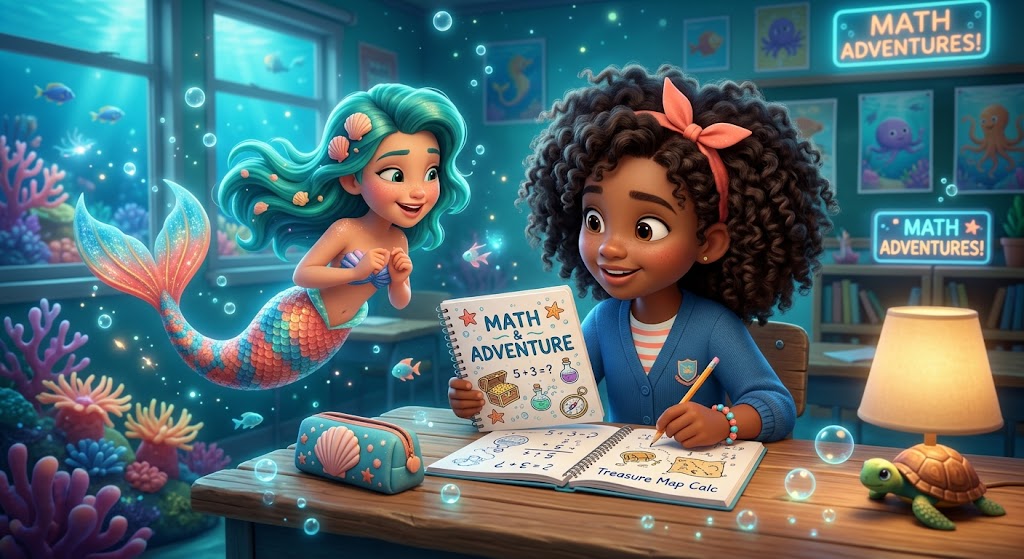
    It started with a splash of water and a puddle of tears. Mia, a bright Year 3 student, sat at the kitchen table, her pencil hovering over a math worksheet. The task: “Distribute 20 wizard potions into 4 equal mermaid treasure chests.”

    To Mia, this wasn’t just math; it was a puzzle she felt she couldn’t solve. The numbers felt cold and abstract. For many parents, this is the daily “homework battle”—watching your child freeze up when faced with a word problem that looks more like a foreign language than a math question.

    The Problem with “Just Divide”

    The mistake we often make is rushing children into abstract operations like formal long division. For a Year 3 student in Stage 2, forcing them to stack numbers without a visual bridge creates anxiety. When math is abstract, the brain shuts down. Mia didn’t need to learn a digit-by-digit process; she needed to visualize the story.

    The Magic Tool: The Sharing Circle Method

    We introduced the Sharing Circle Method. This is a visual weapon that turns a word problem into a physical map. Instead of staring at numbers on a page, we draw four circles (the treasure chests) and physically distribute the items (the potions) one by one.

    This strategy anchors the concept of “equal sets” in the physical world. It transforms abstract division into concrete, rhythmic action—”one for you, one for you”—until every potion is accounted for.

    From Panic to Confidence

    We took Mia’s worksheet: “Distribute 20 wizard potions into 4 equal mermaid treasure chests.”

    Instead of panic, Mia drew four circles. She started counting, placing a tally mark in each circle until she reached 20. She looked up, beaming. “Five! There are five potions in each chest.” By mapping the math, the division calculation became invisible, and the solution became obvious.

    Confidence in math isn’t about memorizing rules; it’s about having the tools to visualize the problem.

    Turn Homework Battles into Quests

    You don’t have to navigate these homework hurdles alone. EinstyAI specializes in transforming dry curriculum-aligned math into engaging, custom-tailored stories that help children overcome math anxiety. Visit EinstyAI today and turn your next math session into a victory.


    Practice Questions: The Mermaid Kingdom Quest

    Question 1

    In the Coral Palace, you have 15 healing kelp bundles to share equally among 3 sleepy baby seahorses. How many bundles does each seahorse get?

    A) 3

    B) 4

    C) 5

    D) 15

    Question 2

    The Mermaid Queen has 24 glowing pearls. She wants to place them into 4 display cases so each case has the same amount. How many pearls go into each case?

    A) 6

    B) 8

    C) 4

    D) 20

    Question 3

    Mia the Mermaid found 12 magic starfish. She wants to arrange them into 2 equal rows on the ocean floor to guide the school of fish. How many starfish are in each row?

    A) 2

    B) 4

    C) 10

    D) 6

  • How the Jump Strategy Helped Leo Slay the Year 3 Math Monster

    How the Jump Strategy Helped Leo Slay the Year 3 Math Monster

    Eight-year-old Leo sat at the kitchen table, pencil gripped tightly in his hand, staring at his Year 3 homework sheet. He could easily tell you what $45 + 38$ was if you asked him out loud. But when those exact same numbers were hidden inside a story about rescuing kangaroos in the Australian bush, he completely froze.

    The kitchen table had transformed into a battleground of tears, heavy sighs, and deeply erased paper.

    Like most caring parents, his mother tried the usual playbook: force him to line up the digits vertically, write small little ones above the columns, and carry the numbers over. But to a frustrated eight-year-old, abstract vertical columns feel like arbitrary rules forced upon them by a cold system.

    Enter the Guide: The Secret Weapon

    Children do not fail at math word problems because they cannot compute; they fail because they cannot visualize the journey inside the story.

    Instead of forcing rigid vertical columns, his mother introduced a simple visual weapon used by top educators: The Jump Strategy on an empty number line.

    Instead of stacking numbers into tall towers, the Jump Strategy turns every math problem into a horizontal trail map across the page.

    The Transformation: From Frozen to Fearless

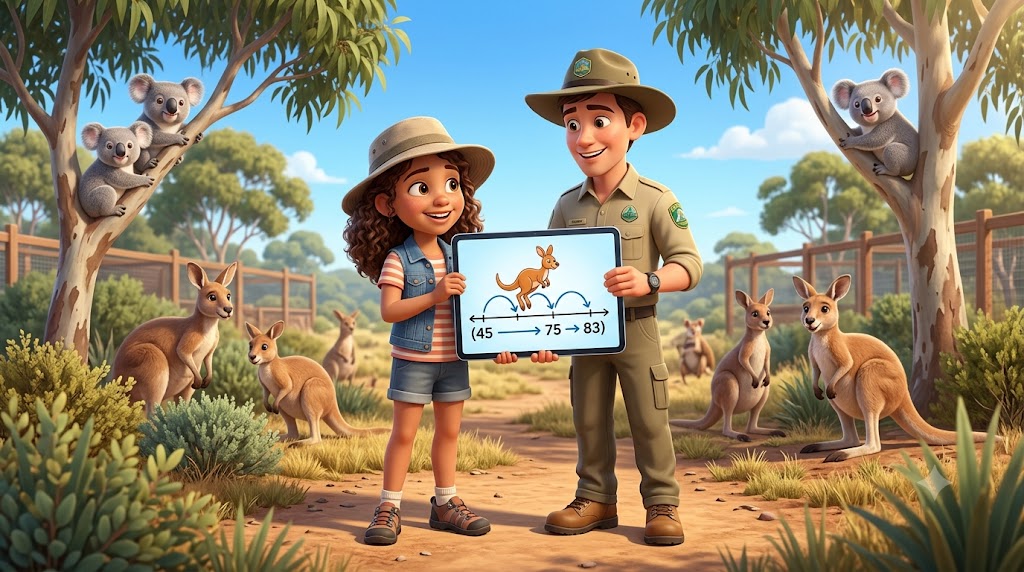
    That evening, Leo tackled a new story problem: “Ranger Sam has 45 kangaroos at the sanctuary and rescues 38 more. How many kangaroos are there now?”

    Instead of panicking, Leo drew a simple horizontal line across his page and followed three clear steps:

    1. Land on the Starting Point: He wrote 45 on the far left of his trail.
    2. Make the Big Jumps: He broke 38 into 3 tens ($30$) and 8 ones. He drew 3 big arc jumps forward by ten: $45 \rightarrow 55 \rightarrow 65 \rightarrow 75$.
    3. Finish with the Small Hops: He drew 8 small hops forward to land softly on 83.

    No column carrying. No erased paper. No tears. Within ten seconds, Leo looked up with a huge grin and announced, “There are 83 kangaroos, Mum!”

    Write Your Child’s Success Story

    When you give your child a visual map to navigate numbers, the “math monster” disappears, replaced by genuine curiosity and confidence.

    At EinstyAI, we believe every child deserves to be the hero of their own learning journey. We transform dry curriculum standards into custom-tailored, interactive adventures featuring your child’s favorite passions—whether that’s wildlife rescue, gaming, or space exploration.

    Head to EinstyAI today and create personalized story problems that turn homework battles into victories!

    PRACTICE QUESTIONS

    Year 3 Math Adventure: The Wildlife Rescue Center!

    Instructions for Parents: Read these wildlife rescue stories with your child. Have them draw an empty number line on paper and use the Jump Strategy (jumping tens first, then hopping ones) to choose the correct answer.

    Problem 1: Kangaroo Count

    The Story: Ranger Sam cares for 45 eastern grey kangaroos at his sanctuary. A neighboring wildlife park transfers 38 more rescued kangaroos to his care.

    • Question: How many kangaroos are at Ranger Sam’s sanctuary in total?
      • A) 73
      • B) 83
      • C) 78
      • D) 88

    Problem 2: Hungry Koalas

    The Story: Matilda the koala keeper collected 124 fresh eucalyptus branches in the morning. By sunset, the hungry koalas ate 46 of the branches.

    • Question: How many eucalyptus branches are left for tomorrow morning?
      • A) 82
      • B) 168
      • C) 78
      • D) 88

    Problem 3: Sea Turtle Nesting

    The Story: Beach volunteers counted 156 sea turtle eggs in Nest A along the Queensland coast. Nest B had 67 fewer eggs than Nest A.

    • Question: How many sea turtle eggs were in Nest B?
      • A) 89
      • B) 99
      • C) 91
      • D) 223

  • Mastering Angles: How to Make Geometry Click for Your Year 3 Student

    Mastering Angles: How to Make Geometry Click for Your Year 3 Student

    Is your child convinced that learning about angles is just dry, boring book work that has nothing to do with their real life? Many parents assume that math homework has to be a battleground, or that geometry is an abstract concept that only “math-minded” kids can grasp.

    The reality is that geometry is everywhere, especially in the world of gaming and digital movement. If your child loves video games, they are already an expert in angles—they just don’t know it yet.

    Angles are Not Just Shapes

    In Year 3, the curriculum moves away from static shapes and introduces angles as measures of turn. This shift is crucial. Instead of looking at a triangle, students need to think about how much an object rotates.

    Think of it like a game character performing a move. When a character spins to face an opponent, they are rotating through a specific angle. Whether it is a quick pivot or a full rotation, every move in a game relies on these geometric principles.

    The “Turn” Strategy

    To help your child master these concepts, teach them to visualize the “Quarter-Turn Technique.”

    • Quarter Turn: Think of this as a sharp 90-degree pivot. It is the movement a character makes to turn exactly to the left or right.
    • Half Turn: This is a 180-degree turn, like the character turning around to face the opposite direction.
    • Full Turn: This is a complete 360-degree spin, bringing the character back to their original position.

    By using this language, you strip away the fear of the word “geometry” and replace it with familiar gaming mechanics. Math becomes navigation, not just calculation.

    Make Math Part of the Play

    If you want to move beyond the struggle, integrate math into their interests. Encourage your child to describe their character’s movements in a game using terms like “quarter turn” or “half turn.”

    When they see that math is the engine behind their favorite games, the anxiety disappears. You can start building these skills today with our custom-tailored resources. If you need a more structured approach to help your child thrive, explore how EinstyAI transforms math practice into engaging stories.

    Practice Questions

    Instructions: Help the Esports champion “Pixel” navigate the arena by identifying the correct turn!

    1. Pixel needs to turn to face the Health Pack located directly behind him. What type of turn must Pixel make?
      A. Quarter turn
      B. Half turn
      C. Full turn
      D. No turn
    2. Pixel is facing North. He performs a quarter turn to the right. Which direction is Pixel now facing?
      A. West
      B. South
      C. East
      D. North
    3. During an esports match, Pixel spins in a complete circle to scan the entire room. How many degrees or what type of turn did he complete?
      A. A quarter turn
      B. A half turn
      C. A full turn
      D. A three-quarter turn

  • How Can I Help My Year 3 Student Master Grid References and Measurement?

    How Can I Help My Year 3 Student Master Grid References and Measurement?

    Why does math homework often turn into a battleground at the kitchen table? If your child tells you, “I’m just not a math person,” they are echoing a dangerous myth. The truth is, children aren’t failing at math; they are often failing to see the story behind the numbers. In Year 3, the curriculum shifts toward complex spatial reasoning, specifically focusing on Measurement and Space, where students must master grid-reference systems and precision measurement.

    The disconnect usually happens because worksheets treat math as an abstract list of tasks rather than a roadmap for problem-solving. When we teach a child how to locate a coordinate on a grid or measure an object to the nearest millimetre, we shouldn’t just ask them to fill in boxes. We need to frame it as a tactical challenge.

    Stop the “Math Anxiety” Cycle

    Stop assuming your child lacks a “math brain.” Anxiety often stems from a lack of visual context. When a student sees a grid map, they shouldn’t just see letters and numbers; they should see a playing field or a treasure map. By shifting the perspective from “doing sums” to “solving a game,” you transform frustration into engagement.

    Mastering Grid References and Precision

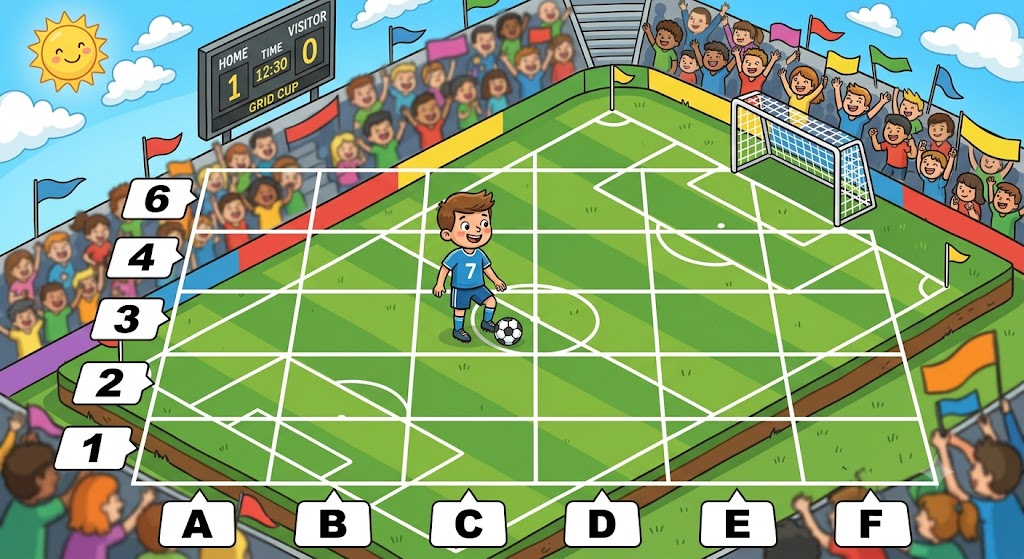
    For Year 3, Stage 2 students, the goal is twofold. First, they must learn to navigate grid-reference systems, such as identifying that a specific point on a map (like B3) is the intersection of column B and row 3. This builds essential spatial logic.

    Second, they must refine their measurement skills. Measuring to the nearest millimetre requires patience and attention to detail—skills that carry over into every area of their education.

    To help them excel:

    • Visualize the Grid: Use real-life maps. Look at a local football pitch layout. Ask, “If the goal is at A1, where is the center circle?”
    • Precision Matters: When measuring objects like a phone or a toy, encourage them to line up the zero mark perfectly. Remind them that in measurement, every millimetre counts.

    At EinstyAI, we believe that custom-tailored, curriculum-aligned stories are the key to breaking down these barriers. By embedding these skills into narrative contexts—like tracking a player’s movement on a pitch or measuring the distance of a spectacular goal—we help students overcome math anxiety and develop genuine competence.

    Don’t wait for the next homework battle. Start turning your child’s math practice into a rewarding story experience today.

    Practice Questions: The Football Pitch Challenge

    Question 1: The Striker’s Position

    On a football pitch grid, the striker is standing at coordinate C4. If the striker moves two squares to the right and one square up to shoot, what is their new coordinate?

    A) D5

    B) E5

    C) C6

    D) D6

    Question 2: Measuring the Goal

    You are measuring the width of a miniature soccer goal using a ruler. The goal width is exactly 12 centimetres and 4 millimetres. How do you write this measurement in millimetres?

    A) 124 mm

    B) 12.4 mm

    C) 140 mm

    D) 1240 mm

    Question 3: The Midfielder’s Pass

    The ball is located at A2. The defender is located at A5. How many grid squares apart are they if they are in the same column?

    A) 2 squares

    B) 3 squares

    C) 4 squares

    D) 5 squares

  • Why Is My Child Struggling With Fractions?

    Why Is My Child Struggling With Fractions?

    “Why does my child cry every time we open the math textbook?” If this sounds familiar, you are not alone. Many parents search for this answer because they watch their children go from confident learners to anxious students the moment fractions appear on the page.

    Here is the truth: Your child does not “hate math,” and they aren’t “bad at numbers.” They are simply reacting to a teaching method that prioritizes abstract rules over logical visualization.

    The Myth of the “Math Kid”

    We often hear the phrase, “Some kids just aren’t math kids.” This is a harmful assumption. Math is a language. When a child struggles with fractions, it is rarely a lack of ability; it is a lack of the right visual context. By aligning our approach with the Australian Curriculum standards, we can transform frustration into understanding. We don’t need to force memorization. We need to tell a better story.

    The Power of the Number Line

    When teaching unit fractions to Year 3 students, we must move away from just “drawing circles.” Circles are great, but they hide the relationship between numbers.

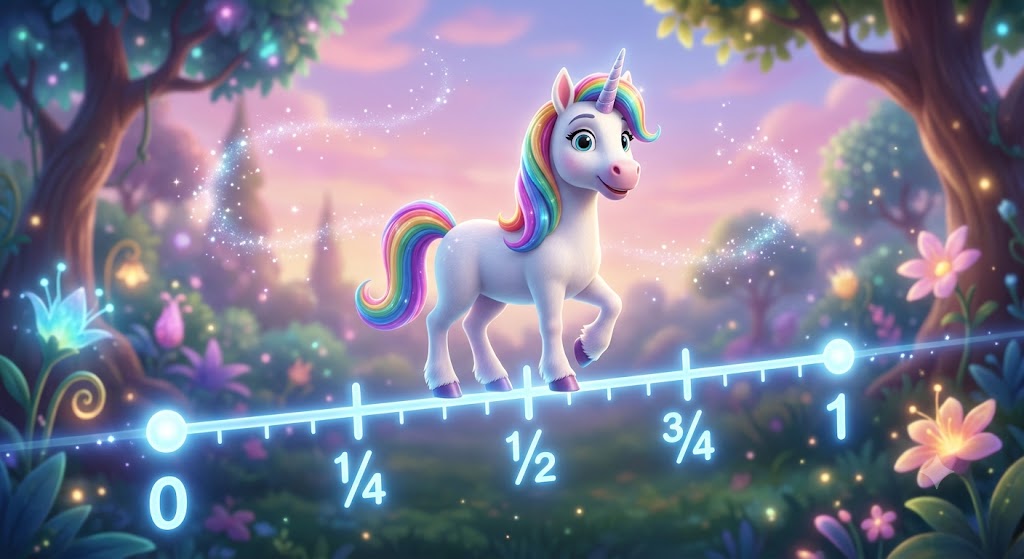
    The Number Line is the secret weapon for Stage 2 success. A number line provides a fixed, linear distance between 0 and 1. It turns a “fraction” into a physical journey.

    Here is the strategy:

    • Visualize the Path: Imagine the distance between 0 and 1 is a magical path.
    • Partitioning: If we want to show 1/4, we must split that path into 4 equal segments.
    • The Anchor: The fraction is simply the point where the first segment ends.

    By using this approach, students stop guessing which number goes on top. They see that the denominator tells them how many “jumps” to make to get to the destination.

    Your Action Plan

    Stop the homework battle tonight. Next time your child struggles with fractions, grab a ruler or draw a straight line on a piece of paper. Label the ends 0 and 1. Ask them, “If we need to place 1/3, how many equal jumps do we need to make to get to 1?”

    Visuals act as a bridge between the abstract concept and the real world. When children see the math, the anxiety disappears, and the logic takes over.

    For parents who want to turn these dry concepts into engaging, custom-tailored stories that align with the curriculum, visit EinstyAI to see how we make math a daily adventure, not a chore.

    Practice Questions

    Math Worksheet: The Magical Unicorn Journey

    Task: Help Sparkle the Unicorn navigate her magical forest. Use the number line below to find the correct spot for each fraction.

    Question 1

    Sparkle starts at 0 and needs to jump halfway to the Magical Meadow (1). Where should she land?

    A) The midpoint between 0 and 1

    B) At the number 1

    C) Before 0

    D) Past the number 1

    Question 2

    The path to the Rainbow Castle is marked in 4 equal parts. Where is 1/4 located?

    A) 3 jumps from 0

    B) 1 jump from 0

    C) 4 jumps from 0

    D) Exactly at 0

    Question 3

    Sparkle is collecting 1/3 of the Magic Gems on the path. The path is divided into 3 equal sections. Which point represents 1/3?

    A) The third mark near 1

    B) The last mark

    C) The first mark after 0

    D) The middle mark

  • How do I stop my Year 3 student from feeling overwhelmed by multiplication?

    How do I stop my Year 3 student from feeling overwhelmed by multiplication?

    Many parents tell us that math homework has become a nightly battleground. If your child struggles with the jump from basic counting to understanding numbers in the thousands and multiplicative fact families, you are not alone.

    There is a dangerous assumption that “some kids just aren’t math kids.” This is a myth. Math anxiety usually stems from teaching math as a set of rules to memorize, rather than a language to speak. When we introduce Year 3 students to larger numbers and multiplication, we must ground it in their reality—not just abstract grids on a page.

    The Leap to Thousands

    Year 3 represents a significant cognitive shift. Students move from working with simple two-digit numbers to understanding place value into the thousands.

    The strategy: Stop treating “thousands” as a bigger version of “ones.” Use visual models. If they understand that a packet of 10 candies is a “ten,” show them that 10 packets make a “hundred,” and 10 of those boxes make a “thousand.” Connecting the visual quantity to the numeral reduces the fear of large numbers.

    Mastering Fact Families (2, 4, 5, 10)

    Multiplication is just efficient addition. When students struggle with 2, 4, 5, and 10 fact families, they often try to memorize tables by rote. This is exhausting and ineffective.

    Try these tricks to make it stick:

    • The 10s rule: Remind them that multiplying by 10 is simply placing a zero on the end. It is the easiest bridge to understanding place value.
    • Doubling strategy: To multiply by 4, teach them to “double, then double again.” If they know 3 x 2 is 6, then 3 x 4 is just 6 doubled (12).
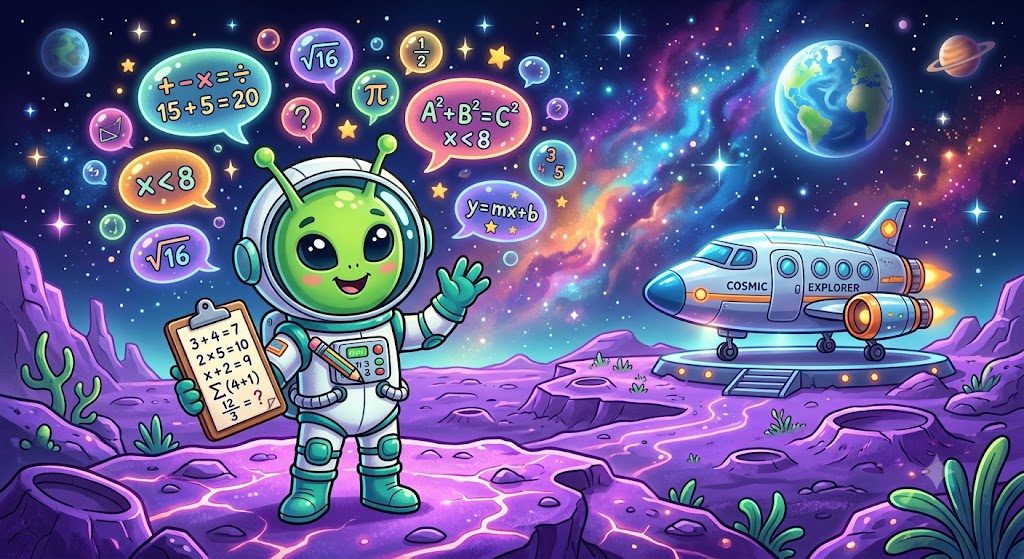
    • The Story Context: Turn the math into a narrative. If they are calculating how many alien legs there are on a spaceship (multiplied by 2), the math becomes a part of the adventure rather than a chore.

    Transform the Homework Routine

    We believe that learning math should be an engaging story, not a test of endurance. EinstyAI transforms standard curriculum requirements into custom-tailored stories that align with ACARA standards.

    When you replace the “battle” with a “narrative,” the math anxiety fades. Stop focusing on the result and start focusing on the story behind the numbers. If your child can visualize the problem, they can solve the equation.

    Practice Questions (Space Explorer Edition)

    1. The Star-System Count

    Captain Zog is charting a course through the Andromeda sector. His ship’s computer identifies 3,000 stars in Sector A, 400 stars in Sector B, and 50 stars in Sector C. How many total stars did the computer identify?

    A) 3,450

    B) 3,045

    C) 3,405

    D) 345

    2. Alien Legs on the Mothership

    The ship lands on a moon where every creature has 2 legs. If there are 8 creatures waiting to greet the crew, how many legs are there in total?

    A) 10

    B) 16

    C) 12

    D) 18

    3. Moon Rock Collection

    The crew collects moon rocks in bags of 5. If they fill 7 bags, how many moon rocks have they collected?

    A) 30

    B) 45

    C) 35

    D) 25