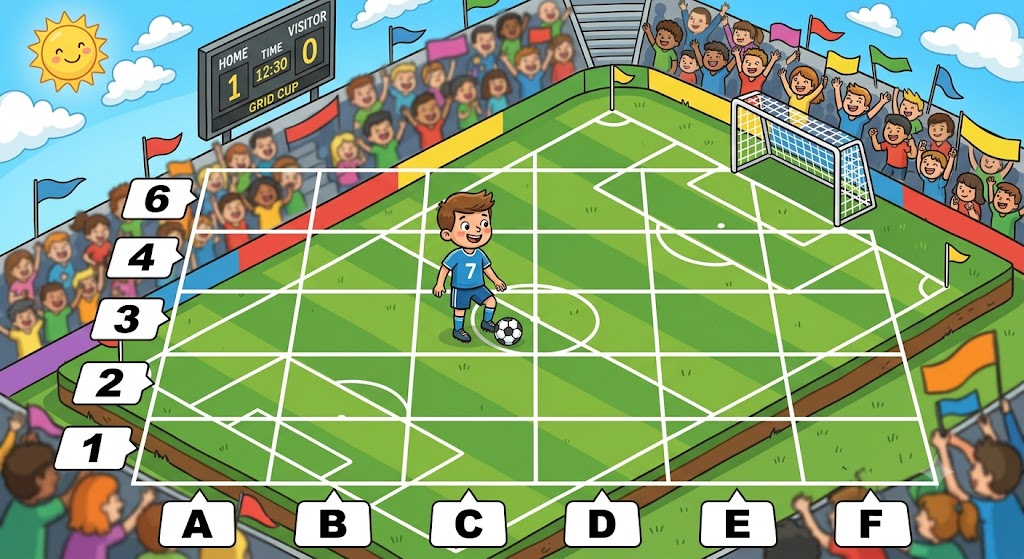
Why does math homework often turn into a battleground at the kitchen table? If your child tells you, “I’m just not a math person,” they are echoing a dangerous myth. The truth is, children aren’t failing at math; they are often failing to see the story behind the numbers. In Year 3, the curriculum shifts toward complex spatial reasoning, specifically focusing on Measurement and Space, where students must master grid-reference systems and precision measurement.
The disconnect usually happens because worksheets treat math as an abstract list of tasks rather than a roadmap for problem-solving. When we teach a child how to locate a coordinate on a grid or measure an object to the nearest millimetre, we shouldn’t just ask them to fill in boxes. We need to frame it as a tactical challenge.
Stop the “Math Anxiety” Cycle
Stop assuming your child lacks a “math brain.” Anxiety often stems from a lack of visual context. When a student sees a grid map, they shouldn’t just see letters and numbers; they should see a playing field or a treasure map. By shifting the perspective from “doing sums” to “solving a game,” you transform frustration into engagement.
Mastering Grid References and Precision
For Year 3, Stage 2 students, the goal is twofold. First, they must learn to navigate grid-reference systems, such as identifying that a specific point on a map (like B3) is the intersection of column B and row 3. This builds essential spatial logic.
Second, they must refine their measurement skills. Measuring to the nearest millimetre requires patience and attention to detail—skills that carry over into every area of their education.
To help them excel:
- Visualize the Grid: Use real-life maps. Look at a local football pitch layout. Ask, “If the goal is at A1, where is the center circle?”
- Precision Matters: When measuring objects like a phone or a toy, encourage them to line up the zero mark perfectly. Remind them that in measurement, every millimetre counts.
At EinstyAI, we believe that custom-tailored, curriculum-aligned stories are the key to breaking down these barriers. By embedding these skills into narrative contexts—like tracking a player’s movement on a pitch or measuring the distance of a spectacular goal—we help students overcome math anxiety and develop genuine competence.
Don’t wait for the next homework battle. Start turning your child’s math practice into a rewarding story experience today.
Practice Questions: The Football Pitch Challenge
Question 1: The Striker’s Position
On a football pitch grid, the striker is standing at coordinate C4. If the striker moves two squares to the right and one square up to shoot, what is their new coordinate?
A) D5
B) E5
C) C6
D) D6
Question 2: Measuring the Goal
You are measuring the width of a miniature soccer goal using a ruler. The goal width is exactly 12 centimetres and 4 millimetres. How do you write this measurement in millimetres?
A) 124 mm
B) 12.4 mm
C) 140 mm
D) 1240 mm
Question 3: The Midfielder’s Pass
The ball is located at A2. The defender is located at A5. How many grid squares apart are they if they are in the same column?
A) 2 squares
B) 3 squares
C) 4 squares
D) 5 squares