Tag: Measurement and Space

  • How the Super-Stacker Strategy Helped Kai Save the Hero HQ

    How the Super-Stacker Strategy Helped Kai Save the Hero HQ

    Does your kitchen table look like a crime scene every time Year 6 math homework comes around? You are not alone. Many parents tell us that their children treat math like a chore to be endured, especially when they move into the Stage 3 curriculum and start dealing with the abstract concepts of volume and cubic units.

    Recently, we met a parent whose son, Kai, was in tears over a simple worksheet on rectangular prisms. Kai is a bright kid who loves video games, but when he saw the grid-based volume problems, he froze. He tried to count every individual cube in the diagram, lost his place, and ended up guessing.

    The myth that “some kids aren’t math kids” is exactly that—a myth. Kai’s frustration didn’t stem from a lack of intelligence. It stemmed from a disconnect between the visual reality of his world and the dry, academic symbols on the page.

    The Common Mistake: Counting Cubes One-by-One

    Most students try to count every single cubic unit in a rectangular prism because they are taught to “find the volume” without being taught to “see the structure.” This creates massive cognitive load. When students try to count 24 or 30 cubes individually, they make errors, get tired, and eventually, decide that math is just too hard.

    The Guide: The Super-Stacker (Layering) Strategy

    Instead of counting every cube, we teach students to use the Super-Stacker Strategy.

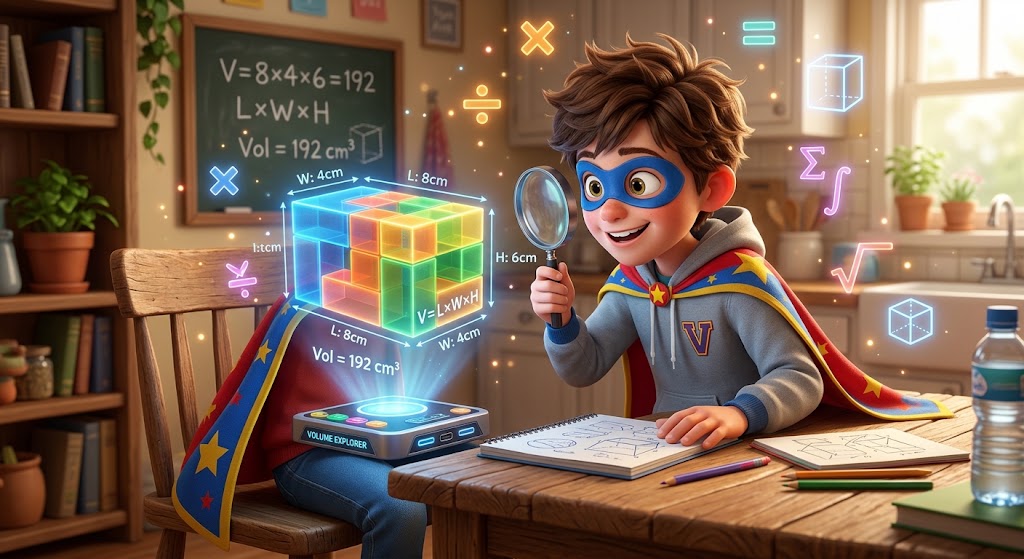
    Think of a rectangular prism not as a solid block, but as a stack of flat layers, exactly like a stack of pancakes or a building’s floor plan.

    1. Identify the Base: Find the number of cubes in the bottom layer (the “floor”).
    2. Count the Height: Count how many layers (the “floors”) there are.
    3. Multiply: Multiply the base layer by the number of layers.

    This transforms a messy counting task into a simple multiplication problem.

    Kai’s Transformation: Saving the Hero HQ

    When Kai looked at the prism on his homework—a box 4 cubes wide, 3 cubes deep, and 2 cubes high—he didn’t panic. He visualized it as his superhero HQ.

    “Okay,” Kai said, “The floor is 4 by 3. That’s 12 cubes on the ground level.”

    Then he looked at the height. “And there are 2 layers total. So, 12 cubes times 2 layers… that’s 24 cubic units!”

    He didn’t just find the right answer; he understood why the answer was 24. The stress melted away, replaced by the satisfaction of solving a puzzle.

    Turn Homework Battles into Victories

    You don’t need to be a math expert to help your child. You just need to change the context. By grounding these concepts in visual logic—like building a superhero base—we help children see the patterns in the world around them.

    Stop the homework battles. Transform your child’s practice into an engaging story that aligns with their curriculum. Visit EinstyAI today to get custom, story-based math resources that make your child the hero of their own learning journey.


    PRACTICE QUESTIONS

    Theme: The Super-Stacker’s Mission to Save Hero HQ

    Mission: Calculate the volume of your secret base components using the Layering Strategy.

    Question 1

    Your secret headquarters has a foundation that is 5 cubes long and 4 cubes wide. If your HQ is 3 layers high, what is the total volume in cubic units?

    A) 20

    B) 60

    C) 12

    D) 40

    Question 2

    You are designing a super-shield box that is 2 cubes long, 2 cubes wide, and 4 cubes high. How many cubic units of space does the shield take up?

    A) 8

    B) 16

    C) 12

    D) 4

    Question 3

    The Villain’s Trap is a rectangular prism that is 6 cubes long and 2 cubes wide. It is 3 layers high. What is the volume?

    A) 11

    B) 18

    C) 36

    D) 24
  • Why Does Your Child Treat Negative Coordinates Like an Impossible Maze?

    Why Does Your Child Treat Negative Coordinates Like an Impossible Maze?

    Why does your Year 6 student freeze up the moment they see a coordinate plane with negative numbers? If math homework feels like a battleground, you are not alone. Parents often worry that their child lacks a “math brain” or that Year 6 math is simply too advanced.

    The truth is rarely about lack of ability. It is about a lack of visualization. When children only experience the first quadrant—where everything is positive and simple—the sudden introduction of the other three quadrants feels like learning a new language. They don’t need more drills; they need a better map.

    The Cartesian Plane: It’s Just a Battle Map

    In Year 6, students must master the Cartesian plane across all four quadrants. If they struggle, it is usually because they are trying to memorize rules rather than understanding the space.

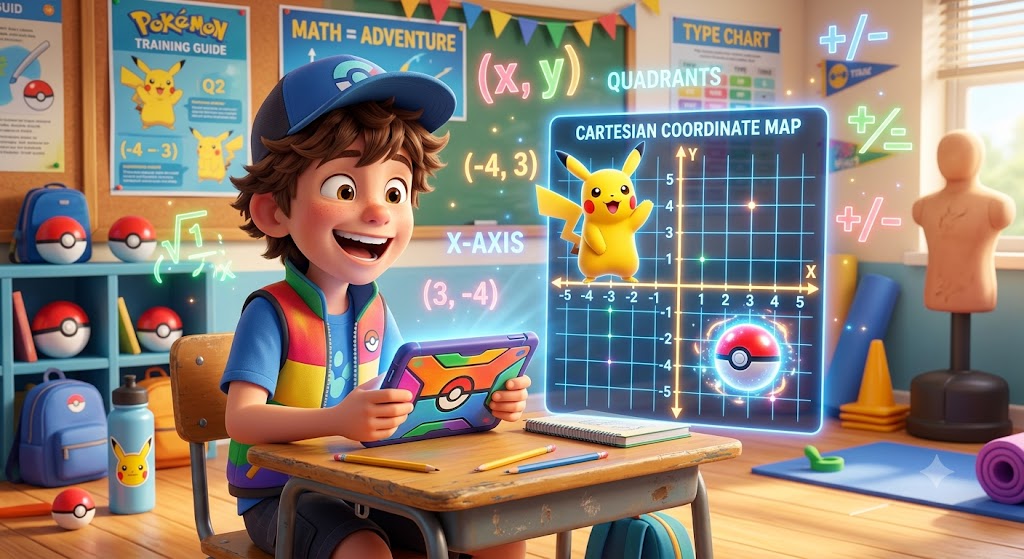
    Stop treating the grid as an abstract chart. Instead, teach your child to see the coordinate plane as a game map. The axes are just the North, South, East, and West boundaries of their playing field.

    When your child plots a point in the third quadrant, they aren’t “doing integers”; they are moving their character to a specific location on the map. By grounding these coordinates in a narrative context, the math becomes intuitive.

    Strategies for Four-Quadrant Mastery

    The “drill and kill” method fails because it bores the student and ignores their natural pattern-spotting abilities. Here is how to shift their mindset today:

    • Master the Quadrant Logic: Ensure they understand that the axes are simply lines. The x-axis is horizontal (left/right) and the y-axis is vertical (up/down). The signs determine the direction: positive is right or up, and negative is left or down.
    • Use Visual Anchors: If your child is stuck, draw the “plus sign” grid. Label the four sections clearly. Encourage them to physically trace the path from the origin (0,0) to the target coordinate with their finger.
    • Gamify the Practice: At EinstyAI, we create stories where coordinates represent locations of rare items or creatures. When math is the key to winning a game, anxiety disappears.

    Math isn’t a wall to hit; it’s a tool to build their own world. Don’t wait for the next homework frustration to start. Help your child visualize the math, and watch their confidence skyrocket.

    Practice Questions

    The Pokétraining Coordinate Challenge

    Question 1: The Starting Point

    A rare Pikachu is spotted at coordinate (-3, 2). Which quadrant is this Pokémon hiding in?

    A) Quadrant 1

    B) Quadrant 2

    C) Quadrant 3

    D) Quadrant 4

    Question 2: The Evolution Jump

    Your Charizard is located at (2, -1). You move it 3 units to the left and 4 units up to reach the gym. What are the new coordinates of your Charizard?

    A) (-1, 3)

    B) (5, 3)

    C) (-1, -5)

    D) (5, -5)

    Question 3: Finding the Berry

    A Sitrus Berry is buried at (-4, -4). To get there from the center (origin 0,0), how many units left and how many units down must you travel?

    A) 4 units left, 4 units up

    B) 4 units right, 4 units down

    C) 4 units left, 4 units down

    D) 4 units right, 4 units up

  • Unlock the Secrets of Geometry: Mastering the Protractor at Home

    Unlock the Secrets of Geometry: Mastering the Protractor at Home

    Does your child view geometry homework as a battlefield where tears are shed over plastic tools? If your Year 5 student struggles with math, you are not alone. Many parents assume their child simply “isn’t a math kid,” but this mindset is the real barrier to learning. Math anxiety often stems from abstract concepts lacking context, not a lack of innate ability. When we turn math into a story, the fear dissolves, replaced by curiosity.

    The Problem with Traditional Geometry

    Standard math sheets often present circles and lines as disconnected, boring shapes. Students stare at a page of disconnected angles and feel nothing. But geometry is the language of architecture, design, and art. In the Year 5 curriculum, students must learn to use protractors to measure angles in degrees. This requires precision and logic. If a student tries to guess, they fail. When they learn the strategy, they succeed.

    The “Protracting” Strategy for Success

    Mastering the protractor isn’t about memory; it is about a consistent three-step process. Teach your child these steps to remove the guesswork:

    • Align the Baseline: Place the protractor’s baseline exactly on one ray of the angle.
    • Center the Vertex: Ensure the small hole or crosshair at the bottom of the protractor sits perfectly on the angle’s vertex.
    • Check the Scale: Look at the scale starting at zero. If the angle opens to the left, use the outer scale. If it opens to the right, use the inner scale. Most students fail here by choosing the wrong scale and recording a 120-degree angle when they should have written 60 degrees.

    Transforming Math into a Fairytale

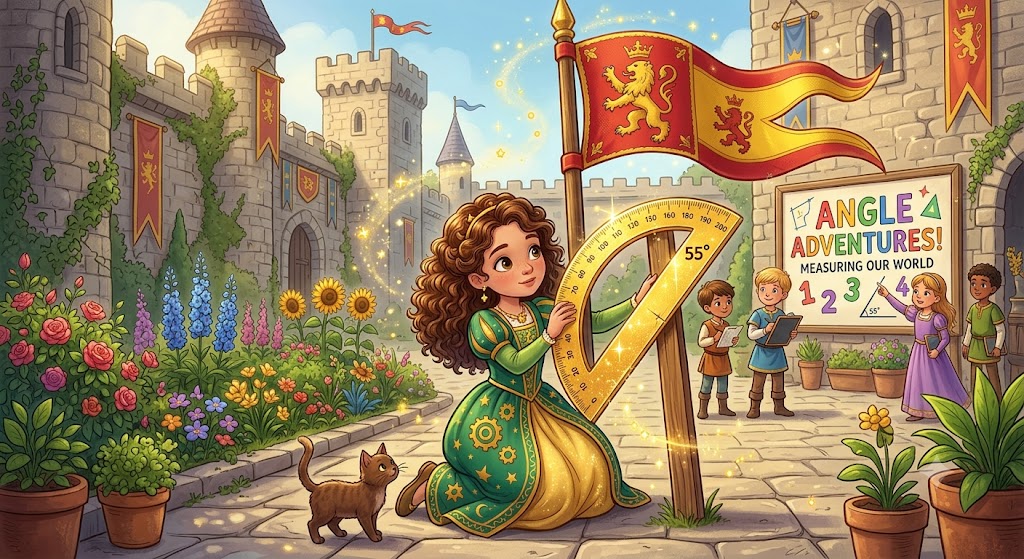
    At EinstyAI, we know that engagement drives mastery. Instead of forcing your child to measure generic floating angles, connect the skill to their world. Imagine a princess protecting her castle. The angle of the castle gate determines if the drawbridge can open. The angle of the tower roof ensures it can withstand heavy rainfall. By shifting the context from a worksheet to a quest, you bypass the “this is boring” wall and activate the brain’s engagement centers.

    Take Action Today

    Stop the nightly homework battles. Shift from being a “tutor” to being a “narrator” of their mathematical journey. Use the practice questions below to transform your next study session into a royal mission. Your child is capable of mastering these concepts—they just need the right map.

    Practice Questions

    The Royal Castle Geometry Challenge

    Question 1: The Drawbridge Angle

    Princess Clara is adjusting the heavy chain on the castle drawbridge. The bridge forms an angle of 45 degrees with the stone wall when lowered halfway. If she moves the chain to make the angle wider, which of these is a possible measurement for the new angle?

    A) 30 degrees

    B) 60 degrees

    C) 180 degrees

    D) 10 degrees

    Question 2: The Tower Roof Slope

    The royal architect is designing a new tower roof. To ensure the snow slides off perfectly, the roof must be an acute angle. Which of the following measurements should the architect choose for the roof’s peak?

    A) 90 degrees

    B) 105 degrees

    C) 40 degrees

    D) 180 degrees

    Question 3: The Dragon’s Wing Span

    A friendly dragon is resting in the courtyard. Its wing is folded at an obtuse angle so it fits inside the castle gates. Which of the following is a possible measurement for the dragon’s wing angle?

    A) 75 degrees

    B) 90 degrees

    C) 130 degrees

    D) 10 degrees

  • Stop the Tears: How to Help Your Child Master Angles at Home

    Stop the Tears: How to Help Your Child Master Angles at Home

    Why do so many students hit a wall when geometry homework arrives, convinced that math is simply not their thing? The truth is, math anxiety isn’t about ability; it’s about approach. When children see a page of numbers and shapes as a chore, they disengage. When they see a puzzle, they become detectives.

    At EinstyAI, we know that transforming dry practice into a story-based mission is the fastest way to overcome math anxiety. If your Year 4 student struggles with the Measurement and Space strand, the issue usually isn’t the concept—it’s the visualization.

    The “Math Kid” Myth

    Let’s be clear: there is no such thing as a “math kid.” Mathematical literacy is a skill, not a genetic trait. If your child struggles with angles, it’s because the abstract definitions haven’t been anchored to anything real.

    Stop focusing on rote memorization. Instead, focus on visual identification. We categorize angles based on their relationship to a perfect corner, and that is a skill any child can master with the right framework.

    The Angle Detective Strategy

    To master the classification of angles—acute, right, obtuse, straight, and reflex—give your child a “Detective’s Tool” to use every time they see a shape.

    The 5-Second Angle Test:

    • The Right Angle (90 degrees): This is the gold standard. Look for the “L” shape. If it looks like the corner of a square, it’s a Right Angle.
    • The Acute Angle (Less than 90): Think of an “a-cute” little angle. It’s smaller, sharper, and squeezed tight.
    • The Obtuse Angle (Greater than 90, less than 180): This one looks wide or lazy. It’s larger than a square corner but hasn’t gone flat yet.
    • The Straight Angle (Exactly 180 degrees): This is a perfectly flat line. The “Detective” knows a straight angle is just two right angles lying down.
    • The Reflex Angle (Greater than 180 degrees): The “outer” angle. This is the giant opening that wraps around the back of the shape.

    Teach your child to use their hand as a protractor. Open their thumb and index finger to match the angle on the page. If it’s smaller than a square corner, it’s acute. If it’s wider, it’s obtuse.

    Transform Practice into Play

    Math should not be a battle of wills. By gamifying the curriculum, you remove the pressure and replace it with curiosity.

    If your child is stuck, don’t force another worksheet. Instead, grab a flashlight and play “Angle Detective” around the house. Finding a right angle on a table or an obtuse angle on a laptop hinge provides the concrete experience needed to solve abstract problems.

    Ready to make math the highlight of their day? Explore our custom-tailored, curriculum-aligned stories at EinstyAI and turn their homework into a mystery worth solving.

    Practice Questions

    Welcome, Detective. A mysterious thief has left geometric clues scattered across the city. Your job is to classify these “angle clues” to identify the thief’s escape route.

    Question 1

    The thief left a mark on a brick wall that looks like a sharp “V” shape, smaller than the corner of a square. Detective, how do we classify this angle?

    A) Obtuse

    B) Acute

    C) Reflex

    D) Straight

    Question 2

    You find a laser beam grid blocking the hallway. You notice the beams meet perfectly to form a square corner. What type of angle is this?

    A) Right

    B) Acute

    C) Straight

    D) Obtuse

    Question 3

    The thief’s footprint is wide and lazy, measuring more than a square corner but less than a straight line. Which angle is this?

    A) Reflex

    B) Acute

    C) Obtuse

    D) Right

  • Mastering Angles: How to Make Geometry Click for Your Year 3 Student

    Mastering Angles: How to Make Geometry Click for Your Year 3 Student

    Is your child convinced that learning about angles is just dry, boring book work that has nothing to do with their real life? Many parents assume that math homework has to be a battleground, or that geometry is an abstract concept that only “math-minded” kids can grasp.

    The reality is that geometry is everywhere, especially in the world of gaming and digital movement. If your child loves video games, they are already an expert in angles—they just don’t know it yet.

    Angles are Not Just Shapes

    In Year 3, the curriculum moves away from static shapes and introduces angles as measures of turn. This shift is crucial. Instead of looking at a triangle, students need to think about how much an object rotates.

    Think of it like a game character performing a move. When a character spins to face an opponent, they are rotating through a specific angle. Whether it is a quick pivot or a full rotation, every move in a game relies on these geometric principles.

    The “Turn” Strategy

    To help your child master these concepts, teach them to visualize the “Quarter-Turn Technique.”

    • Quarter Turn: Think of this as a sharp 90-degree pivot. It is the movement a character makes to turn exactly to the left or right.
    • Half Turn: This is a 180-degree turn, like the character turning around to face the opposite direction.
    • Full Turn: This is a complete 360-degree spin, bringing the character back to their original position.

    By using this language, you strip away the fear of the word “geometry” and replace it with familiar gaming mechanics. Math becomes navigation, not just calculation.

    Make Math Part of the Play

    If you want to move beyond the struggle, integrate math into their interests. Encourage your child to describe their character’s movements in a game using terms like “quarter turn” or “half turn.”

    When they see that math is the engine behind their favorite games, the anxiety disappears. You can start building these skills today with our custom-tailored resources. If you need a more structured approach to help your child thrive, explore how EinstyAI transforms math practice into engaging stories.

    Practice Questions

    Instructions: Help the Esports champion “Pixel” navigate the arena by identifying the correct turn!

    1. Pixel needs to turn to face the Health Pack located directly behind him. What type of turn must Pixel make?
      A. Quarter turn
      B. Half turn
      C. Full turn
      D. No turn
    2. Pixel is facing North. He performs a quarter turn to the right. Which direction is Pixel now facing?
      A. West
      B. South
      C. East
      D. North
    3. During an esports match, Pixel spins in a complete circle to scan the entire room. How many degrees or what type of turn did he complete?
      A. A quarter turn
      B. A half turn
      C. A full turn
      D. A three-quarter turn

  • How Can I Help My Year 5 Student Master the Cartesian Plane and Perimeter?

    How Can I Help My Year 5 Student Master the Cartesian Plane and Perimeter?

    Why does your child view math problems as an unsolvable maze rather than a blueprint to build their own world? Many parents assume that math anxiety is an inherited trait—that some kids are simply “not math people.” This is a myth. When students struggle with Year 5 Measurement and Space concepts, it is rarely because they lack ability. It is because the abstract concepts feel disconnected from reality.

    The Problem: Math in a Vacuum

    In Year 5 (Stage 3), students are introduced to the Cartesian plane and the calculation of perimeters for composite shapes. Without context, a grid of coordinates and a series of lines are just numbers on a page. This is where disengagement starts. Children do not learn mathematics by staring at textbooks; they learn by interacting with their environment.

    The Solution: Building with Coordinates

    The Cartesian plane is essentially a map. If your child plays Minecraft, they are already using coordinate geometry. Every block placed in a Minecraft world occupies a specific x and y coordinate. When we shift the focus from rote memorization to spatial reasoning, the math becomes intuitive.

    To teach perimeter of composite shapes, stop asking for “perimeter” and start asking for the “fencing required to secure a base.” A composite shape is just two simple rectangles joined together. The secret trick is to treat the shape like a room layout. Instead of guessing the missing sides, break the complex shape into two smaller, simple rectangles. Calculate their perimeters individually, then subtract the shared wall. This prevents the common trap of counting interior lines.

    Master the Grid Today

    If your child struggles with math, stop the “drill and kill” homework sessions. Connect the curriculum to the games they love. When they calculate the perimeter of a virtual base, they aren’t just doing math; they are engineering. Math is not a battle to be won; it is a tool to be used.

    Practice Questions

    Theme: The Minecraft Architect Challenge

    Question 1: The Diamond Coordinates

    Steve is placing a rare Diamond Block on his base grid. The base starts at (0,0). Steve places the block exactly 3 units to the right and 4 units up from the starting point. What are the coordinates of the Diamond Block?

    A) (4, 3)

    B) (3, 4)

    C) (3, 3)

    D) (4, 4)

    Question 2: Protecting the Base

    Steve builds a rectangular crafting room that is 5 metres long and 4 metres wide. What is the total perimeter of this room?

    A) 9 metres

    B) 18 metres

    C) 20 metres

    D) 15 metres

    Question 3: The L-Shaped Lookout

    Steve builds an L-shaped lookout tower. The horizontal bottom is 6 metres wide. The vertical left side is 8 metres high. The top horizontal arm is 2 metres, and the vertical drop is 4 metres. The remaining two sides close the shape. Assuming all angles are right angles, what is the total perimeter of the lookout?

    A) 20 metres

    B) 24 metres

    C) 28 metres

    D) 32 metres

  • How do I explain area and perimeter to my Year 4 child without the tears?

    How do I explain area and perimeter to my Year 4 child without the tears?

    Is your kitchen table the nightly battleground for math homework? You are not alone. Many parents search for ways to simplify geometry, often assuming that math homework is naturally a battle. Here is the truth: Math doesn’t have to be a struggle. When you shift the mindset from “solving problems” to “solving stories,” the anxiety disappears.

    Perimeter vs. Area: The Simple Distinction

    Children often confuse perimeter and area because both involve shapes. To keep them clear, use the Fence and Grass analogy:

    • Perimeter is the fence. It is the distance around the edge. If your child were a skater, the perimeter is the metal rail they ride along.
    • Area is the grass. It is the space inside the shape. If your child is skating, the area is the concrete slab they roll across.

    The “Border and Fill” Trick

    To help students master these concepts, teach them to physically trace the shape before calculating.

    1. Trace the Border: Use a finger to outline the object. This is for Perimeter (measured in centimetres or metres).
    2. Fill the Space: Use a shading motion to cover the surface. This is for Area (measured in square centimetres or square metres).

    When students encounter a question, ask them: “Are we counting the fence, or are we tiling the floor?” This simple check prevents the most common mistake: adding the length and width instead of calculating the space inside.

    Bring Math to Life

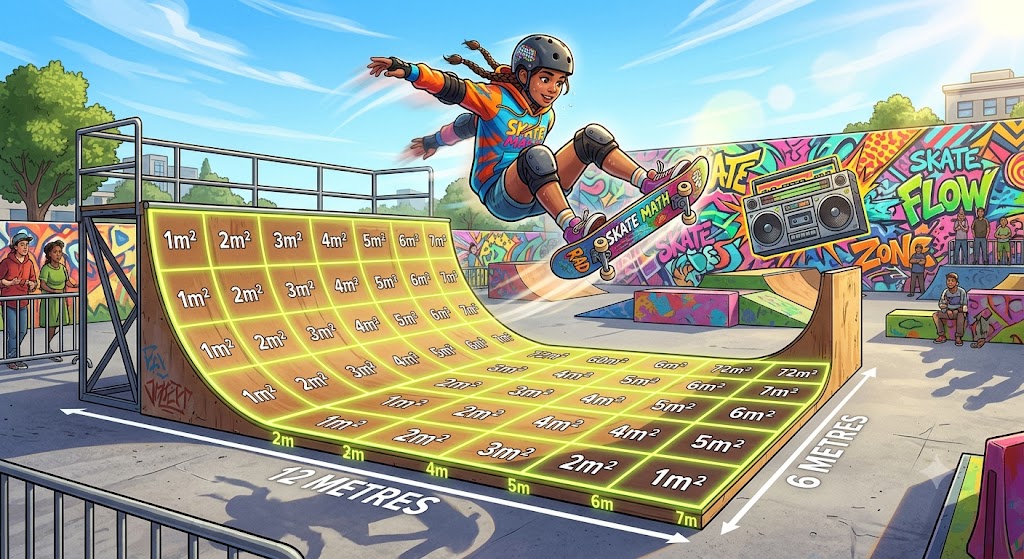
    The key to deep learning is context. If your child loves skateboarding, don’t force them to measure abstract rectangles in a workbook. Instead, have them design a dream skate park. Ask them to calculate the perimeter of a new ramp for safety fencing, or the area of concrete needed for a flat-bank section. By connecting abstract concepts like square centimetres to real-world objects, you move them from rote memorization to true understanding.

    If you are looking for ready-to-use math stories that turn these concepts into engaging adventures, check out EinstyAI. We help students conquer math anxiety by transforming dry curriculum requirements into compelling stories. Stop fighting over homework and start exploring.

    Practice Questions: The Skate Park Challenge

    1. The Grind Rail

    A new rectangular grind rail is 4 metres long and 1 metre wide. If we need to put rubber edging all the way around the rail, what is the total length of edging required?

    A) 4 square metres

    B) 5 metres

    C) 8 metres

    D) 10 metres

    2. The Concrete Pad

    You are designing a small concrete practice slab that is 3 metres long and 3 metres wide. How much surface area will this slab cover?

    A) 6 square metres

    B) 9 square metres

    C) 12 square metres

    D) 18 square metres

    3. The Half-Pipe Floor

    A skater needs to cover a section of the half-pipe floor with non-slip grip tape. The section is 5 centimetres wide and 4 centimetres long. What is the area of the grip tape needed?

    A) 9 square centimetres

    B) 18 square centimetres

    C) 20 square centimetres

    D) 25 square centimetres

  • How Can I Help My Year 3 Student Master Grid References and Measurement?

    How Can I Help My Year 3 Student Master Grid References and Measurement?

    Why does math homework often turn into a battleground at the kitchen table? If your child tells you, “I’m just not a math person,” they are echoing a dangerous myth. The truth is, children aren’t failing at math; they are often failing to see the story behind the numbers. In Year 3, the curriculum shifts toward complex spatial reasoning, specifically focusing on Measurement and Space, where students must master grid-reference systems and precision measurement.

    The disconnect usually happens because worksheets treat math as an abstract list of tasks rather than a roadmap for problem-solving. When we teach a child how to locate a coordinate on a grid or measure an object to the nearest millimetre, we shouldn’t just ask them to fill in boxes. We need to frame it as a tactical challenge.

    Stop the “Math Anxiety” Cycle

    Stop assuming your child lacks a “math brain.” Anxiety often stems from a lack of visual context. When a student sees a grid map, they shouldn’t just see letters and numbers; they should see a playing field or a treasure map. By shifting the perspective from “doing sums” to “solving a game,” you transform frustration into engagement.

    Mastering Grid References and Precision

    For Year 3, Stage 2 students, the goal is twofold. First, they must learn to navigate grid-reference systems, such as identifying that a specific point on a map (like B3) is the intersection of column B and row 3. This builds essential spatial logic.

    Second, they must refine their measurement skills. Measuring to the nearest millimetre requires patience and attention to detail—skills that carry over into every area of their education.

    To help them excel:

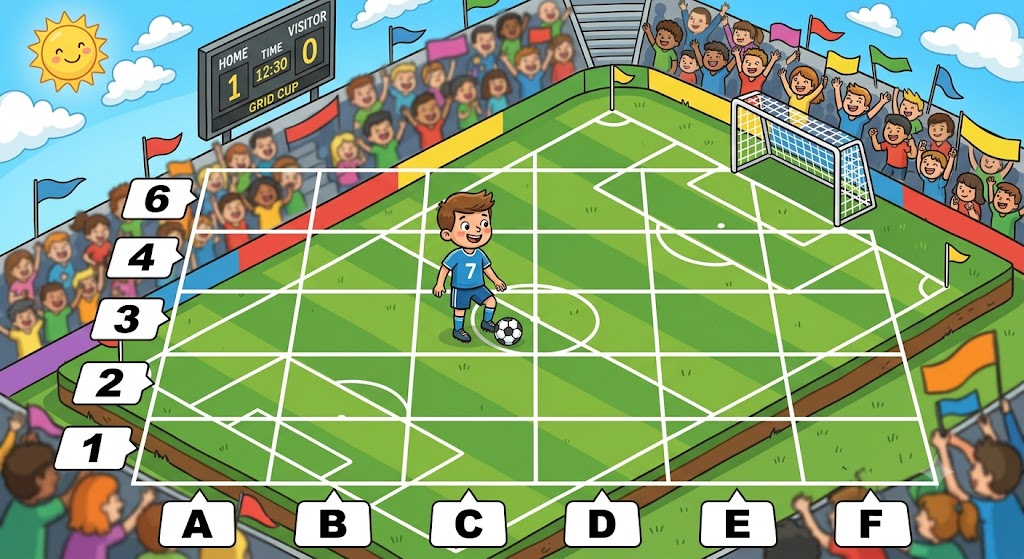
    • Visualize the Grid: Use real-life maps. Look at a local football pitch layout. Ask, “If the goal is at A1, where is the center circle?”
    • Precision Matters: When measuring objects like a phone or a toy, encourage them to line up the zero mark perfectly. Remind them that in measurement, every millimetre counts.

    At EinstyAI, we believe that custom-tailored, curriculum-aligned stories are the key to breaking down these barriers. By embedding these skills into narrative contexts—like tracking a player’s movement on a pitch or measuring the distance of a spectacular goal—we help students overcome math anxiety and develop genuine competence.

    Don’t wait for the next homework battle. Start turning your child’s math practice into a rewarding story experience today.

    Practice Questions: The Football Pitch Challenge

    Question 1: The Striker’s Position

    On a football pitch grid, the striker is standing at coordinate C4. If the striker moves two squares to the right and one square up to shoot, what is their new coordinate?

    A) D5

    B) E5

    C) C6

    D) D6

    Question 2: Measuring the Goal

    You are measuring the width of a miniature soccer goal using a ruler. The goal width is exactly 12 centimetres and 4 millimetres. How do you write this measurement in millimetres?

    A) 124 mm

    B) 12.4 mm

    C) 140 mm

    D) 1240 mm

    Question 3: The Midfielder’s Pass

    The ball is located at A2. The defender is located at A5. How many grid squares apart are they if they are in the same column?

    A) 2 squares

    B) 3 squares

    C) 4 squares

    D) 5 squares

  • How can I help my Year 2 child master measurement and time without the frustration?

    How can I help my Year 2 child master measurement and time without the frustration?

    Do you find that your Year 2 student struggles to grasp the difference between a centimetre and a metre, or gets confused every time the clock hits the half-hour mark? You are not alone. Parents often assume their child simply “isn’t a math kid” because they struggle with abstract numbers. The truth is, math at this stage is not about numbers—it is about spatial awareness and logic.

    When children rely on counting steps or hand spans to measure, they are using informal units. Moving to formal units like metres and centimetres can feel like a jump because the measurement scale changes. Similarly, reading a clock is not just about memorising numbers; it is about understanding fractions of time (quarters and halves). To make this stick, you must anchor these concepts in a world that matters to them: storytelling.

    The “Story Problem” Trick for Better Results

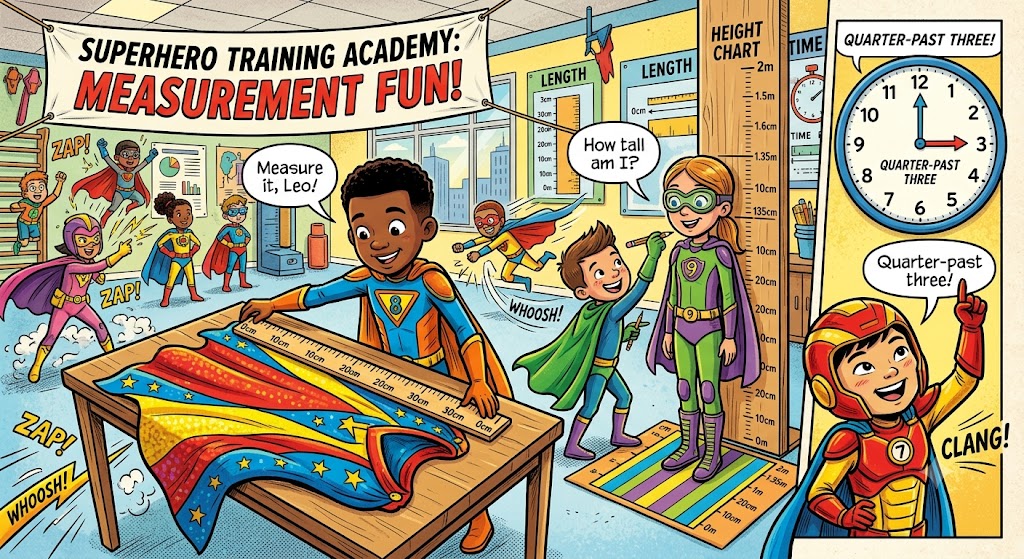
    The fastest way to teach measurement and time is to remove the “math” label entirely. If you want your child to understand that 100 centimetres equals 1 metre, don’t ask them to solve a worksheet. Ask them to design a superhero cape.

    Teach your child to visualise the problem. If a hero needs a cape that is 120 centimetres long, they need to see that this is “one metre and 20 centimetres.” By turning the measurement into a requirement for a character’s costume, the abstract numbers become tools they need to solve a narrative puzzle.

    When it comes to time, stop showing them the clock as a math problem. Treat the clock as a map. A quarter-past the hour is just a “slice” of the pizza. If the big hand is on the 3, it has moved one-quarter of the way around the circle. Visualising these segments makes the movement of the clock hands logical, not confusing.

    Why Contextual Learning Wins

    At EinstyAI, we believe that math anxiety stems from a lack of relevance. When math is isolated from the real world, it feels like a chore. When it is embedded in a story, it becomes a mission.

    Key takeaway: Stop teaching formulas and start teaching stories.

    If your child is learning to read time to the half-hour or measure objects in metres and centimetres, use their interests to frame the challenge. Are they measuring the height of a Lego tower? Are they timing how long it takes for a villain to escape a trap? By aligning the curriculum with their imagination, you bypass the anxiety and hit the learning objective head-on.

    Stop the battle at the kitchen table. Download our targeted practice set below, designed specifically for Year 2 students to bridge the gap between informal and formal measurement, and master that tricky clock face.


    Practice Questions

    Theme: The Superhero Training Academy

    1. The Cape Challenge

    Captain Zoom needs a new cape that is exactly 1 metre long. If he measures his current cape and finds it is 80 centimetres, how many more centimetres does he need to add to make it exactly 1 metre?

    A) 10 centimetres

    B) 20 centimetres

    C) 30 centimetres

    D) 120 centimetres

    2. The Villain Escape

    The arch-villain, Dr. Dread, is planning to escape his cell. The security alarm is set to go off at quarter-past 3. Which position on the clock face will the big hand be pointing to?

    A) 3

    B) 6

    C) 9

    D) 12

    3. Shield Dimensions

    Super-Strength Sam is building a new shield. He knows his shield is 50 centimetres wide. If he places two of these shields side-by-side, what is the total width in metres?

    A) 1 metre

    B) 100 metres

    C) 50 centimetres

    D) 150 centimetres

  • How can I help my Year 1 child understand directional language in maths?

    How can I help my Year 1 child understand directional language in maths?

    Ever feel like your child gets lost just by hearing the instructions “turn left” or “move forward”? It is a common frustration for parents. Many assume that if a child struggles with directions, they simply “aren’t math kids.” This is a harmful myth. Spatial awareness is a foundational skill, not a fixed talent.

    At EinstyAI, we believe that mastering the Measurement and Space strand in Year 1 does not require endless drills or stressful homework battles. It requires context. Children learn best when they can visualise the math in front of them. When you treat directional instructions as part of a story, the abstract becomes concrete.

    The Power of Spatial Reasoning

    In Year 1, students need to learn how to give and follow directions to move between locations. This is the bedrock of future geometry and complex problem-solving. If a child cannot conceptualise moving from Point A to Point B, they will struggle with more advanced concepts later, like coordinate planes or graphing.

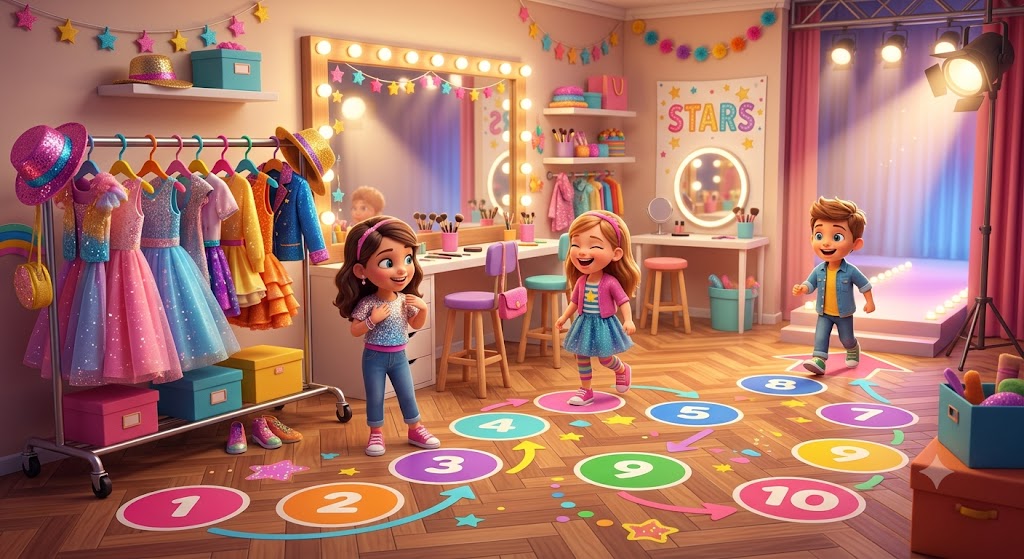
    Spatial reasoning is like a muscle. You build it by practice, not by memorising formulas. By framing directional movement within a relatable scenario—like a high-stakes fashion show—you take the pressure off. Suddenly, the math isn’t a “subject”; it is a way to solve a problem and keep the show running on time.

    How to Turn Math into Play

    Stop asking your child to “do their math worksheet.” Instead, invite them to “help the fashion models get ready.”

    Use these three quick tips to bridge the gap:

    • Use physical props: Use toys or household items to mark “locations.”
    • Walk the path: Have your child physically move across the floor to execute the instructions they are learning. This connects the brain to the body.
    • Narrative focus: Always use a story. Whether it is a fashion show, a treasure hunt, or a trip to the bakery, a story provides the “why” behind the math.

    The takeaway is simple: If you change the context, you change the outcome. Math anxiety thrives in sterile, abstract environments. It dies when kids are having fun with a narrative that makes sense to them.

    Download the practice questions below to start applying these principles today. Let’s make the next math session the best one yet.

    Practice Questions: The Fashion Show Runway Challenge

    Help the runway models navigate the backstage area to reach their outfits. Use these questions to practice spatial awareness and directional language.

    Question 1

    The model is standing at the Dressing Room Door. To reach the Red Dress, they must move forward 3 steps and turn right. If they are facing the Red Dress, which way is the door now?

    A) Behind them

    B) To their left

    C) To their right

    D) In front of them

    Question 2

    The model is at the Shoe Rack. They need to get to the mirror. The instruction says: “Move forward 2 steps, turn left, and move forward 1 step.” Where will the model be standing?

    A) At the door

    B) At the mirror

    C) Back at the start

    D) At the hat rack

    Question 3

    The model is facing the front of the runway. To put on the Glamour Sunglasses, they must turn 90 degrees to the right. Which direction are they facing now?

    A) Towards the audience

    B) Towards the side wall

    C) Towards the back of the room

    D) Towards the floor