Tag: Grid maps

  • How the Tally-to-Graph Bridge Helped Mia Turn Puppy Data Into Math Magic

    How the Tally-to-Graph Bridge Helped Mia Turn Puppy Data Into Math Magic

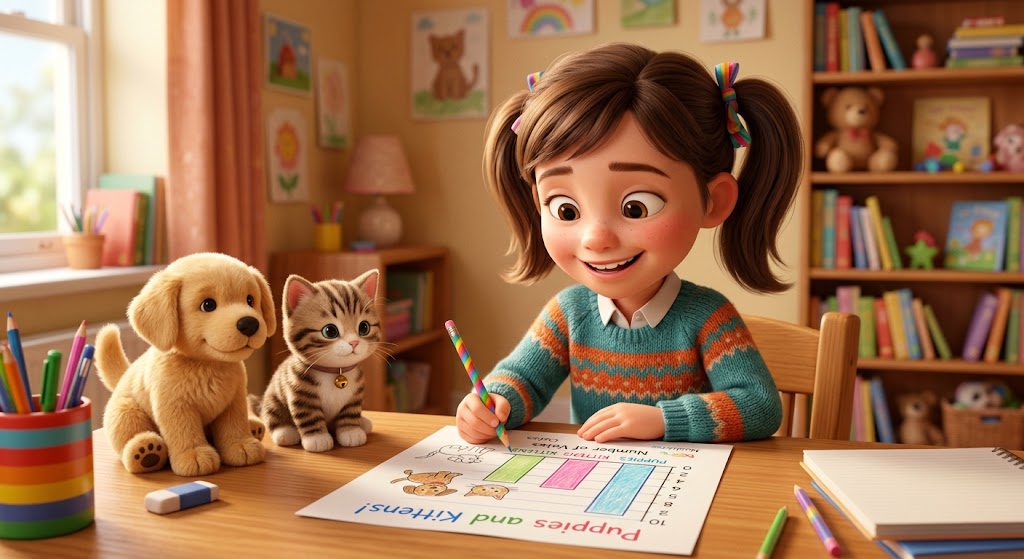
    The kitchen table was quiet, except for the sound of an eraser aggressively rubbing against paper. Mia, a bright Year 3 student, was on the verge of tears. In front of her sat a jumble of raw tally marks for a “Cute Puppies & Kittens” survey. The task was simple: turn the data into a column graph. But for Mia, the numbers felt like a foreign language.

    Her parents watched, feeling that familiar knot of frustration. They knew the drill: homework time was supposed to be a learning moment, but it had turned into a battle of wills, confusion, and paper-tearing exhaustion.

    The Common Mistake

    Most students struggle with graphing because they try to jump directly from a list of words to a finished, pretty graph. They look at the “Puppies” and “Kittens” labels and try to guess the bar height without anchoring the data. When the abstract lines on the graph don’t align with the tangible numbers in their heads, panic sets in. Children aren’t failing at math; they are failing to see the invisible thread connecting the data to the picture.

    The Guide & Magic Tool: The Tally-to-Graph Bridge

    To turn confusion into confidence, we use the “Tally-to-Graph Bridge.” This strategy treats the tally marks not as abstract scratches, but as physical “blocks” that are simply moved from the tally sheet to the graph paper. By counting the tallies first and writing the total above the tally mark, the child creates a “Bridge” of information. This number becomes the exact target for the bar height, removing the guesswork.

    The Transformation

    Mia took a deep breath. She looked at her tally marks for “Golden Retrievers” (five tallies). She wrote a clear “5” right above them—her Bridge.

    Then, she looked at her graph paper. She started at the bottom and colored up, counting aloud: “One, two, three, four, five.” Because she had her Bridge number (5) written down, she stopped exactly at the right line. She wasn’t just drawing a random rectangle; she was building a home for her data. For the first time all week, the graph didn’t look like a mystery—it looked like a map she had drawn herself.

    Conquer Math Anxiety with EinstyAI

    Stop the homework battles and start the breakthrough moments. At EinstyAI, we transform dry curriculum requirements into personalized stories that your child actually wants to solve. Whether it’s puppies, space exploration, or ninja adventures, we make the math make sense. Visit EinstyAI today and turn your next study session into a victory.

    Practice Questions: The Puppy & Kitten Data Challenge

    Question 1

    Mia surveyed her friends about their favorite pets. She found 6 tallies for “Golden Retrievers” and 4 tallies for “Siamese Kittens.” If Mia draws a column graph, how high should the column for Golden Retrievers go?

    A) 4

    B) 6

    C) 10

    D) 2

    Question 2

    Mia wants to show that 8 people chose “Beagle Puppies.” When drawing her dot plot, how many dots should she place in the column above “Beagle Puppies”?

    A) 8

    B) 1

    C) 7

    D) 18

    Question 3

    Looking at the completed graph, the “Persian Kitten” column reaches up to 5, and the “Pug Puppy” column reaches up to 3. How many people chose these two pets in total?

    A) 2

    B) 7

    C) 8

    D) 15

  • Mastering Angles: How to Make Geometry Click for Your Year 3 Student

    Mastering Angles: How to Make Geometry Click for Your Year 3 Student

    Is your child convinced that learning about angles is just dry, boring book work that has nothing to do with their real life? Many parents assume that math homework has to be a battleground, or that geometry is an abstract concept that only “math-minded” kids can grasp.

    The reality is that geometry is everywhere, especially in the world of gaming and digital movement. If your child loves video games, they are already an expert in angles—they just don’t know it yet.

    Angles are Not Just Shapes

    In Year 3, the curriculum moves away from static shapes and introduces angles as measures of turn. This shift is crucial. Instead of looking at a triangle, students need to think about how much an object rotates.

    Think of it like a game character performing a move. When a character spins to face an opponent, they are rotating through a specific angle. Whether it is a quick pivot or a full rotation, every move in a game relies on these geometric principles.

    The “Turn” Strategy

    To help your child master these concepts, teach them to visualize the “Quarter-Turn Technique.”

    • Quarter Turn: Think of this as a sharp 90-degree pivot. It is the movement a character makes to turn exactly to the left or right.
    • Half Turn: This is a 180-degree turn, like the character turning around to face the opposite direction.
    • Full Turn: This is a complete 360-degree spin, bringing the character back to their original position.

    By using this language, you strip away the fear of the word “geometry” and replace it with familiar gaming mechanics. Math becomes navigation, not just calculation.

    Make Math Part of the Play

    If you want to move beyond the struggle, integrate math into their interests. Encourage your child to describe their character’s movements in a game using terms like “quarter turn” or “half turn.”

    When they see that math is the engine behind their favorite games, the anxiety disappears. You can start building these skills today with our custom-tailored resources. If you need a more structured approach to help your child thrive, explore how EinstyAI transforms math practice into engaging stories.

    Practice Questions

    Instructions: Help the Esports champion “Pixel” navigate the arena by identifying the correct turn!

    1. Pixel needs to turn to face the Health Pack located directly behind him. What type of turn must Pixel make?
      A. Quarter turn
      B. Half turn
      C. Full turn
      D. No turn
    2. Pixel is facing North. He performs a quarter turn to the right. Which direction is Pixel now facing?
      A. West
      B. South
      C. East
      D. North
    3. During an esports match, Pixel spins in a complete circle to scan the entire room. How many degrees or what type of turn did he complete?
      A. A quarter turn
      B. A half turn
      C. A full turn
      D. A three-quarter turn

  • How Can I Help My Year 3 Student Master Grid References and Measurement?

    How Can I Help My Year 3 Student Master Grid References and Measurement?

    Why does math homework often turn into a battleground at the kitchen table? If your child tells you, “I’m just not a math person,” they are echoing a dangerous myth. The truth is, children aren’t failing at math; they are often failing to see the story behind the numbers. In Year 3, the curriculum shifts toward complex spatial reasoning, specifically focusing on Measurement and Space, where students must master grid-reference systems and precision measurement.

    The disconnect usually happens because worksheets treat math as an abstract list of tasks rather than a roadmap for problem-solving. When we teach a child how to locate a coordinate on a grid or measure an object to the nearest millimetre, we shouldn’t just ask them to fill in boxes. We need to frame it as a tactical challenge.

    Stop the “Math Anxiety” Cycle

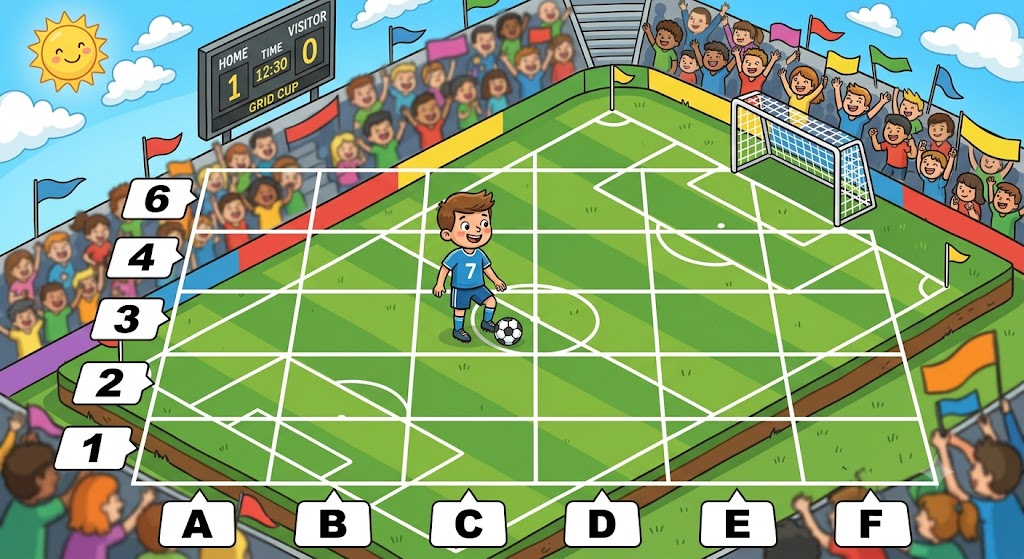
    Stop assuming your child lacks a “math brain.” Anxiety often stems from a lack of visual context. When a student sees a grid map, they shouldn’t just see letters and numbers; they should see a playing field or a treasure map. By shifting the perspective from “doing sums” to “solving a game,” you transform frustration into engagement.

    Mastering Grid References and Precision

    For Year 3, Stage 2 students, the goal is twofold. First, they must learn to navigate grid-reference systems, such as identifying that a specific point on a map (like B3) is the intersection of column B and row 3. This builds essential spatial logic.

    Second, they must refine their measurement skills. Measuring to the nearest millimetre requires patience and attention to detail—skills that carry over into every area of their education.

    To help them excel:

    • Visualize the Grid: Use real-life maps. Look at a local football pitch layout. Ask, “If the goal is at A1, where is the center circle?”
    • Precision Matters: When measuring objects like a phone or a toy, encourage them to line up the zero mark perfectly. Remind them that in measurement, every millimetre counts.

    At EinstyAI, we believe that custom-tailored, curriculum-aligned stories are the key to breaking down these barriers. By embedding these skills into narrative contexts—like tracking a player’s movement on a pitch or measuring the distance of a spectacular goal—we help students overcome math anxiety and develop genuine competence.

    Don’t wait for the next homework battle. Start turning your child’s math practice into a rewarding story experience today.

    Practice Questions: The Football Pitch Challenge

    Question 1: The Striker’s Position

    On a football pitch grid, the striker is standing at coordinate C4. If the striker moves two squares to the right and one square up to shoot, what is their new coordinate?

    A) D5

    B) E5

    C) C6

    D) D6

    Question 2: Measuring the Goal

    You are measuring the width of a miniature soccer goal using a ruler. The goal width is exactly 12 centimetres and 4 millimetres. How do you write this measurement in millimetres?

    A) 124 mm

    B) 12.4 mm

    C) 140 mm

    D) 1240 mm

    Question 3: The Midfielder’s Pass

    The ball is located at A2. The defender is located at A5. How many grid squares apart are they if they are in the same column?

    A) 2 squares

    B) 3 squares

    C) 4 squares

    D) 5 squares