Category: Number and Algebra

Number and Algebra

  • Practice Questions: Skip-Counting Cluster

    Practice Questions: Skip-Counting Cluster

    1. Maya is visiting the Martian Barn where 12 space-frogs are jumping. If she circles them in groups of 2, how many groups will she have?

    A) 4 groups

    B) 6 groups

    C) 5 groups

    D) 12 groups

    2. There are 15 tiny space-crickets chirping in the asteroid field. Maya circles them in groups of 5. How many groups of 5 are there?

    A) 2 groups

    B) 4 groups

    C) 3 groups

    D) 5 groups

    3. Maya finds 20 glowing space-worms. She decides to circle them in groups of 2. How many groups does she make?

    A) 8 groups

    B) 9 groups

    C) 10 groups

    D) 5 groups

    4. In the lunar coop, there are 25 space-chickens. Maya groups them by 5s to feed them. How many groups does she have?

    A) 5 groups

    B) 4 groups

    C) 6 groups

    D) 10 groups

    5. Maya counts 8 space-bees buzzing around a crater. If she groups them by 2s, how many groups does she have?

    A) 2 groups

    B) 3 groups

    C) 5 groups

    D) 4 groups

    1. Correct Answer: B (6 groups).
      Strategy: Use the Skip-Counting Cluster method. Circle pairs: (1,2), (3,4), (5,6), (7,8), (9,10), (11,12). Count the circles = 6.
    2. Correct Answer: C (3 groups).
      Strategy: Circle groups of 5. Count: 5, 10, 15. That is 3 groups of five.
    3. Correct Answer: C (10 groups).
      Strategy: Count by 2s up to 20: 2, 4, 6, 8, 10, 12, 14, 16, 18, 20. There are 10 intervals.
    4. Correct Answer: A (5 groups).
      Strategy: Count by 5s: 5, 10, 15, 20, 25. That is 5 groups.
    5. Correct Answer: D (4 groups).
      Strategy: Pair them up: (2), (4), (6), (8). That is 4 groups of two.

  • How the ‘Part-Part-Whole’ Secret Turned Leo into a Prehistoric Math Hero

    How the ‘Part-Part-Whole’ Secret Turned Leo into a Prehistoric Math Hero

    The kitchen table was silent, save for the rhythmic tapping of a pencil and the heavy sigh of a six-year-old. Leo stared at his math worksheet, his eyes misting over. Before him sat a pile of plastic dinosaur toys and a printed problem about adding sea shells. “I don’t get it,” he whispered, pushing the paper away. “It’s too many numbers.” For many Year 1 parents, this scene is all too familiar. The tears, the frustration, and the erased holes in the paper are not signs that your child lacks intelligence—they are signs that they are being taught in a language they don’t speak yet.

    The Common Mistake: Why Abstract Numbers Cause Panic

    The traditional approach to teaching math often jumps straight to vertical column addition or rote memorization. For a Year 1 student in Stage 1, this feels like learning a secret code without a key. When we force abstract symbols (like 8 + 5) onto a child who is still developing number sense, their brain freezes. They lose the visual context that makes math tangible. They aren’t struggling with the math; they are struggling with the lack of a story.

    The Guide & Magic Tool: The Part-Part-Whole Method

    The solution isn’t to work harder; it’s to make math visible. We use the ‘Part-Part-Whole’ strategy. Imagine math as a dinosaur adventure. If our dinosaur hero finds one group of sea shells (the first part) and another group (the second part), we can visualize the total (the whole) by simply combining them. This strategy transforms a confusing sum into a concrete treasure hunt, giving children a visual map to solve the problem before they ever touch a pencil to the answer box.

    The Transformation: Leo’s Lightbulb Moment

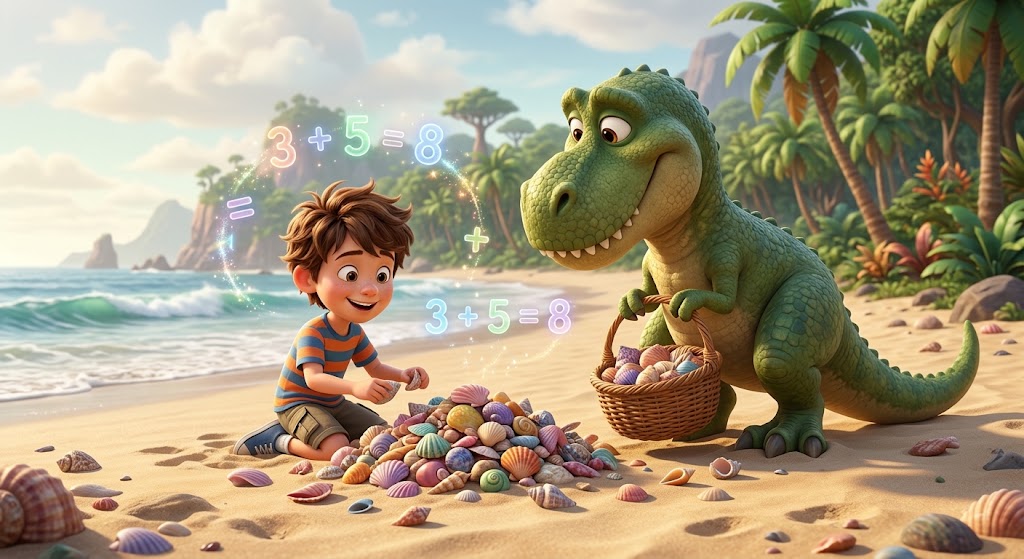
    Leo took a deep breath. We looked at his dinosaur problem: “A T-Rex finds 8 shiny sea shells on the beach. Then, he finds 5 more hidden in the sand. How many shells does the T-Rex have now?”

    Instead of panic, Leo used the Part-Part-Whole method. He put 8 fingers up for the first group. Then, he counted on 5 more fingers. His face lit up. “He has 13!” he shouted. The panic vanished, replaced by the thrill of discovery. Leo wasn’t just doing addition; he was solving a prehistoric mystery.

    Turn Homework Battles into Victories

    You don’t have to be a math expert to help your child succeed. You just need the right tools to bridge the gap between confusion and confidence. At EinstyAI, we transform dry math practice into custom-tailored stories that align with the curriculum. Stop the homework battles and start building confidence—visit us today to create personalized math adventures your child will actually love.


    Practice Questions: The Dinosaur Treasure Hunt

    Solve these addition problems by using your Part-Part-Whole strategy.

    1. A friendly Triceratops finds 7 smooth sea shells by the river. Later, she spots 4 more shells near a rock. How many shells does the Triceratops have in total?
      A) 10
      B) 11
      C) 12
      D) 9
    2. A Spinosaurus is collecting shells to decorate his cave. He has 9 shells already and finds 6 more in the sand. How many shells does he have now?
      A) 14
      B) 15
      C) 16
      D) 13
    3. A baby Stegosaurus finds 8 blue shells. His mom gives him 5 yellow shells. How many shells does the baby Stegosaurus have altogether?
      A) 12
      B) 13
      C) 14
      D) 11

  • How the Benchmark Method Helped Ethan Score the Best Deals in Roblox

    How the Benchmark Method Helped Ethan Score the Best Deals in Roblox

    The kitchen table was silent, save for the rhythmic tapping of Ethan’s pencil. In front of him sat a math worksheet about calculating percentage discounts on “limited edition” Roblox skins. Tears were welling up in his eyes. For a Year 5 student, the abstract concept of “finding 25% of 400” felt like trying to decode a secret language without a cipher. The frustration wasn’t just about the numbers; it was about the disconnect between the math on the page and the world he understood.

    Many parents see this exact scene daily. 

    When children are taught to force numbers into traditional algorithms—like long division or complex multiplication—without a visual mental model, they freeze. Their brains panic because they cannot “see” what they are solving. They aren’t struggling with math; they are struggling with the lack of a bridge between the classroom and their reality.

    The secret to breaking this cycle is the Benchmark Percentage Method. 

    Instead of jumping straight into complex calculations, we teach children to find the easy “anchors” first: 10% and 50%. These benchmarks act as the building blocks for any discount. If Ethan can find 10% (by moving the decimal point one place to the left), he can instantly find 20%, 30%, or even 5% by scaling up or down. This turns a terrifying word problem into a logical, visual map.

    Let’s look at Ethan’s transformation. He was asked to find 25% off a rare Roblox item priced at 800 Robux. Instead of panicking, he paused. He found 50% first (half of 800 is 400), then found half of that to get his 25% (200). He realized the sale price was 600 Robux. The panic vanished, replaced by the satisfying “click” of understanding. He wasn’t just doing math; he was hacking the system to save his digital currency.

    Stop the homework battles and start the breakthrough moments. 

    At EinstyAI, we transform dry syllabus requirements into custom-tailored math stories that resonate with your child’s interests. Turn the kitchen table into a place of confidence, not conflict.


    Practice Questions: The Roblox Discount Challenge

    Question 1

    Ethan wants to buy a “Golden Dragon” cape originally priced at 400 Robux. There is a 10% discount for “Flash Sale” members. What is the discount amount in Robux?

    A) 4 Robux

    B) 40 Robux

    C) 400 Robux

    D) 10 Robux

    Question 2

    An “Epic Space Suit” costs 200 Robux. During the “Space Event,” it is marked down by 25%. What is the new price Ethan pays?

    A) 50 Robux

    B) 100 Robux

    C) 150 Robux

    D) 175 Robux

    Question 3

    A rare “Neon Sword” costs 600 Robux. The shop offers a 50% discount. How much is the item now?

    A) 60 Robux

    B) 300 Robux

    C) 550 Robux

    D) 50 Robux

  • How the CUBES Method Helped Jim Master Decimals and Soccer Dreams

    How the CUBES Method Helped Jim Master Decimals and Soccer Dreams

    Jim, a passionate young soccer player, sat slumped at the kitchen table, his forehead resting on his textbook. Spread before him was his Year 4 math homework—a word problem about Olympic swimming race times. His eyes were red, and he had already erased a hole through his page. For Jim, these numbers weren’t just math; they were a source of overwhelming frustration that made him want to quit studying entirely.

    His struggle is something many parents know all too well. The “tear-filled kitchen table” moment happens when kids are taught to attack word problems with standard vertical algorithms before they understand the story behind the numbers. When abstract decimal values for race times—like 25.45 seconds versus 25.50 seconds—are thrown into a complex word problem, the brain freezes. The student tries to jump straight to the math before understanding what the question is actually asking.

    The Missing Map: The CUBES Method

    The reason many children struggle with “Number and Algebra” word problems isn’t that they can’t do the math; it’s that they don’t have a strategy to decode the language. This is where the CUBES Method acts as a secret weapon. It turns a scary wall of text into a simple, step-by-step visual map:

    • C – Circle the numbers.
    • U – Underline the specific question.
    • B – Box the key math words (like “faster,” “total,” or “difference”).
    • E – Evaluate what operation to use.
    • S – Solve and check.

    From Panic to Podium

    Let’s look at the problem that stumped Jim: “Jim is training for soccer by swimming. His first lap was 25.45 seconds and his second lap was 25.50 seconds. Which lap was faster?”

    Using CUBES, Jim stopped guessing. He circled 25.45 and 25.50. He underlined “Which lap was faster?” He boxed the word “faster.” He realized that in swimming, a smaller number of seconds means a faster time.

    By mapping the numbers on a simple number line, he saw clearly that 25.45 comes before 25.50. The fog lifted. Jim wasn’t just “doing math” anymore; he was analyzing data. He circled 25.45 as the winner. Confidence, not tears, was the final result.

    Turn Homework Battles into Victories

    You don’t have to navigate these homework battles alone. When math is presented as a dry, abstract chore, kids disengage. When it is woven into the things they love—like sports, gaming, or fantasy adventures—everything changes.

    At EinstyAI, we transform curriculum-aligned math practice into custom-tailored stories that help children overcome math anxiety. Stop the tears and start the excitement by visiting EinstyAI today to create personalized math experiences for your child.


    Practice Questions: The Soccer Swim Challenge

    1. During preseason training, Jim swam his first lap in 32.15 seconds. His second lap was 32.08 seconds. Which lap time is the faster (smaller) time?

    A. 32.15 seconds

    B. 32.08 seconds

    C. They are the same

    D. 32.50 seconds

    2. The soccer team relay swim was tight! Team Red finished in 1 minute and 45.2 seconds. Team Blue finished in 1 minute and 45.9 seconds. How much faster was Team Red than Team Blue?

    A. 0.7 seconds

    B. 0.3 seconds

    C. 7 seconds

    D. 0.07 seconds

    3. Jim needs to improve his swim time to qualify for the Junior Soccer League challenge. His current best is 28.5 seconds. If he shaves off 0.15 seconds, what will his new time be?

    A. 28.40 seconds

    B. 28.35 seconds

    C. 27.0 seconds

    D. 28.65 seconds

  • How the Sharing Circle Strategy Helped Mia Save the Mermaid Kingdom

    How the Sharing Circle Strategy Helped Mia Save the Mermaid Kingdom

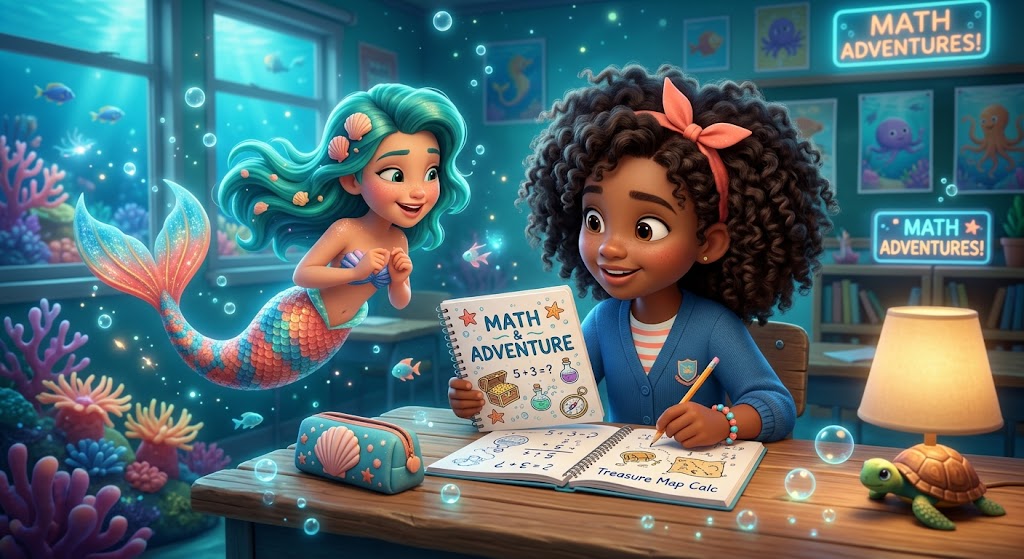
    It started with a splash of water and a puddle of tears. Mia, a bright Year 3 student, sat at the kitchen table, her pencil hovering over a math worksheet. The task: “Distribute 20 wizard potions into 4 equal mermaid treasure chests.”

    To Mia, this wasn’t just math; it was a puzzle she felt she couldn’t solve. The numbers felt cold and abstract. For many parents, this is the daily “homework battle”—watching your child freeze up when faced with a word problem that looks more like a foreign language than a math question.

    The Problem with “Just Divide”

    The mistake we often make is rushing children into abstract operations like formal long division. For a Year 3 student in Stage 2, forcing them to stack numbers without a visual bridge creates anxiety. When math is abstract, the brain shuts down. Mia didn’t need to learn a digit-by-digit process; she needed to visualize the story.

    The Magic Tool: The Sharing Circle Method

    We introduced the Sharing Circle Method. This is a visual weapon that turns a word problem into a physical map. Instead of staring at numbers on a page, we draw four circles (the treasure chests) and physically distribute the items (the potions) one by one.

    This strategy anchors the concept of “equal sets” in the physical world. It transforms abstract division into concrete, rhythmic action—”one for you, one for you”—until every potion is accounted for.

    From Panic to Confidence

    We took Mia’s worksheet: “Distribute 20 wizard potions into 4 equal mermaid treasure chests.”

    Instead of panic, Mia drew four circles. She started counting, placing a tally mark in each circle until she reached 20. She looked up, beaming. “Five! There are five potions in each chest.” By mapping the math, the division calculation became invisible, and the solution became obvious.

    Confidence in math isn’t about memorizing rules; it’s about having the tools to visualize the problem.

    Turn Homework Battles into Quests

    You don’t have to navigate these homework hurdles alone. EinstyAI specializes in transforming dry curriculum-aligned math into engaging, custom-tailored stories that help children overcome math anxiety. Visit EinstyAI today and turn your next math session into a victory.


    Practice Questions: The Mermaid Kingdom Quest

    Question 1

    In the Coral Palace, you have 15 healing kelp bundles to share equally among 3 sleepy baby seahorses. How many bundles does each seahorse get?

    A) 3

    B) 4

    C) 5

    D) 15

    Question 2

    The Mermaid Queen has 24 glowing pearls. She wants to place them into 4 display cases so each case has the same amount. How many pearls go into each case?

    A) 6

    B) 8

    C) 4

    D) 20

    Question 3

    Mia the Mermaid found 12 magic starfish. She wants to arrange them into 2 equal rows on the ocean floor to guide the school of fish. How many starfish are in each row?

    A) 2

    B) 4

    C) 10

    D) 6

  • How the ‘Bar Model’ Saved the Day for Superhero-Obsessed Leo

    How the ‘Bar Model’ Saved the Day for Superhero-Obsessed Leo

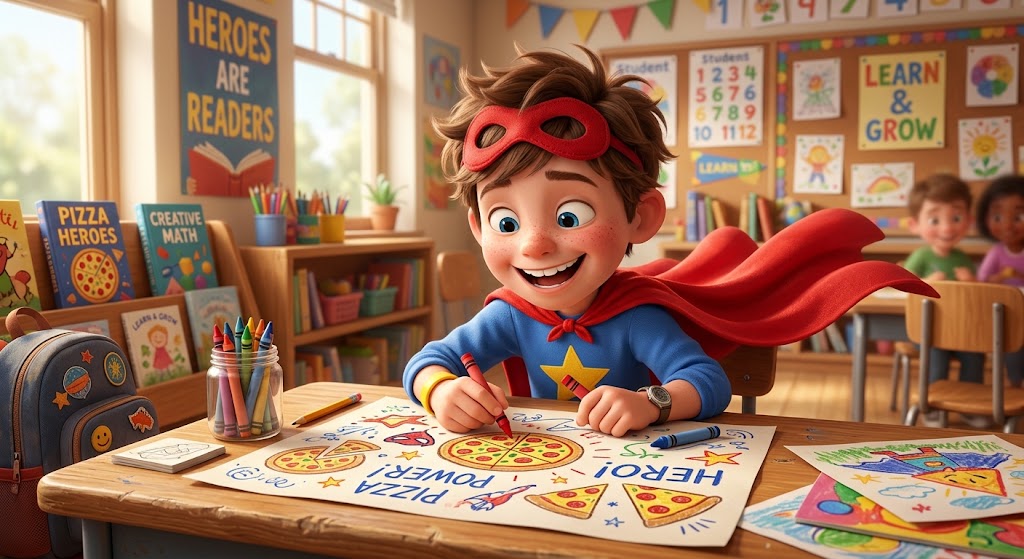
    Leo sat at the kitchen table, his superhero cape draped over his chair, but his shoulders were slumped. In front of him lay a math worksheet filled with numbers and circles. He was tasked with dividing a “party pizza” into equal shares for his team of heroes, but the numbers weren’t clicking. Tears welled up as he tried to visualize the math. For parents, this is the heartbreak of the homework battle—when a bright, creative child hits a wall because math feels like a dry, abstract chore rather than a story.

    The Problem with the ‘Memorize First’ Trap

    Many parents try to help by pushing traditional division algorithms or rote memorization of multiplication tables. The problem? When a child like Leo sees “12 divided by 4” without context, it’s just a floating number. Without a visual anchor, they panic. They guess, they erase until the paper tears, and they start to believe they simply “aren’t math people.” We need to stop forcing children to calculate numbers and start teaching them to model stories.

    Enter the Bar Model: Your Secret Weapon

    The Bar Model is a visual bridge that turns text problems into drawings. Instead of worrying about the abstract, we use rectangles to represent quantities. For Year 2 students, this makes the division of fractions or sharing quantities intuitive. It transforms “12 pizzas shared by 3 heroes” into three clear boxes, allowing the child to “see” the answer by drawing the distribution.

    The Transformation

    When we sat down with Leo, we didn’t open with a number sentence. We said, “Leo, imagine you have 8 slices of pizza to share between 2 hungry superheroes.” We drew one long rectangle and split it into two. Leo immediately drew 8 dots, placing one in each side alternately. He stopped. He counted. He realized each hero got 4.

    He didn’t just solve a math problem; he mapped out a reality. The panic vanished, replaced by the quiet confidence of a child who understands the “why” behind the math.

    Turn Homework Battles into Heroic Wins

    You don’t have to be a math teacher to help your child succeed. At EinstyAI, we create custom-tailored, story-aligned math practice that fits your child’s interests. Whether they love space, dinosaurs, or superheroes, we turn the curriculum into the stories they already love. Stop the tears and start the journey—visit EinstyAI today and let’s get your little hero back on track.


    PRACTICE QUESTIONS

    Question 1: The Pizza Party Rescue

    Captain Zoom and his sidekick have 8 slices of pepperoni pizza to share equally after saving the city. If they divide the pizza using the Bar Model, how many slices does each hero get?

    A) 2 slices

    B) 4 slices

    C) 6 slices

    D) 10 slices

    Question 2: The Energy Cupcakes

    The Superhero League has 12 energy cupcakes to share among 4 hungry team members. If each member gets the same amount, how many cupcakes go to each hero?

    A) 2 cupcakes

    B) 3 cupcakes

    C) 4 cupcakes

    D) 6 cupcakes

    Question 3: Dividing the Shields

    A group of 3 superheroes finds 9 super-shields in a secret cave. They share them equally so everyone has the same gear. How many shields does each hero have?

    A) 2 shields

    B) 3 shields

    C) 4 shields

    D) 6 shields

  • How the ‘Skip-Counting Cluster’ Method Helped Maya Save the Space-Farm

    How the ‘Skip-Counting Cluster’ Method Helped Maya Save the Space-Farm

    Maya sat at the kitchen table, her pencil hovering over a worksheet about “counting groups.” Tears welled in her eyes. The page was filled with tiny pictures of alien creatures, and the instructions were a jumble of words. “I can’t do it, Mum,” she sobbed. “There are too many to count one by one, and I keep losing my place.” Maya’s experience is common for Year 1 students facing the leap from counting individual objects to conceptualizing groups.

    The Common Mistake: Why Counting One-by-One Fails

    When children encounter larger collections—like our alien wildlife counting exercise—forcing them to count “1, 2, 3…” creates a cognitive bottleneck. As the numbers grow, the child’s working memory becomes overloaded, leading to skipped numbers, frustration, and a dislike for math. This “counting fatigue” is exactly why students panic when they see a big group of items.

    The Guide & Magic Tool: The Skip-Counting Cluster Method

    To help Maya, we introduced the “Skip-Counting Cluster” method. Instead of seeing a chaotic swarm of creatures, we taught her to draw a circle around groups of 2 or 5. By isolating these clusters, the math changes from a long, painful sequence into a fast, rhythmic skip-count: “2, 4, 6, 8…” or “5, 10, 15…” This visual strategy transforms an intimidating task into a manageable game of sorting.

    The Transformation: From Panic to Power

    Maya looked at the “Alien Farm” problem: “There are 10 alien space-goats hiding in the asteroid barn. Count them in groups of 2.” Maya stopped counting one-by-one. She drew circles around each pair. She counted: “2, 4, 6, 8, 10!” Suddenly, the tears were gone. She wasn’t just counting anymore; she was organizing data. She felt like a space commander mastering her fleet, and her confidence soared.

    Turn Homework into a Victory

    At EinstyAI, we don’t just assign problems; we build stories that make math feel like an adventure. If your child is struggling with foundational math concepts, let us help you turn those daily homework battles into moments of triumph. Visit us today to generate custom-tailored math stories that fit your child’s interests and curriculum needs.


    PRACTICE QUESTIONS

    Problem 1

    Maya is visiting the Martian Barn where 12 space-frogs are jumping. If she circles them in groups of 2, how many groups will she have?

    A) 4 groups

    B) 6 groups

    C) 5 groups

    D) 12 groups

    Problem 2

    There are 15 tiny space-crickets chirping in the asteroid field. Maya circles them in groups of 5. How many groups of 5 are there?

    A) 2 groups

    B) 4 groups

    C) 3 groups

    D) 5 groups

    Problem 3

    Maya finds 20 glowing space-worms. She decides to circle them in groups of 2. How many groups does she make?

    A) 8 groups

    B) 9 groups

    C) 10 groups

    D) 5 groups

  • How the Jump Strategy Helped Leo Slay the Year 3 Math Monster

    How the Jump Strategy Helped Leo Slay the Year 3 Math Monster

    Eight-year-old Leo sat at the kitchen table, pencil gripped tightly in his hand, staring at his Year 3 homework sheet. He could easily tell you what $45 + 38$ was if you asked him out loud. But when those exact same numbers were hidden inside a story about rescuing kangaroos in the Australian bush, he completely froze.

    The kitchen table had transformed into a battleground of tears, heavy sighs, and deeply erased paper.

    Like most caring parents, his mother tried the usual playbook: force him to line up the digits vertically, write small little ones above the columns, and carry the numbers over. But to a frustrated eight-year-old, abstract vertical columns feel like arbitrary rules forced upon them by a cold system.

    Enter the Guide: The Secret Weapon

    Children do not fail at math word problems because they cannot compute; they fail because they cannot visualize the journey inside the story.

    Instead of forcing rigid vertical columns, his mother introduced a simple visual weapon used by top educators: The Jump Strategy on an empty number line.

    Instead of stacking numbers into tall towers, the Jump Strategy turns every math problem into a horizontal trail map across the page.

    The Transformation: From Frozen to Fearless

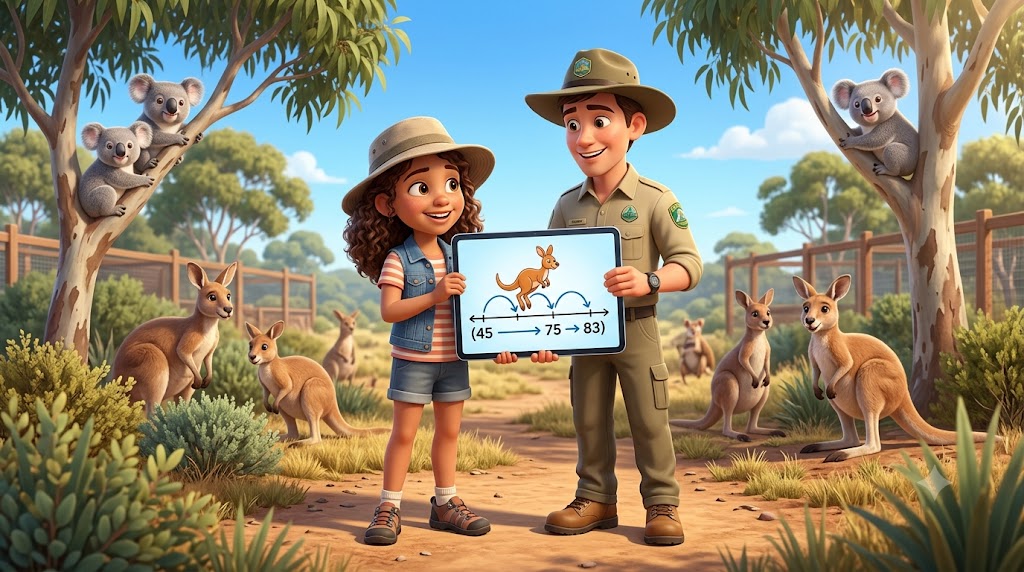
    That evening, Leo tackled a new story problem: “Ranger Sam has 45 kangaroos at the sanctuary and rescues 38 more. How many kangaroos are there now?”

    Instead of panicking, Leo drew a simple horizontal line across his page and followed three clear steps:

    1. Land on the Starting Point: He wrote 45 on the far left of his trail.
    2. Make the Big Jumps: He broke 38 into 3 tens ($30$) and 8 ones. He drew 3 big arc jumps forward by ten: $45 \rightarrow 55 \rightarrow 65 \rightarrow 75$.
    3. Finish with the Small Hops: He drew 8 small hops forward to land softly on 83.

    No column carrying. No erased paper. No tears. Within ten seconds, Leo looked up with a huge grin and announced, “There are 83 kangaroos, Mum!”

    Write Your Child’s Success Story

    When you give your child a visual map to navigate numbers, the “math monster” disappears, replaced by genuine curiosity and confidence.

    At EinstyAI, we believe every child deserves to be the hero of their own learning journey. We transform dry curriculum standards into custom-tailored, interactive adventures featuring your child’s favorite passions—whether that’s wildlife rescue, gaming, or space exploration.

    Head to EinstyAI today and create personalized story problems that turn homework battles into victories!

    PRACTICE QUESTIONS

    Year 3 Math Adventure: The Wildlife Rescue Center!

    Instructions for Parents: Read these wildlife rescue stories with your child. Have them draw an empty number line on paper and use the Jump Strategy (jumping tens first, then hopping ones) to choose the correct answer.

    Problem 1: Kangaroo Count

    The Story: Ranger Sam cares for 45 eastern grey kangaroos at his sanctuary. A neighboring wildlife park transfers 38 more rescued kangaroos to his care.

    • Question: How many kangaroos are at Ranger Sam’s sanctuary in total?
      • A) 73
      • B) 83
      • C) 78
      • D) 88

    Problem 2: Hungry Koalas

    The Story: Matilda the koala keeper collected 124 fresh eucalyptus branches in the morning. By sunset, the hungry koalas ate 46 of the branches.

    • Question: How many eucalyptus branches are left for tomorrow morning?
      • A) 82
      • B) 168
      • C) 78
      • D) 88

    Problem 3: Sea Turtle Nesting

    The Story: Beach volunteers counted 156 sea turtle eggs in Nest A along the Queensland coast. Nest B had 67 fewer eggs than Nest A.

    • Question: How many sea turtle eggs were in Nest B?
      • A) 89
      • B) 99
      • C) 91
      • D) 223

  • How to Explain Multiplying and Dividing Decimals by 10, 100, and 1000 to Year 6 Students?

    How to Explain Multiplying and Dividing Decimals by 10, 100, and 1000 to Year 6 Students?

    Why does my child panic the moment a decimal point appears in their homework?

    If you have ever watched your Year 6 student freeze up at a math problem, you are not alone. Parents often assume their child just isn’t a “math kid” or that they lack natural talent. The reality is usually simpler: they are missing the visual mental model for place value.

    Math homework does not have to be a battle. When students view math as a set of rigid, confusing rules, they struggle. When they view it as a pattern-spotting game, they succeed.

    The Secret: Stop Calculating, Start Sliding

    The biggest mistake students make is trying to perform traditional multiplication or division when dealing with powers of 10. They try to line up numbers vertically and carry values, which leads to mistakes.

    Instead, teach them the “Decimal Slide.”

    The decimal point does not move; the digits move. When multiplying by 10, 100, or 1000, the digits of the number slide to the left into larger place value columns. When dividing, they slide to the right into smaller columns.

    Using Storytelling to Make It Stick

    Abstract numbers are hard to remember. Prehistoric creatures are not.

    If we talk about a T-Rex egg weighing 2.5 kilograms, students immediately picture the weight. If we then “multiply by 10” to see what a nest of 10 eggs weighs, the calculation becomes a tangible, visual narrative. By anchoring these concepts in stories—like those we build at EinstyAI—we remove the “math anxiety” barrier and replace it with engagement.

    Master the Pattern Today

    Do not rely on repetitive drills that bore your child. Help them visualize the movement of numbers.

    Key Takeaways for Parents:

    • Focus on Place Value: Remind them that the decimal point is just a marker for where the “ones” column ends.
    • Use Visual Aids: If they get stuck, draw a place value chart with columns (Hundreds, Tens, Ones, . Tenths, Hundredths).
    • Consistency is Key: Practice with real-world scenarios, not just dry equations on a page.

    Want to see how this works in practice? See the “Prehistoric Decimal Hunt” worksheet below to turn your child’s next math session into an adventure.

    Practice Questions

    The Prehistoric Decimal Hunt: Worksheet

    Instructions: Help our paleontologists solve these dinosaur discoveries by multiplying and dividing decimals!

    Question 1

    A baby T-Rex weighs 4.25 kg. After a month of eating ferns and forest snacks, its weight has multiplied by 10. What does the T-Rex weigh now?

    A) 42.5 kg

    B) 425 kg

    C) 0.425 kg

    D) 4.250 kg

    Question 2

    A Triceratops footprint is 350.5 cm long. To calculate the scale for a model footprint that is 1/10th the size, you must divide the length by 10. How long is the model footprint?

    A) 3505 cm

    B) 35.05 cm

    C) 3.505 cm

    D) 350.5 cm

    Question 3

    A Pterodactyl glides across a canyon measuring 1.25 km. If a map maker wants to convert this distance into metres, they multiply the value by 1000. What is the distance in metres?

    A) 12.5 metres

    B) 125 metres

    C) 1250 metres

    D) 12500 metres

  • Why does my Year 5 student get stuck on multi-step math problems?

    Why does my Year 5 student get stuck on multi-step math problems?

    Every parent has faced the same wall: you sit down to help with homework, and the initial enthusiasm quickly dissolves into frustration. Why do students who are perfectly capable of adding and subtracting suddenly freeze when faced with a “word problem”?

    The answer is rarely about their ability to calculate. It is about their ability to translate. At the Year 5 Stage 3 level, math moves beyond simple arithmetic into Number and Algebra, where understanding the relationship between numbers is critical. When a child sees a multi-step word problem, they often see a wall of text that looks nothing like the neat equations in their textbook. They aren’t struggling with the math; they are struggling with the story.

    The mindset shift: Math is just a story

    Too many parents fall into the trap of thinking their child just “isn’t a math kid.” This creates a fixed mindset that labels a temporary struggle as a permanent character trait. In reality, math anxiety often stems from the disconnect between abstract numbers and real-world logic.

    By teaching students to break down complex problems into manageable steps, we lower that anxiety. At EinstyAI, we believe that if you can change the story, you change the result. When you frame a percentage calculation as a quest for rare loot in a game, the abstract concepts—like calculating 10%, 25%, or 50%—become tangible tools for success rather than chores to be completed.

    Mastering percentages and multi-step logic

    To solve multi-step problems, encourage your child to use the “Highlight and Pause” method.

    • Highlight the goal: What is the final question asking for?
    • Pause and plan: Before calculating, write down the known variables.
    • Divide and conquer: If the problem asks to find 10% of a total and then subtract it, that is two separate, solvable tasks. Treat them that way.

    When students learn to look for benchmarks like 10% (move the decimal one spot), 50% (divide by 2), and 25% (half of 50%), they stop guessing and start strategizing. These aren’t just tricks; they are foundational skills that make complex Number and Algebra tasks feel intuitive. Stop fighting the homework. Start building the story, and watch the math follow.

    Practice Questions

    Scenario: You are a top-tier gamer in the Roblox universe. Your success depends on your ability to manage your Robux and inventory to build the ultimate game world.

    Question 1

    You have 800 Robux. You decide to spend 50% of it on a new avatar skin and then use 10% of your remaining Robux to buy a special hat. How many Robux do you have left after these purchases?

    A) 400

    B) 360

    C) 440

    D) 320

    Question 2

    Your guild has collected 1,200 digital gems. You need to give 25% of the gems to the guild leader and then divide the remaining gems equally among 5 team members. How many gems does each team member receive?

    A) 180

    B) 240

    C) 300

    D) 200

    Question 3

    You are designing a map. You have 200 building blocks. You use 10% of your blocks for the floor and 50% of the remaining blocks to build a wall. How many blocks do you have left to build your tower?

    A) 90

    B) 100

    C) 80

    D) 110