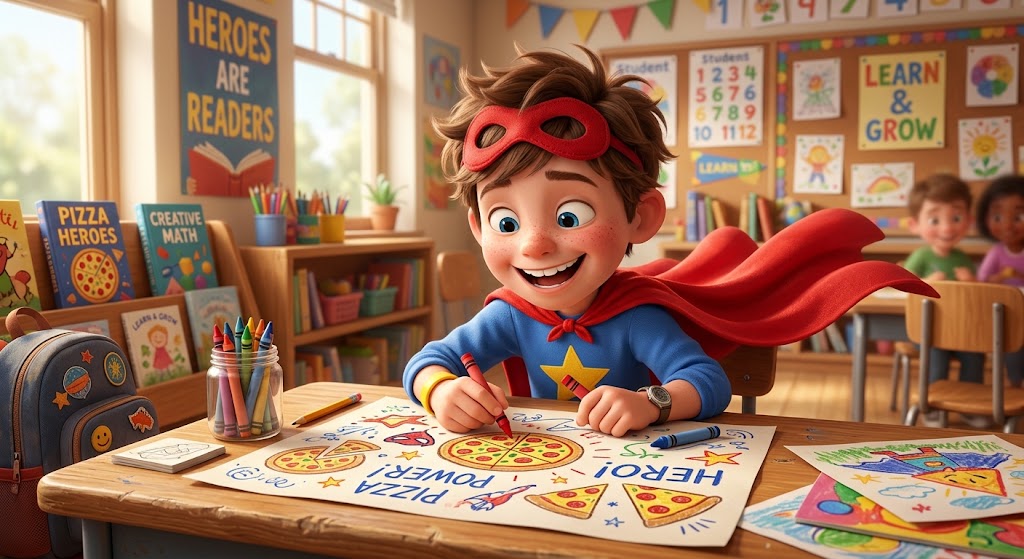
Leo sat at the kitchen table, his superhero cape draped over his chair, but his shoulders were slumped. In front of him lay a math worksheet filled with numbers and circles. He was tasked with dividing a “party pizza” into equal shares for his team of heroes, but the numbers weren’t clicking. Tears welled up as he tried to visualize the math. For parents, this is the heartbreak of the homework battle—when a bright, creative child hits a wall because math feels like a dry, abstract chore rather than a story.
The Problem with the ‘Memorize First’ Trap
Many parents try to help by pushing traditional division algorithms or rote memorization of multiplication tables. The problem? When a child like Leo sees “12 divided by 4” without context, it’s just a floating number. Without a visual anchor, they panic. They guess, they erase until the paper tears, and they start to believe they simply “aren’t math people.” We need to stop forcing children to calculate numbers and start teaching them to model stories.
Enter the Bar Model: Your Secret Weapon
The Bar Model is a visual bridge that turns text problems into drawings. Instead of worrying about the abstract, we use rectangles to represent quantities. For Year 2 students, this makes the division of fractions or sharing quantities intuitive. It transforms “12 pizzas shared by 3 heroes” into three clear boxes, allowing the child to “see” the answer by drawing the distribution.
The Transformation
When we sat down with Leo, we didn’t open with a number sentence. We said, “Leo, imagine you have 8 slices of pizza to share between 2 hungry superheroes.” We drew one long rectangle and split it into two. Leo immediately drew 8 dots, placing one in each side alternately. He stopped. He counted. He realized each hero got 4.
He didn’t just solve a math problem; he mapped out a reality. The panic vanished, replaced by the quiet confidence of a child who understands the “why” behind the math.
Turn Homework Battles into Heroic Wins
You don’t have to be a math teacher to help your child succeed. At EinstyAI, we create custom-tailored, story-aligned math practice that fits your child’s interests. Whether they love space, dinosaurs, or superheroes, we turn the curriculum into the stories they already love. Stop the tears and start the journey—visit EinstyAI today and let’s get your little hero back on track.
PRACTICE QUESTIONS
Question 1: The Pizza Party Rescue
Captain Zoom and his sidekick have 8 slices of pepperoni pizza to share equally after saving the city. If they divide the pizza using the Bar Model, how many slices does each hero get?
A) 2 slices
B) 4 slices
C) 6 slices
D) 10 slices
Question 2: The Energy Cupcakes
The Superhero League has 12 energy cupcakes to share among 4 hungry team members. If each member gets the same amount, how many cupcakes go to each hero?
A) 2 cupcakes
B) 3 cupcakes
C) 4 cupcakes
D) 6 cupcakes
Question 3: Dividing the Shields
A group of 3 superheroes finds 9 super-shields in a secret cave. They share them equally so everyone has the same gear. How many shields does each hero have?
A) 2 shields
B) 3 shields
C) 4 shields
D) 6 shields