Tag: numbers

  • How the CUBES Method Helped Jim Master Decimals and Soccer Dreams

    How the CUBES Method Helped Jim Master Decimals and Soccer Dreams

    Jim, a passionate young soccer player, sat slumped at the kitchen table, his forehead resting on his textbook. Spread before him was his Year 4 math homework—a word problem about Olympic swimming race times. His eyes were red, and he had already erased a hole through his page. For Jim, these numbers weren’t just math; they were a source of overwhelming frustration that made him want to quit studying entirely.

    His struggle is something many parents know all too well. The “tear-filled kitchen table” moment happens when kids are taught to attack word problems with standard vertical algorithms before they understand the story behind the numbers. When abstract decimal values for race times—like 25.45 seconds versus 25.50 seconds—are thrown into a complex word problem, the brain freezes. The student tries to jump straight to the math before understanding what the question is actually asking.

    The Missing Map: The CUBES Method

    The reason many children struggle with “Number and Algebra” word problems isn’t that they can’t do the math; it’s that they don’t have a strategy to decode the language. This is where the CUBES Method acts as a secret weapon. It turns a scary wall of text into a simple, step-by-step visual map:

    • C – Circle the numbers.
    • U – Underline the specific question.
    • B – Box the key math words (like “faster,” “total,” or “difference”).
    • E – Evaluate what operation to use.
    • S – Solve and check.

    From Panic to Podium

    Let’s look at the problem that stumped Jim: “Jim is training for soccer by swimming. His first lap was 25.45 seconds and his second lap was 25.50 seconds. Which lap was faster?”

    Using CUBES, Jim stopped guessing. He circled 25.45 and 25.50. He underlined “Which lap was faster?” He boxed the word “faster.” He realized that in swimming, a smaller number of seconds means a faster time.

    By mapping the numbers on a simple number line, he saw clearly that 25.45 comes before 25.50. The fog lifted. Jim wasn’t just “doing math” anymore; he was analyzing data. He circled 25.45 as the winner. Confidence, not tears, was the final result.

    Turn Homework Battles into Victories

    You don’t have to navigate these homework battles alone. When math is presented as a dry, abstract chore, kids disengage. When it is woven into the things they love—like sports, gaming, or fantasy adventures—everything changes.

    At EinstyAI, we transform curriculum-aligned math practice into custom-tailored stories that help children overcome math anxiety. Stop the tears and start the excitement by visiting EinstyAI today to create personalized math experiences for your child.


    Practice Questions: The Soccer Swim Challenge

    1. During preseason training, Jim swam his first lap in 32.15 seconds. His second lap was 32.08 seconds. Which lap time is the faster (smaller) time?

    A. 32.15 seconds

    B. 32.08 seconds

    C. They are the same

    D. 32.50 seconds

    2. The soccer team relay swim was tight! Team Red finished in 1 minute and 45.2 seconds. Team Blue finished in 1 minute and 45.9 seconds. How much faster was Team Red than Team Blue?

    A. 0.7 seconds

    B. 0.3 seconds

    C. 7 seconds

    D. 0.07 seconds

    3. Jim needs to improve his swim time to qualify for the Junior Soccer League challenge. His current best is 28.5 seconds. If he shaves off 0.15 seconds, what will his new time be?

    A. 28.40 seconds

    B. 28.35 seconds

    C. 27.0 seconds

    D. 28.65 seconds
  • How the Sharing Circle Strategy Helped Mia Save the Mermaid Kingdom

    How the Sharing Circle Strategy Helped Mia Save the Mermaid Kingdom

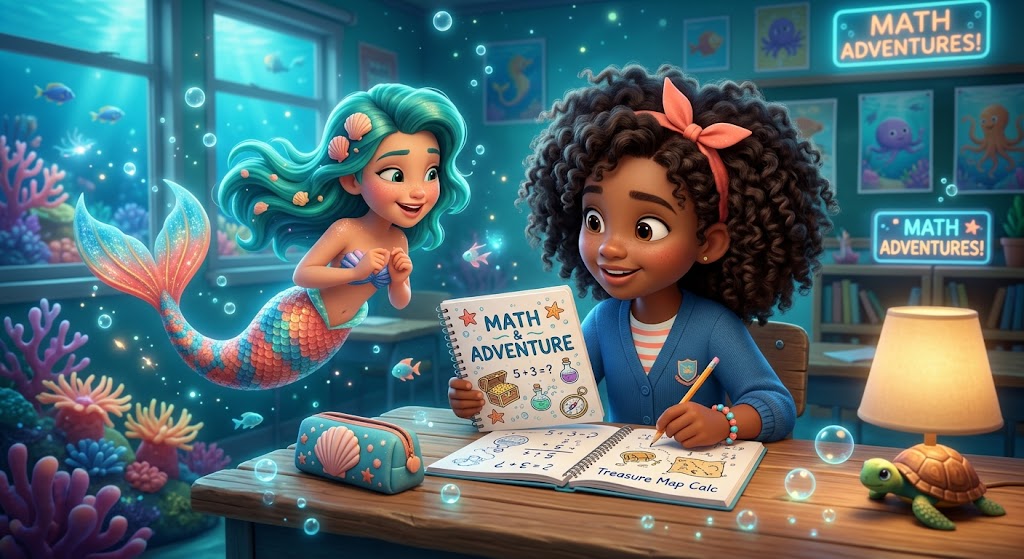
    It started with a splash of water and a puddle of tears. Mia, a bright Year 3 student, sat at the kitchen table, her pencil hovering over a math worksheet. The task: “Distribute 20 wizard potions into 4 equal mermaid treasure chests.”

    To Mia, this wasn’t just math; it was a puzzle she felt she couldn’t solve. The numbers felt cold and abstract. For many parents, this is the daily “homework battle”—watching your child freeze up when faced with a word problem that looks more like a foreign language than a math question.

    The Problem with “Just Divide”

    The mistake we often make is rushing children into abstract operations like formal long division. For a Year 3 student in Stage 2, forcing them to stack numbers without a visual bridge creates anxiety. When math is abstract, the brain shuts down. Mia didn’t need to learn a digit-by-digit process; she needed to visualize the story.

    The Magic Tool: The Sharing Circle Method

    We introduced the Sharing Circle Method. This is a visual weapon that turns a word problem into a physical map. Instead of staring at numbers on a page, we draw four circles (the treasure chests) and physically distribute the items (the potions) one by one.

    This strategy anchors the concept of “equal sets” in the physical world. It transforms abstract division into concrete, rhythmic action—”one for you, one for you”—until every potion is accounted for.

    From Panic to Confidence

    We took Mia’s worksheet: “Distribute 20 wizard potions into 4 equal mermaid treasure chests.”

    Instead of panic, Mia drew four circles. She started counting, placing a tally mark in each circle until she reached 20. She looked up, beaming. “Five! There are five potions in each chest.” By mapping the math, the division calculation became invisible, and the solution became obvious.

    Confidence in math isn’t about memorizing rules; it’s about having the tools to visualize the problem.

    Turn Homework Battles into Quests

    You don’t have to navigate these homework hurdles alone. EinstyAI specializes in transforming dry curriculum-aligned math into engaging, custom-tailored stories that help children overcome math anxiety. Visit EinstyAI today and turn your next math session into a victory.


    Practice Questions: The Mermaid Kingdom Quest

    Question 1

    In the Coral Palace, you have 15 healing kelp bundles to share equally among 3 sleepy baby seahorses. How many bundles does each seahorse get?

    A) 3

    B) 4

    C) 5

    D) 15

    Question 2

    The Mermaid Queen has 24 glowing pearls. She wants to place them into 4 display cases so each case has the same amount. How many pearls go into each case?

    A) 6

    B) 8

    C) 4

    D) 20

    Question 3

    Mia the Mermaid found 12 magic starfish. She wants to arrange them into 2 equal rows on the ocean floor to guide the school of fish. How many starfish are in each row?

    A) 2

    B) 4

    C) 10

    D) 6

  • How the ‘Bar Model’ Saved the Day for Superhero-Obsessed Leo

    How the ‘Bar Model’ Saved the Day for Superhero-Obsessed Leo

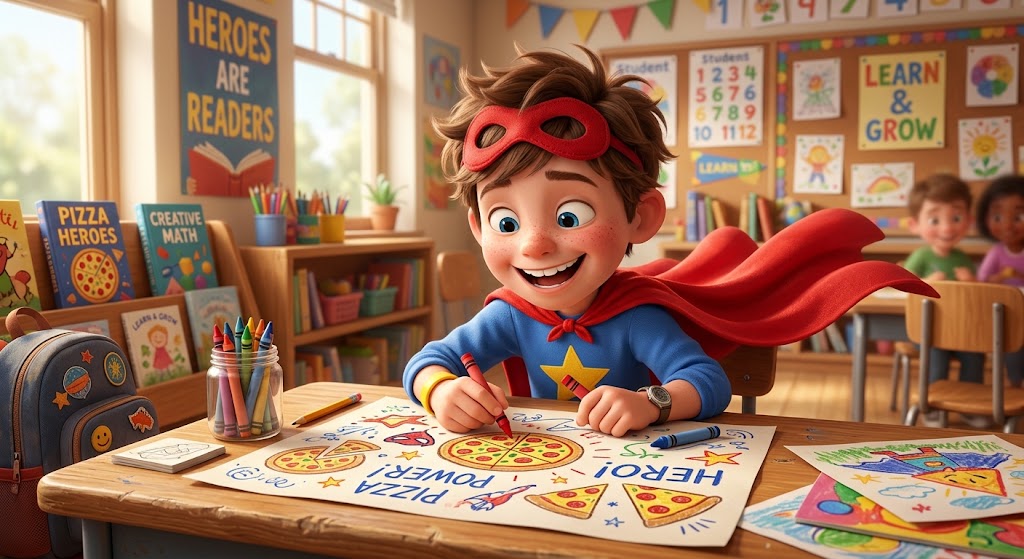
    Leo sat at the kitchen table, his superhero cape draped over his chair, but his shoulders were slumped. In front of him lay a math worksheet filled with numbers and circles. He was tasked with dividing a “party pizza” into equal shares for his team of heroes, but the numbers weren’t clicking. Tears welled up as he tried to visualize the math. For parents, this is the heartbreak of the homework battle—when a bright, creative child hits a wall because math feels like a dry, abstract chore rather than a story.

    The Problem with the ‘Memorize First’ Trap

    Many parents try to help by pushing traditional division algorithms or rote memorization of multiplication tables. The problem? When a child like Leo sees “12 divided by 4” without context, it’s just a floating number. Without a visual anchor, they panic. They guess, they erase until the paper tears, and they start to believe they simply “aren’t math people.” We need to stop forcing children to calculate numbers and start teaching them to model stories.

    Enter the Bar Model: Your Secret Weapon

    The Bar Model is a visual bridge that turns text problems into drawings. Instead of worrying about the abstract, we use rectangles to represent quantities. For Year 2 students, this makes the division of fractions or sharing quantities intuitive. It transforms “12 pizzas shared by 3 heroes” into three clear boxes, allowing the child to “see” the answer by drawing the distribution.

    The Transformation

    When we sat down with Leo, we didn’t open with a number sentence. We said, “Leo, imagine you have 8 slices of pizza to share between 2 hungry superheroes.” We drew one long rectangle and split it into two. Leo immediately drew 8 dots, placing one in each side alternately. He stopped. He counted. He realized each hero got 4.

    He didn’t just solve a math problem; he mapped out a reality. The panic vanished, replaced by the quiet confidence of a child who understands the “why” behind the math.

    Turn Homework Battles into Heroic Wins

    You don’t have to be a math teacher to help your child succeed. At EinstyAI, we create custom-tailored, story-aligned math practice that fits your child’s interests. Whether they love space, dinosaurs, or superheroes, we turn the curriculum into the stories they already love. Stop the tears and start the journey—visit EinstyAI today and let’s get your little hero back on track.


    PRACTICE QUESTIONS

    Question 1: The Pizza Party Rescue

    Captain Zoom and his sidekick have 8 slices of pepperoni pizza to share equally after saving the city. If they divide the pizza using the Bar Model, how many slices does each hero get?

    A) 2 slices

    B) 4 slices

    C) 6 slices

    D) 10 slices

    Question 2: The Energy Cupcakes

    The Superhero League has 12 energy cupcakes to share among 4 hungry team members. If each member gets the same amount, how many cupcakes go to each hero?

    A) 2 cupcakes

    B) 3 cupcakes

    C) 4 cupcakes

    D) 6 cupcakes

    Question 3: Dividing the Shields

    A group of 3 superheroes finds 9 super-shields in a secret cave. They share them equally so everyone has the same gear. How many shields does each hero have?

    A) 2 shields

    B) 3 shields

    C) 4 shields

    D) 6 shields

  • How the ‘Skip-Counting Cluster’ Method Helped Maya Save the Space-Farm

    How the ‘Skip-Counting Cluster’ Method Helped Maya Save the Space-Farm

    Maya sat at the kitchen table, her pencil hovering over a worksheet about “counting groups.” Tears welled in her eyes. The page was filled with tiny pictures of alien creatures, and the instructions were a jumble of words. “I can’t do it, Mum,” she sobbed. “There are too many to count one by one, and I keep losing my place.” Maya’s experience is common for Year 1 students facing the leap from counting individual objects to conceptualizing groups.

    The Common Mistake: Why Counting One-by-One Fails

    When children encounter larger collections—like our alien wildlife counting exercise—forcing them to count “1, 2, 3…” creates a cognitive bottleneck. As the numbers grow, the child’s working memory becomes overloaded, leading to skipped numbers, frustration, and a dislike for math. This “counting fatigue” is exactly why students panic when they see a big group of items.

    The Guide & Magic Tool: The Skip-Counting Cluster Method

    To help Maya, we introduced the “Skip-Counting Cluster” method. Instead of seeing a chaotic swarm of creatures, we taught her to draw a circle around groups of 2 or 5. By isolating these clusters, the math changes from a long, painful sequence into a fast, rhythmic skip-count: “2, 4, 6, 8…” or “5, 10, 15…” This visual strategy transforms an intimidating task into a manageable game of sorting.

    The Transformation: From Panic to Power

    Maya looked at the “Alien Farm” problem: “There are 10 alien space-goats hiding in the asteroid barn. Count them in groups of 2.” Maya stopped counting one-by-one. She drew circles around each pair. She counted: “2, 4, 6, 8, 10!” Suddenly, the tears were gone. She wasn’t just counting anymore; she was organizing data. She felt like a space commander mastering her fleet, and her confidence soared.

    Turn Homework into a Victory

    At EinstyAI, we don’t just assign problems; we build stories that make math feel like an adventure. If your child is struggling with foundational math concepts, let us help you turn those daily homework battles into moments of triumph. Visit us today to generate custom-tailored math stories that fit your child’s interests and curriculum needs.


    PRACTICE QUESTIONS

    Problem 1

    Maya is visiting the Martian Barn where 12 space-frogs are jumping. If she circles them in groups of 2, how many groups will she have?

    A) 4 groups

    B) 6 groups

    C) 5 groups

    D) 12 groups

    Problem 2

    There are 15 tiny space-crickets chirping in the asteroid field. Maya circles them in groups of 5. How many groups of 5 are there?

    A) 2 groups

    B) 4 groups

    C) 3 groups

    D) 5 groups

    Problem 3

    Maya finds 20 glowing space-worms. She decides to circle them in groups of 2. How many groups does she make?

    A) 8 groups

    B) 9 groups

    C) 10 groups

    D) 5 groups

  • Why does my Year 2 child struggle with three-digit numbers?

    Why does my Year 2 child struggle with three-digit numbers?

    Does math homework often turn into a battle of tears and frustration at your kitchen table? You aren’t alone, and the problem usually isn’t that your child “isn’t a math kid.” The disconnect often happens because we teach children to memorize isolated steps rather than visualizing numbers as physical objects.

    Many parents assume that math success requires rapid calculation skills. In reality, the ACARA curriculum for Stage 1 (B) emphasizes conceptual fluency over raw speed. When children can partition three-digit numbers and use the jump strategy on empty number lines, they unlock the ability to visualize math instead of guessing.

    What is the “Jump Strategy”?

    The jump strategy is a visual technique for addition where we break numbers apart (partitioning) to make them easier to handle. Instead of trying to add everything in one go, your child starts on a number line and makes “jumps.”

    For a problem like 345 + 123, we partition the second number (123) into 100, 20, and 3. On the empty number line, we start at 345. We jump 100 to reach 445. Then, we jump 20 to reach 465, and finally, we jump 3 to reach the total of 468.

    Why this method works

    Partitioning turns abstract math into a story problem. It allows the brain to process one chunk of the number at a time, reducing the cognitive load. By placing these chunks onto a line, children can actually see the distance they are traveling.

    Key Takeaway: Stop focusing on the “right answer” and start focusing on the “right path.” If your child can explain their jumps, they understand the place value, and the calculation will naturally follow.

    Helping your child at home

    Stop forcing rote memorization of sums. Instead, draw an empty number line on a piece of paper. Ask your child to mark the starting number on the left and show you how they would “jump” toward the answer.

    If they get stuck, help them break the second number down into hundreds, tens, and ones. This builds the foundational number sense needed for higher stages of primary school.

    At EinstyAI, we help children transform these concepts into engaging, custom-tailored, curriculum-aligned stories. When math becomes a story about characters rather than dry equations, the anxiety disappears, and confidence builds.

    Ready to change the way your child learns? Grab a pencil, draw an empty line, and start jumping today.

    Practice Questions

    The Great Outback Animal Rescue: Worksheet

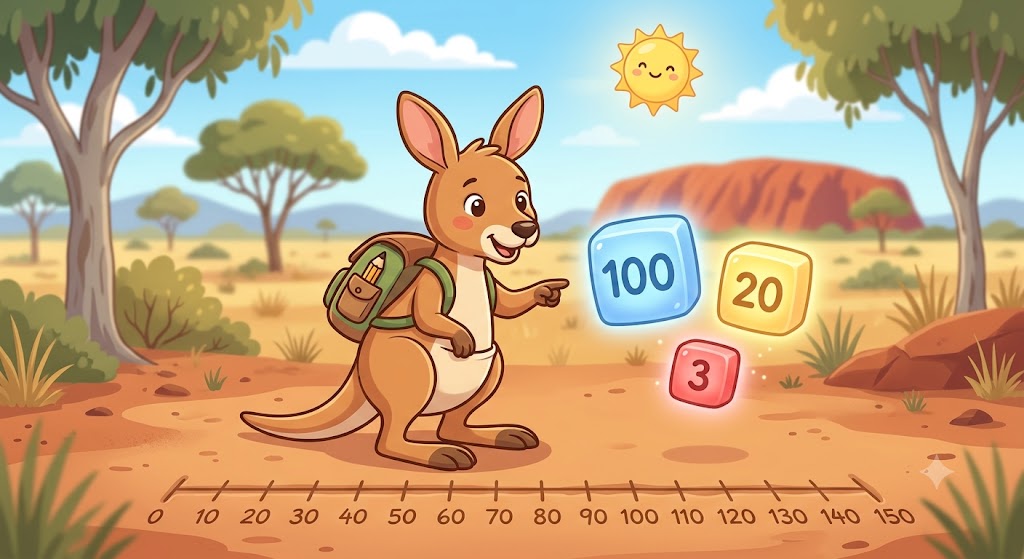
    Join Kiki the Kangaroo and her friends as they help rescue lost animals in the Australian Outback. Solve these number problems using the jump strategy!

    Question 1

    Kiki found 234 lost wallabies. Later, she found 120 more hidden in a cave. Which partition shows how to break down the number 120 to help with the jump strategy?

    A) 100 + 20 + 0

    B) 100 + 2 + 0

    C) 10 + 20 + 0

    D) 120 + 0 + 0

    Question 2

    Emu Eddy is running to find water. He starts at 350 and needs to jump forward by 210. After his first jump of 200, where does he land on the number line?

    A) 500

    B) 550

    C) 450

    D) 650

    Question 3

    A hungry wombat has 425 berries. He collects 142 more from a bush. Using the jump strategy, what is the best sequence of jumps to solve 425 + 142?

    A) Jump 1, then 4, then 2

    B) Jump 100, then 40, then 2

    C) Jump 10, then 40, then 20

    D) Jump 140, then 2, then 0

  • Why Does My Year 5 Child Get Stuck on Multistep Math Word Problems?

    Why Does My Year 5 Child Get Stuck on Multistep Math Word Problems?

    Do you find yourself sitting at the kitchen table, watching your Year 5 student stare blankly at a word problem, only to give up because “it’s too hard”? You aren’t alone. Many parents assume that math ability is fixed—that some children are simply “math kids” and others are not. This is a myth. The reality is that most students don’t struggle with the math itself; they struggle with the language and the multi-layered logic of the question.

    In Stage 3 of the Australian curriculum, the jump in complexity is significant. Students are expected to move from simple arithmetic to solving multistep problems involving percentages. If your child struggles with this, they likely need a strategy to decode the story, not more repetitive drills. At EinstyAI, we help students transform this frustration into confidence by aligning math practice with stories they actually want to read.

    The Secret to Decoding Word Problems

    To help your child succeed with multistep problems—specifically calculating 10%, 25%, and 50%—teach them the “STOP-THINK-SOLVE” method.

    1. Stop and Underline Keywords:

    Ask your child to highlight the important numbers and the specific percentage they need to find. If the problem asks for 10% of a collection, circle “10%.” If it mentions “total” or “remaining,” highlight those. Ignoring keywords is the number one reason for errors.

    2. Think in “Easy Chunks”:

    Before jumping into complex division, use “friendly” percentages.

    • 50% is half: Just divide the number by 2.
    • 25% is half of a half: Divide by 2, then divide by 2 again.
    • 10% is a tenth: Just move the decimal point one place to the left (e.g., 10% of 80 is 8).

    3. Solve the Steps Separately:

    Multistep problems are just a series of small problems chained together. Teach your child to solve one part, write the answer down, and then use that answer to solve the next part. Never try to hold all the numbers in your head at once.

    Changing the Mindset

    Math homework doesn’t have to be a battleground. When you shift the focus from “getting the right answer” to “solving the mystery” within the story, anxiety drops. A Year 5 student who views a word problem as a puzzle to be cracked—rather than a test to be failed—will naturally develop better problem-solving stamina.

    Ready to put these strategies into practice with your child? Scroll down to download our latest story-based worksheet designed to make Stage 3 percentages manageable and fun.

    Practice Questions

    The Great Outback Wildlife Rescue

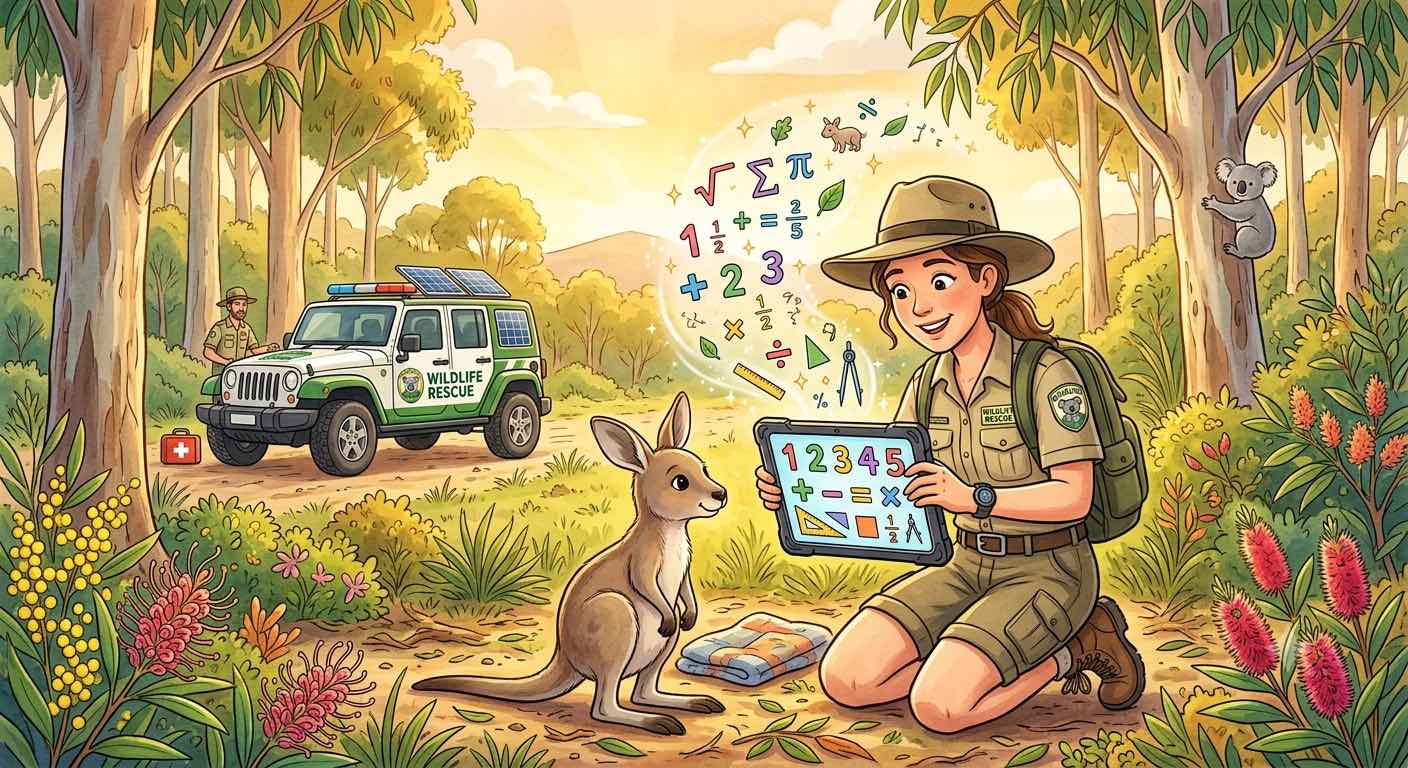
    Help the ranger team save our native animals! Use your math skills to calculate the supplies needed for the rescue mission.

    Question 1

    The ranger team found 120 injured kangaroos in the bush. They need to give medicine to 25% of them immediately. How many kangaroos need immediate medicine?

    A) 20

    B) 30

    C) 40

    D) 60

    Question 2

    The rescue station has a stockpile of 400kg of eucalyptus leaves for the koalas. The team uses 10% of the stockpile for the morning feed. How much eucalyptus is left for the rest of the day?

    A) 40kg

    B) 300kg

    C) 360kg

    D) 390kg

    Question 3

    The team rescued 80 baby wombats. They decided to transport 50% of them to the main shelter and keep the rest at the field hospital. Later, 25% of the wombats at the field hospital were cleared to go home. How many wombats are still at the field hospital?

    A) 10

    B) 30

    C) 40

    D) 20