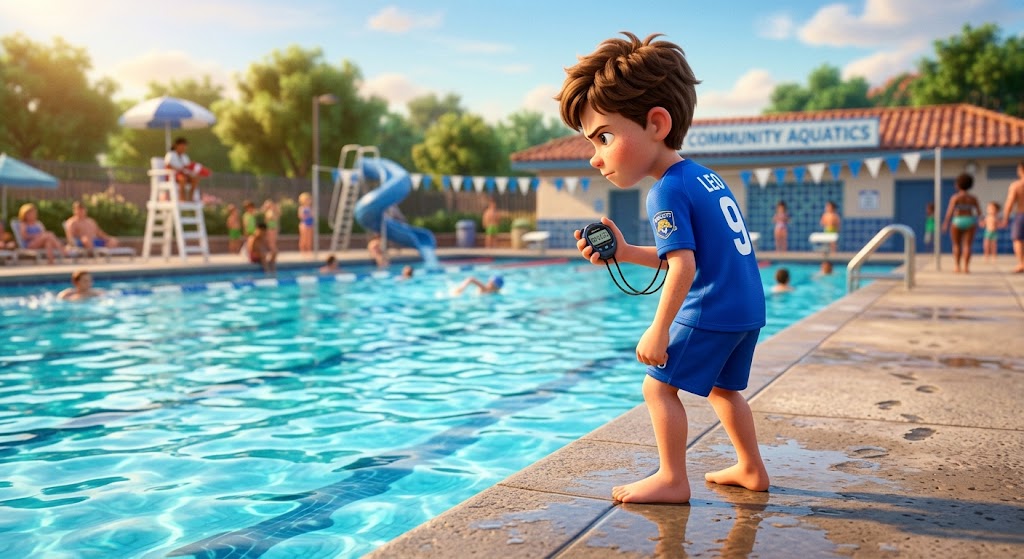
Jim, a passionate young soccer player, sat slumped at the kitchen table, his forehead resting on his textbook. Spread before him was his Year 4 math homework—a word problem about Olympic swimming race times. His eyes were red, and he had already erased a hole through his page. For Jim, these numbers weren’t just math; they were a source of overwhelming frustration that made him want to quit studying entirely.
His struggle is something many parents know all too well. The “tear-filled kitchen table” moment happens when kids are taught to attack word problems with standard vertical algorithms before they understand the story behind the numbers. When abstract decimal values for race times—like 25.45 seconds versus 25.50 seconds—are thrown into a complex word problem, the brain freezes. The student tries to jump straight to the math before understanding what the question is actually asking.
The Missing Map: The CUBES Method
The reason many children struggle with “Number and Algebra” word problems isn’t that they can’t do the math; it’s that they don’t have a strategy to decode the language. This is where the CUBES Method acts as a secret weapon. It turns a scary wall of text into a simple, step-by-step visual map:
- C – Circle the numbers.
- U – Underline the specific question.
- B – Box the key math words (like “faster,” “total,” or “difference”).
- E – Evaluate what operation to use.
- S – Solve and check.
From Panic to Podium
Let’s look at the problem that stumped Jim: “Jim is training for soccer by swimming. His first lap was 25.45 seconds and his second lap was 25.50 seconds. Which lap was faster?”
Using CUBES, Jim stopped guessing. He circled 25.45 and 25.50. He underlined “Which lap was faster?” He boxed the word “faster.” He realized that in swimming, a smaller number of seconds means a faster time.
By mapping the numbers on a simple number line, he saw clearly that 25.45 comes before 25.50. The fog lifted. Jim wasn’t just “doing math” anymore; he was analyzing data. He circled 25.45 as the winner. Confidence, not tears, was the final result.
Turn Homework Battles into Victories
You don’t have to navigate these homework battles alone. When math is presented as a dry, abstract chore, kids disengage. When it is woven into the things they love—like sports, gaming, or fantasy adventures—everything changes.
At EinstyAI, we transform curriculum-aligned math practice into custom-tailored stories that help children overcome math anxiety. Stop the tears and start the excitement by visiting EinstyAI today to create personalized math experiences for your child.
Practice Questions: The Soccer Swim Challenge
1. During preseason training, Jim swam his first lap in 32.15 seconds. His second lap was 32.08 seconds. Which lap time is the faster (smaller) time?
A. 32.15 seconds
B. 32.08 seconds
C. They are the same
D. 32.50 seconds
2. The soccer team relay swim was tight! Team Red finished in 1 minute and 45.2 seconds. Team Blue finished in 1 minute and 45.9 seconds. How much faster was Team Red than Team Blue?
A. 0.7 seconds
B. 0.3 seconds
C. 7 seconds
D. 0.07 seconds
3. Jim needs to improve his swim time to qualify for the Junior Soccer League challenge. His current best is 28.5 seconds. If he shaves off 0.15 seconds, what will his new time be?
A. 28.40 seconds
B. 28.35 seconds
C. 27.0 seconds
D. 28.65 seconds