Tag: Year 4

  • How the CUBES Method Helped Jim Master Decimals and Soccer Dreams

    How the CUBES Method Helped Jim Master Decimals and Soccer Dreams

    Jim, a passionate young soccer player, sat slumped at the kitchen table, his forehead resting on his textbook. Spread before him was his Year 4 math homework—a word problem about Olympic swimming race times. His eyes were red, and he had already erased a hole through his page. For Jim, these numbers weren’t just math; they were a source of overwhelming frustration that made him want to quit studying entirely.

    His struggle is something many parents know all too well. The “tear-filled kitchen table” moment happens when kids are taught to attack word problems with standard vertical algorithms before they understand the story behind the numbers. When abstract decimal values for race times—like 25.45 seconds versus 25.50 seconds—are thrown into a complex word problem, the brain freezes. The student tries to jump straight to the math before understanding what the question is actually asking.

    The Missing Map: The CUBES Method

    The reason many children struggle with “Number and Algebra” word problems isn’t that they can’t do the math; it’s that they don’t have a strategy to decode the language. This is where the CUBES Method acts as a secret weapon. It turns a scary wall of text into a simple, step-by-step visual map:

    • C – Circle the numbers.
    • U – Underline the specific question.
    • B – Box the key math words (like “faster,” “total,” or “difference”).
    • E – Evaluate what operation to use.
    • S – Solve and check.

    From Panic to Podium

    Let’s look at the problem that stumped Jim: “Jim is training for soccer by swimming. His first lap was 25.45 seconds and his second lap was 25.50 seconds. Which lap was faster?”

    Using CUBES, Jim stopped guessing. He circled 25.45 and 25.50. He underlined “Which lap was faster?” He boxed the word “faster.” He realized that in swimming, a smaller number of seconds means a faster time.

    By mapping the numbers on a simple number line, he saw clearly that 25.45 comes before 25.50. The fog lifted. Jim wasn’t just “doing math” anymore; he was analyzing data. He circled 25.45 as the winner. Confidence, not tears, was the final result.

    Turn Homework Battles into Victories

    You don’t have to navigate these homework battles alone. When math is presented as a dry, abstract chore, kids disengage. When it is woven into the things they love—like sports, gaming, or fantasy adventures—everything changes.

    At EinstyAI, we transform curriculum-aligned math practice into custom-tailored stories that help children overcome math anxiety. Stop the tears and start the excitement by visiting EinstyAI today to create personalized math experiences for your child.


    Practice Questions: The Soccer Swim Challenge

    1. During preseason training, Jim swam his first lap in 32.15 seconds. His second lap was 32.08 seconds. Which lap time is the faster (smaller) time?

    A. 32.15 seconds

    B. 32.08 seconds

    C. They are the same

    D. 32.50 seconds

    2. The soccer team relay swim was tight! Team Red finished in 1 minute and 45.2 seconds. Team Blue finished in 1 minute and 45.9 seconds. How much faster was Team Red than Team Blue?

    A. 0.7 seconds

    B. 0.3 seconds

    C. 7 seconds

    D. 0.07 seconds

    3. Jim needs to improve his swim time to qualify for the Junior Soccer League challenge. His current best is 28.5 seconds. If he shaves off 0.15 seconds, what will his new time be?

    A. 28.40 seconds

    B. 28.35 seconds

    C. 27.0 seconds

    D. 28.65 seconds
  • How the Scale-Check Strategy Helped Max Win the Race Against Math Anxiety

    How the Scale-Check Strategy Helped Max Win the Race Against Math Anxiety

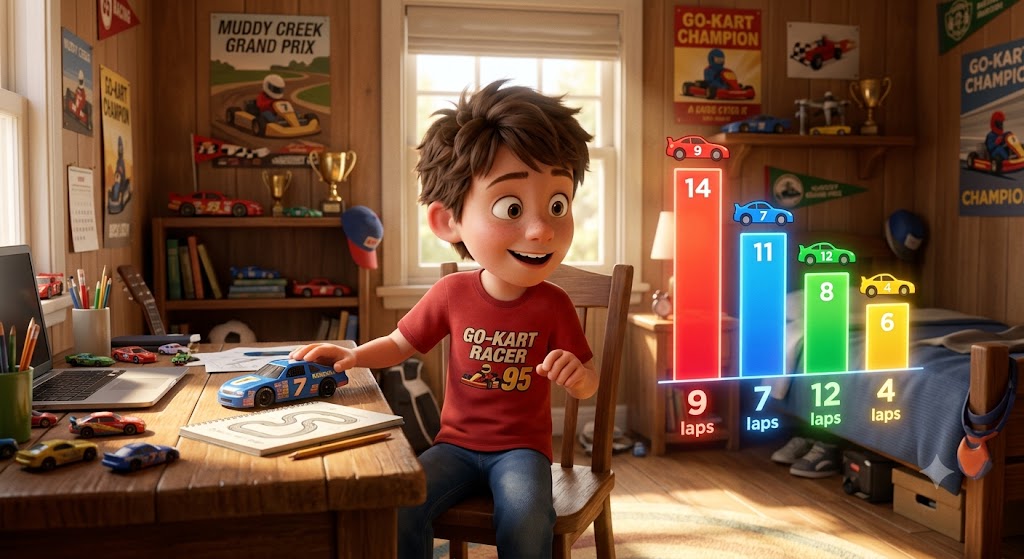
    The kitchen table was littered with crumpled paper, and seven-year-old Max was in tears. Before him sat a worksheet about race cars and probability, but he was stuck on a bar graph that didn’t look like the ones he knew. “It doesn’t make sense!” he sobbed. His mother felt that familiar, sinking feeling—the frustration of watching her bright child freeze up over a math problem that should be straightforward.

    The trouble wasn’t the math; it was the visual context. Traditional teaching often starts with simple one-to-one graphs, so when children like Max encounter graphs where one symbol represents five or ten cars, they panic. They instinctively count the symbols one by one, arriving at the wrong answer and feeling discouraged when the numbers don’t add up.

    The Scale-Check Strategy: Your Child’s New Visual Weapon

    To help Max, we introduced the Scale-Check Strategy. This simple, three-step technique transforms abstract data into a clear story. Instead of diving straight into the bars, we teach children to treat the graph like a treasure map:

    1. Find the Key: Look for the legend or scale indicator first.
    2. Label the Multiplier: Write the scale value next to each bar (e.g., if one car = 5, write the total).
    3. Read the Probability: Now that the numbers are real, identifying the “likely” or “unlikely” outcomes becomes easy.

    By using this visual map, Max stopped guessing and started calculating. When he looked at the racing graph, he wasn’t looking at “three cars”; he was looking at “fifteen wins.” The panic vanished, replaced by the confidence of a driver who knows exactly how fast his car can go.

    Turning Homework Battles into Victories

    Mathematics shouldn’t be a source of anxiety. When we align learning with engaging interests—like racing—and provide the right visual tools, students stop feeling like they are falling behind and start feeling like they are in the driver’s seat.

    If your child is struggling with math concepts, EinstyAI is here to help. We turn dry, textbook-style homework into custom-tailored story problems that match your child’s passions, helping them build the confidence to solve any equation. Visit EinstyAI today to turn your next homework battle into a celebration of learning.

    PRACTICE QUESTIONS:

    RACE TRACK PROBABILITY

    1. The Starting Line

    At the Grand Prix, 20 cars are ready to race. 15 are red, 3 are blue, and 2 are yellow. If Max picks a car at random, which outcome is most likely?

    A) Picking a blue car.

    B) Picking a red car.

    C) Picking a yellow car.

    D) Picking a green car.

    2. The Many-to-One Graph

    The “Fast Lap” graph shows race wins. The key says: 1 Car Symbol = 4 Wins. Max sees 3 car symbols in the “Turbo Team” row. How many wins did the Turbo Team have?

    A) 3 wins.

    B) 7 wins.

    C) 12 wins.

    D) 4 wins.

    3. The Impossible Turn

    Max is looking at a bag of racing tokens. The bag contains only blue and red tokens. How would you describe the likelihood of picking a green token?

    A) Certain.

    B) Likely.

    C) Unlikely.

    D) Impossible.

  • Stop the Tears: How to Help Your Child Master Angles at Home

    Stop the Tears: How to Help Your Child Master Angles at Home

    Why do so many students hit a wall when geometry homework arrives, convinced that math is simply not their thing? The truth is, math anxiety isn’t about ability; it’s about approach. When children see a page of numbers and shapes as a chore, they disengage. When they see a puzzle, they become detectives.

    At EinstyAI, we know that transforming dry practice into a story-based mission is the fastest way to overcome math anxiety. If your Year 4 student struggles with the Measurement and Space strand, the issue usually isn’t the concept—it’s the visualization.

    The “Math Kid” Myth

    Let’s be clear: there is no such thing as a “math kid.” Mathematical literacy is a skill, not a genetic trait. If your child struggles with angles, it’s because the abstract definitions haven’t been anchored to anything real.

    Stop focusing on rote memorization. Instead, focus on visual identification. We categorize angles based on their relationship to a perfect corner, and that is a skill any child can master with the right framework.

    The Angle Detective Strategy

    To master the classification of angles—acute, right, obtuse, straight, and reflex—give your child a “Detective’s Tool” to use every time they see a shape.

    The 5-Second Angle Test:

    • The Right Angle (90 degrees): This is the gold standard. Look for the “L” shape. If it looks like the corner of a square, it’s a Right Angle.
    • The Acute Angle (Less than 90): Think of an “a-cute” little angle. It’s smaller, sharper, and squeezed tight.
    • The Obtuse Angle (Greater than 90, less than 180): This one looks wide or lazy. It’s larger than a square corner but hasn’t gone flat yet.
    • The Straight Angle (Exactly 180 degrees): This is a perfectly flat line. The “Detective” knows a straight angle is just two right angles lying down.
    • The Reflex Angle (Greater than 180 degrees): The “outer” angle. This is the giant opening that wraps around the back of the shape.

    Teach your child to use their hand as a protractor. Open their thumb and index finger to match the angle on the page. If it’s smaller than a square corner, it’s acute. If it’s wider, it’s obtuse.

    Transform Practice into Play

    Math should not be a battle of wills. By gamifying the curriculum, you remove the pressure and replace it with curiosity.

    If your child is stuck, don’t force another worksheet. Instead, grab a flashlight and play “Angle Detective” around the house. Finding a right angle on a table or an obtuse angle on a laptop hinge provides the concrete experience needed to solve abstract problems.

    Ready to make math the highlight of their day? Explore our custom-tailored, curriculum-aligned stories at EinstyAI and turn their homework into a mystery worth solving.

    Practice Questions

    Welcome, Detective. A mysterious thief has left geometric clues scattered across the city. Your job is to classify these “angle clues” to identify the thief’s escape route.

    Question 1

    The thief left a mark on a brick wall that looks like a sharp “V” shape, smaller than the corner of a square. Detective, how do we classify this angle?

    A) Obtuse

    B) Acute

    C) Reflex

    D) Straight

    Question 2

    You find a laser beam grid blocking the hallway. You notice the beams meet perfectly to form a square corner. What type of angle is this?

    A) Right

    B) Acute

    C) Straight

    D) Obtuse

    Question 3

    The thief’s footprint is wide and lazy, measuring more than a square corner but less than a straight line. Which angle is this?

    A) Reflex

    B) Acute

    C) Obtuse

    D) Right

  • How do I explain area and perimeter to my Year 4 child without the tears?

    How do I explain area and perimeter to my Year 4 child without the tears?

    Is your kitchen table the nightly battleground for math homework? You are not alone. Many parents search for ways to simplify geometry, often assuming that math homework is naturally a battle. Here is the truth: Math doesn’t have to be a struggle. When you shift the mindset from “solving problems” to “solving stories,” the anxiety disappears.

    Perimeter vs. Area: The Simple Distinction

    Children often confuse perimeter and area because both involve shapes. To keep them clear, use the Fence and Grass analogy:

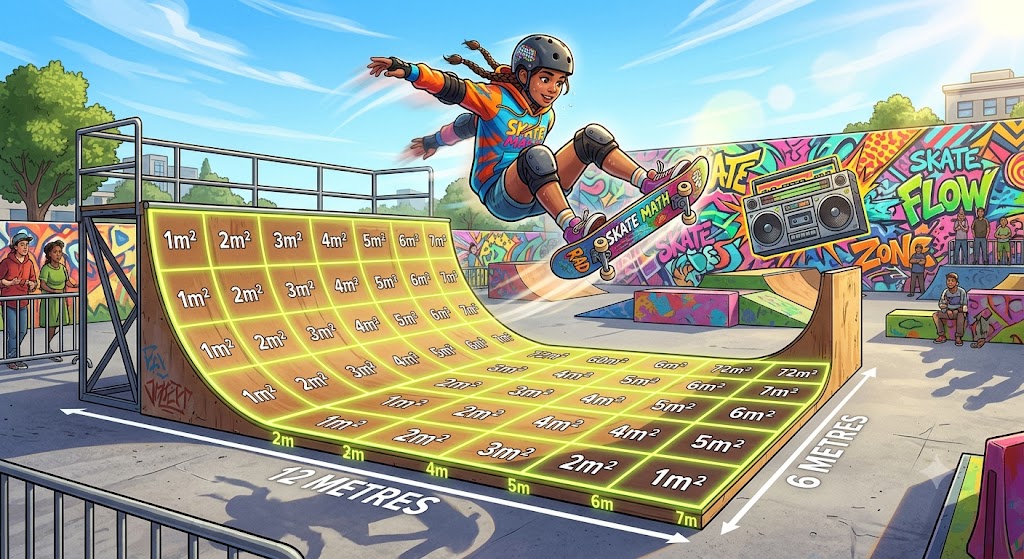
    • Perimeter is the fence. It is the distance around the edge. If your child were a skater, the perimeter is the metal rail they ride along.
    • Area is the grass. It is the space inside the shape. If your child is skating, the area is the concrete slab they roll across.

    The “Border and Fill” Trick

    To help students master these concepts, teach them to physically trace the shape before calculating.

    1. Trace the Border: Use a finger to outline the object. This is for Perimeter (measured in centimetres or metres).
    2. Fill the Space: Use a shading motion to cover the surface. This is for Area (measured in square centimetres or square metres).

    When students encounter a question, ask them: “Are we counting the fence, or are we tiling the floor?” This simple check prevents the most common mistake: adding the length and width instead of calculating the space inside.

    Bring Math to Life

    The key to deep learning is context. If your child loves skateboarding, don’t force them to measure abstract rectangles in a workbook. Instead, have them design a dream skate park. Ask them to calculate the perimeter of a new ramp for safety fencing, or the area of concrete needed for a flat-bank section. By connecting abstract concepts like square centimetres to real-world objects, you move them from rote memorization to true understanding.

    If you are looking for ready-to-use math stories that turn these concepts into engaging adventures, check out EinstyAI. We help students conquer math anxiety by transforming dry curriculum requirements into compelling stories. Stop fighting over homework and start exploring.

    Practice Questions: The Skate Park Challenge

    1. The Grind Rail

    A new rectangular grind rail is 4 metres long and 1 metre wide. If we need to put rubber edging all the way around the rail, what is the total length of edging required?

    A) 4 square metres

    B) 5 metres

    C) 8 metres

    D) 10 metres

    2. The Concrete Pad

    You are designing a small concrete practice slab that is 3 metres long and 3 metres wide. How much surface area will this slab cover?

    A) 6 square metres

    B) 9 square metres

    C) 12 square metres

    D) 18 square metres

    3. The Half-Pipe Floor

    A skater needs to cover a section of the half-pipe floor with non-slip grip tape. The section is 5 centimetres wide and 4 centimetres long. What is the area of the grip tape needed?

    A) 9 square centimetres

    B) 18 square centimetres

    C) 20 square centimetres

    D) 25 square centimetres

  • How can I help my Year 4 child master mental multiplication without tears?

    How can I help my Year 4 child master mental multiplication without tears?

    Does your child freeze up when faced with multiplication facts like 7×6? You are not alone. Many parents search for ways to help their children overcome math anxiety, assuming that multiplication is just about rote memorization and endless flashcards.

    The truth is, math does not have to be a battle.

    Most children struggle with multiplication because they view it as a massive, intimidating wall of numbers. They try to memorize “7×6 = 42” without understanding the mechanics behind it. This creates a reliance on memorization that crumbles the moment they encounter a slightly larger or unfamiliar equation.

    The mental shift: Multiplication is flexible.

    At EinstyAI, we teach students to stop seeing numbers as static and start seeing them as building blocks. The secret weapon for Year 4 students is the Distributive Property.

    Think of the distributive property as the “divide and conquer” strategy of the math world. Instead of trying to solve 7×6 in one go, you break it into two smaller, easier chunks that you already know.

    How to teach the “Baking Hack”

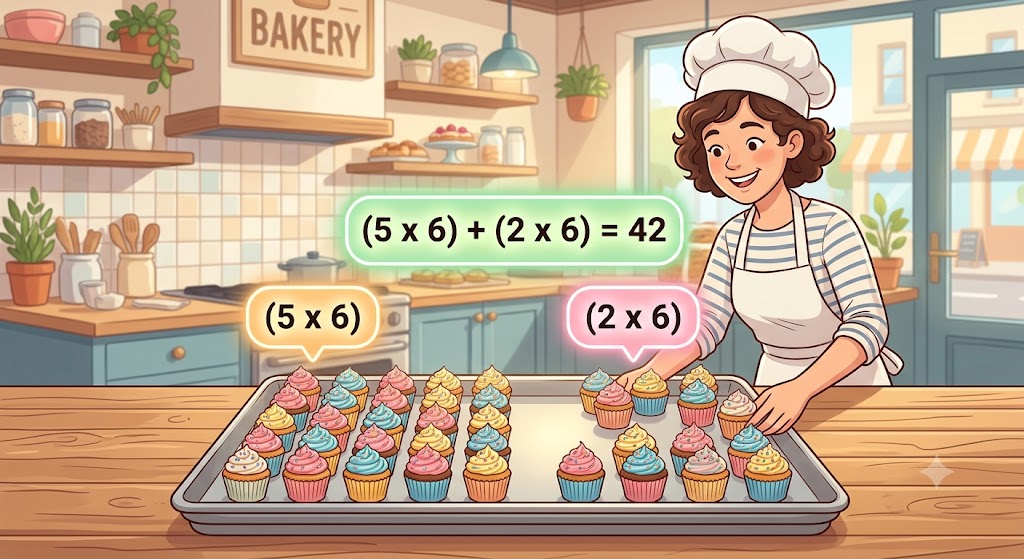
    Imagine you are baking cookies. If you need to arrange 7 rows of 6 cookies, don’t try to solve “7×6” immediately.

    1. Split the big number: Take that 7 and split it into 5 and 2.
    2. Solve the easy parts: Now you have 5 rows of 6 (which is 30) and 2 rows of 6 (which is 12).
    3. Bring them together: Add 30 and 12. You get 42.

    Why this works

    By using the distributive property, your child moves from “I don’t know this” to “I can build this.” This reduces math anxiety immediately because the child gains control over the problem. They aren’t guessing; they are calculating using known facts.

    Start your journey today

    Stop relying on rote memorization that fades under pressure. Give your child the tools to visualize numbers, solve problems creatively, and build lasting confidence.

    Download the practice worksheet below to help your child master multiplication through the art of baking. When math feels like a story, the numbers stop being scary.

    Practice Questions

    Baking Adventure: Mental Math Challenge

    Instructions: Help the bakery staff organize their orders by using the distributive property. Select the correct method or answer for each challenge.

    Question 1

    The bakery needs to arrange 8 trays of muffins, with 6 muffins on each tray. Which expression correctly uses the distributive property to help calculate the total?

    A) 8 x 6 = 8 + 6

    B) (4 x 6) + (4 x 6)

    C) (8 x 5) + 1

    D) 8 x 3 x 2

    Question 2

    You are decorating a large cake with 9 rows of 7 cherries. To calculate the total, you split 9 into 5 and 4. What is the calculation you perform?

    A) (5 x 7) + (4 x 7)

    B) (5 + 7) + (4 + 7)

    C) (5 x 9) + (4 x 9)

    D) (5 x 4) + (7 x 9)

    Question 3

    The shop has 6 boxes of donuts, and each box contains 8 donuts. How can you use your knowledge of the 5 times table to solve this?

    A) (5 x 8) + (1 x 8)

    B) (6 x 5) + (6 x 3)

    C) (5 x 6) + (8 x 6)

    D) 5 x 8 + 6

  • How to Help Your Year 4 Child Master Decimals and Multiplication Without the Tears?

    How to Help Your Year 4 Child Master Decimals and Multiplication Without the Tears?

    Why does Year 4 feel like the moment math becomes “too hard” for so many students? It is a common frustration. Parents often assume their child simply lacks a “math brain,” but the reality is that the curriculum shifts dramatically during this year. Students move from basic arithmetic into the abstract world of decimals to hundredths and complex multiplication facts up to 10×10.

    Math is not a fixed talent; it is a learned language. When children struggle, it is usually because they are trying to memorize disconnected rules rather than understanding the story behind the numbers.

    The “Mental Math” Mindset Shift

    The biggest mistake parents make is focusing on rote memorization. Memorizing tables is useful, but understanding the “why” is transformative.

    For multiplication facts up to 10×10, teach your child to use the distributive property. If they are stuck on 7×6, encourage them to break it down into 7×5 plus 7×1. This simple trick reduces cognitive load and stops the “blank stare” that happens during timed tests.

    Visualizing Decimals to Hundredths

    Decimals often baffle students because they are taught as abstract symbols. Bring them into the real world. Use money (dollars and cents) or length (meters and centimeters) to make the concept of “hundredths” concrete.

    When a child sees 0.45 as 45 cents out of a dollar, they stop seeing decimals as confusing dots and start seeing them as parts of a whole.

    Stop the Homework Battle

    If math homework has become a battleground, stop. Math anxiety stems from high-pressure environments where errors are punished rather than explored.

    Instead of hovering, ask your child to explain the logic they used. If they get the wrong answer, ask, “How did you arrive at that?” instead of “No, that’s wrong.” This shift builds confidence and critical thinking.

    At EinstyAI, we specialize in transforming these dry, academic requirements into engaging, custom-tailored stories that align with the curriculum. You don’t need to be a math expert to support your child; you just need the right tools to turn practice into play.

    Take the first step today: Stop battling, start story-telling.

    Practice Questions

    Math Worksheet: The Deep Space Explorer’s Mission

    Theme: You are a Deep Space Data Analyst. Use your math skills to repair the navigation systems of the Starship Numerator.

    Question 1

    The ship’s scanner detected an asteroid at 0.52 kilometers away. The shield sensors are only active for objects closer than 0.5 kilometers. Is the asteroid inside the danger zone?

    A) Yes, because 0.52 is smaller than 0.5.

    B) No, because 0.52 is greater than 0.5.

    C) Yes, because 52 is a larger number than 5.

    D) No, because 0.5 is equal to 0.50.

    Question 2

    To boost the warp drive, you need to calculate 7×8. You have a “Distributive Shortcut” chip installed. Which of these is the correct way to solve this using your shortcut?

    A) Solve 7×4 and multiply the result by 2.

    B) Solve 7×5 and add 7×3.

    C) Solve 7×10 and subtract 7.

    D) Solve 7×6 and add 7×1.

    Question 3

    The alien fuel pod is currently filled to 0.08 of its total capacity. What is another way to represent this amount?

    A) 8 tenths.

    B) 8 hundredths.

    C) 80 hundredths.

    D) 0.8.