Author: Fritz Loho

  • How the ‘Skip-Counting Cluster’ Method Helped Maya Save the Space-Farm

    How the ‘Skip-Counting Cluster’ Method Helped Maya Save the Space-Farm

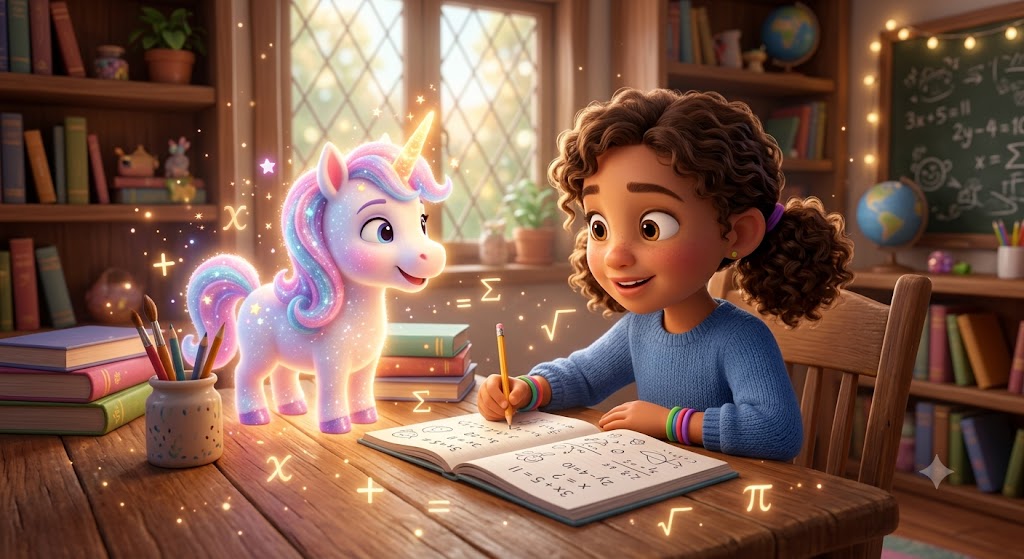
    Maya sat at the kitchen table, her pencil hovering over a worksheet about “counting groups.” Tears welled in her eyes. The page was filled with tiny pictures of alien creatures, and the instructions were a jumble of words. “I can’t do it, Mum,” she sobbed. “There are too many to count one by one, and I keep losing my place.” Maya’s experience is common for Year 1 students facing the leap from counting individual objects to conceptualizing groups.

    The Common Mistake: Why Counting One-by-One Fails

    When children encounter larger collections—like our alien wildlife counting exercise—forcing them to count “1, 2, 3…” creates a cognitive bottleneck. As the numbers grow, the child’s working memory becomes overloaded, leading to skipped numbers, frustration, and a dislike for math. This “counting fatigue” is exactly why students panic when they see a big group of items.

    The Guide & Magic Tool: The Skip-Counting Cluster Method

    To help Maya, we introduced the “Skip-Counting Cluster” method. Instead of seeing a chaotic swarm of creatures, we taught her to draw a circle around groups of 2 or 5. By isolating these clusters, the math changes from a long, painful sequence into a fast, rhythmic skip-count: “2, 4, 6, 8…” or “5, 10, 15…” This visual strategy transforms an intimidating task into a manageable game of sorting.

    The Transformation: From Panic to Power

    Maya looked at the “Alien Farm” problem: “There are 10 alien space-goats hiding in the asteroid barn. Count them in groups of 2.” Maya stopped counting one-by-one. She drew circles around each pair. She counted: “2, 4, 6, 8, 10!” Suddenly, the tears were gone. She wasn’t just counting anymore; she was organizing data. She felt like a space commander mastering her fleet, and her confidence soared.

    Turn Homework into a Victory

    At EinstyAI, we don’t just assign problems; we build stories that make math feel like an adventure. If your child is struggling with foundational math concepts, let us help you turn those daily homework battles into moments of triumph. Visit us today to generate custom-tailored math stories that fit your child’s interests and curriculum needs.


    PRACTICE QUESTIONS

    Problem 1

    Maya is visiting the Martian Barn where 12 space-frogs are jumping. If she circles them in groups of 2, how many groups will she have?

    A) 4 groups

    B) 6 groups

    C) 5 groups

    D) 12 groups

    Problem 2

    There are 15 tiny space-crickets chirping in the asteroid field. Maya circles them in groups of 5. How many groups of 5 are there?

    A) 2 groups

    B) 4 groups

    C) 3 groups

    D) 5 groups

    Problem 3

    Maya finds 20 glowing space-worms. She decides to circle them in groups of 2. How many groups does she make?

    A) 8 groups

    B) 9 groups

    C) 10 groups

    D) 5 groups

  • How the ‘Expansion Box’ Helped Sam Transform Math Panic into Puppy-Loving Confidence

    How the ‘Expansion Box’ Helped Sam Transform Math Panic into Puppy-Loving Confidence

    Sam sat at the kitchen table, tears welling up as a blank sheet of paper mocked him. He was supposed to expand and factorise linear expressions—part of his Year 8 curriculum in Algebra and Relationships—but all he saw were abstract letters and numbers that didn’t make sense. Beside him, a photo of his favourite shelter animals served as a reminder of the pet adoption drive he wanted to organize, but the math needed to plan the supply bags felt impossible. His parents felt that familiar sting of helplessness; they knew how to do the math, but explaining it without causing an argument was a different story.

    The issue isn’t the child; it’s the method. Forcing Year 8 students to jump straight into abstract symbol manipulation—like multiplying 2(x+3)—without a visual map is a recipe for anxiety. When kids try to memorise “rules” instead of understanding the geometry of numbers, they freeze the moment they encounter a sign change or a complex variable.

    Enter the Expansion Box (or Area Model), our secret weapon for conquering algebra. Instead of looking at expressions as scary strings of letters, we treat them as shapes. If Sam needs to organise supply bags for his Cute Puppies & Kittens charity event, he can view his algebra problem as physical boxes of treats.

    Here is the transformation: When Sam sees 2(x + 4), he draws a rectangle. The side of the rectangle is 2, and the length is split into x and 4. He fills the two smaller boxes: 2 times x is 2x, and 2 times 4 is 8. Adding them together gives 2x + 8. Suddenly, the abstract equation isn’t a riddle; it’s a picture of reality. Sam shifted from panic to pride, successfully mapping his supply needs on the Cartesian plane to visualize his event data.

    Stop the homework tears and reclaim your evenings. At EinstyAI, we transform dry math problems into engaging, custom-tailored stories that make sense to your child. Let’s turn math anxiety into mastery.

    Practice Questions

    1. Sam is organizing treat bags for a kitten adoption drive. Each of the 5 bags contains x treats and 2 toy mice. Which expression represents the total number of items if we factorise the distribution?
      A) 5x + 2
      B) 5(x + 2)
      C) 5x + 10
      D) 5 + 2x
    2. Sam needs to expand the expression 3(2x – 4) to calculate the total puppy food cups required. What is the correct expansion?
      A) 5x – 1
      B) 6x – 4
      C) 6x – 12
      D) 3x – 12
    3. On his Cartesian map, Sam plots the number of puppies (x) against the number of food bowls (y). If the relationship is y = 2x + 3, how many bowls are needed for 4 puppies?
      A) 7
      B) 9
      C) 11
      D) 10

  • How the Inverse Operation Method Helped Sam Banish the Unicorn Algebra Monster

    How the Inverse Operation Method Helped Sam Banish the Unicorn Algebra Monster

    Sam sat at the kitchen table, pencil hovering over a worksheet about “Pronumerals.” Between the tears and the crumpled paper, a unicorn-themed textbook lay open, but the numbers might as well have been in a foreign language. Sam wasn’t just struggling with Algebra; the frustration was palpable. The equation 3x + 4 = 19 looked like a riddle with no answer, and every attempt felt like a guess in the dark.

    The Guessing Game Trap

    Many students in Year 7 get stuck because they try to “guess” the value of the letter (the pronumeral). They look at an expression and try to mentally force a number into the ‘x’ slot. When that doesn’t work, they panic. This approach fails because algebra isn’t about guessing; it is about logic. When parents try to explain it using abstract rules, children often freeze. The math feels like a chore, disconnected from the logic they actually possess.

    The Guide: The “Inverse Operation” Method

    To master two-step linear equations, we stop guessing and start “un-doing.” Think of an equation like a balanced scale or a locked treasure chest. To find the secret number, we must apply the Inverse Operation Method. If the equation added a number, we subtract it. If it multiplied, we divide. By reversing the operations in the correct order, we peel away the layers until the ‘x’ stands alone.

    The Transformation: Solving for the Unicorn’s Treasure

    Let’s look at Sam’s homework problem: 3x + 4 = 19.

    1. Step 1 (The Subtraction): We see “+ 4”. To undo this, we subtract 4 from both sides. Now, 3x = 15.
    2. Step 2 (The Division): We see “3x” (which means 3 times x). To undo this, we divide by 3. Now, x = 5.

    Suddenly, Sam wasn’t staring at a scary “x”; Sam was cracking a code. The anxiety evaporated, replaced by the satisfaction of solving the puzzle.

    End the Homework Battle

    Don’t let your child feel like math is an unsolvable mystery. At EinstyAI, we transform dry curriculum outcomes into personalized stories that stick. By aligning abstract concepts like algebra with the topics your child loves—whether it’s unicorns, sports, or space—we turn the “homework battle” into a moment of discovery. Stop fighting the curriculum and start using stories that make math feel like play. Visit EinstyAI to find custom-tailored resources designed to help your child succeed.

    Algebra Practice: The Unicorn Enchantment

    1. The Magic Forest Trail

    A magical forest path requires 3 enchanted crystals plus an extra 5 magic pebbles to open. If the total cost to open the path is 20 items, how many crystals (c) do you need? (Equation: 3c + 5 = 20)

    A) 4

    B) 5

    C) 8

    D) 15

    2. Feeding the Unicorns

    You have 2 bags of star-dust plus 7 extra pouches of moon-beams to feed your unicorns. If the total number of items is 15, how many items are in each bag of star-dust (s)? (Equation: 2s + 7 = 15)

    A) 11

    B) 4

    C) 8

    D) 3

    3. The Wizard’s Potion

    To make a flight potion, you need 4 drops of liquid gold plus a 2-drop starter base. The total drops needed is 18. How many drops are in each liquid gold portion (g)? (Equation: 4g + 2 = 18)

    A) 4

    B) 5

    C) 6

    D) 4.5

  • How the Scale-Check Strategy Helped Max Win the Race Against Math Anxiety

    How the Scale-Check Strategy Helped Max Win the Race Against Math Anxiety

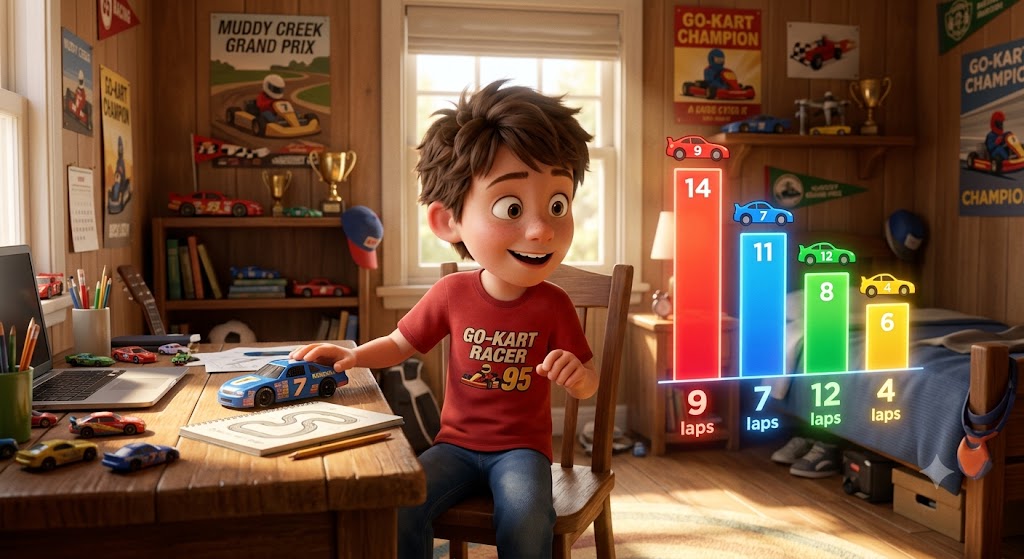
    The kitchen table was littered with crumpled paper, and seven-year-old Max was in tears. Before him sat a worksheet about race cars and probability, but he was stuck on a bar graph that didn’t look like the ones he knew. “It doesn’t make sense!” he sobbed. His mother felt that familiar, sinking feeling—the frustration of watching her bright child freeze up over a math problem that should be straightforward.

    The trouble wasn’t the math; it was the visual context. Traditional teaching often starts with simple one-to-one graphs, so when children like Max encounter graphs where one symbol represents five or ten cars, they panic. They instinctively count the symbols one by one, arriving at the wrong answer and feeling discouraged when the numbers don’t add up.

    The Scale-Check Strategy: Your Child’s New Visual Weapon

    To help Max, we introduced the Scale-Check Strategy. This simple, three-step technique transforms abstract data into a clear story. Instead of diving straight into the bars, we teach children to treat the graph like a treasure map:

    1. Find the Key: Look for the legend or scale indicator first.
    2. Label the Multiplier: Write the scale value next to each bar (e.g., if one car = 5, write the total).
    3. Read the Probability: Now that the numbers are real, identifying the “likely” or “unlikely” outcomes becomes easy.

    By using this visual map, Max stopped guessing and started calculating. When he looked at the racing graph, he wasn’t looking at “three cars”; he was looking at “fifteen wins.” The panic vanished, replaced by the confidence of a driver who knows exactly how fast his car can go.

    Turning Homework Battles into Victories

    Mathematics shouldn’t be a source of anxiety. When we align learning with engaging interests—like racing—and provide the right visual tools, students stop feeling like they are falling behind and start feeling like they are in the driver’s seat.

    If your child is struggling with math concepts, EinstyAI is here to help. We turn dry, textbook-style homework into custom-tailored story problems that match your child’s passions, helping them build the confidence to solve any equation. Visit EinstyAI today to turn your next homework battle into a celebration of learning.

    PRACTICE QUESTIONS:

    RACE TRACK PROBABILITY

    1. The Starting Line

    At the Grand Prix, 20 cars are ready to race. 15 are red, 3 are blue, and 2 are yellow. If Max picks a car at random, which outcome is most likely?

    A) Picking a blue car.

    B) Picking a red car.

    C) Picking a yellow car.

    D) Picking a green car.

    2. The Many-to-One Graph

    The “Fast Lap” graph shows race wins. The key says: 1 Car Symbol = 4 Wins. Max sees 3 car symbols in the “Turbo Team” row. How many wins did the Turbo Team have?

    A) 3 wins.

    B) 7 wins.

    C) 12 wins.

    D) 4 wins.

    3. The Impossible Turn

    Max is looking at a bag of racing tokens. The bag contains only blue and red tokens. How would you describe the likelihood of picking a green token?

    A) Certain.

    B) Likely.

    C) Unlikely.

    D) Impossible.

  • How the Jump Strategy Helped Leo Slay the Year 3 Math Monster

    How the Jump Strategy Helped Leo Slay the Year 3 Math Monster

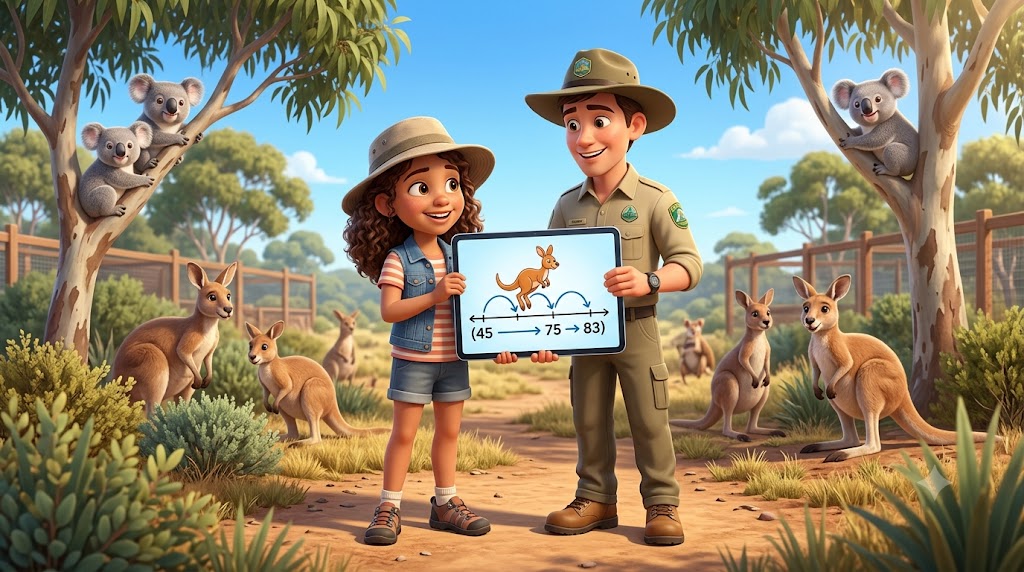
    Eight-year-old Leo sat at the kitchen table, pencil gripped tightly in his hand, staring at his Year 3 homework sheet. He could easily tell you what $45 + 38$ was if you asked him out loud. But when those exact same numbers were hidden inside a story about rescuing kangaroos in the Australian bush, he completely froze.

    The kitchen table had transformed into a battleground of tears, heavy sighs, and deeply erased paper.

    Like most caring parents, his mother tried the usual playbook: force him to line up the digits vertically, write small little ones above the columns, and carry the numbers over. But to a frustrated eight-year-old, abstract vertical columns feel like arbitrary rules forced upon them by a cold system.

    Enter the Guide: The Secret Weapon

    Children do not fail at math word problems because they cannot compute; they fail because they cannot visualize the journey inside the story.

    Instead of forcing rigid vertical columns, his mother introduced a simple visual weapon used by top educators: The Jump Strategy on an empty number line.

    Instead of stacking numbers into tall towers, the Jump Strategy turns every math problem into a horizontal trail map across the page.

    The Transformation: From Frozen to Fearless

    That evening, Leo tackled a new story problem: “Ranger Sam has 45 kangaroos at the sanctuary and rescues 38 more. How many kangaroos are there now?”

    Instead of panicking, Leo drew a simple horizontal line across his page and followed three clear steps:

    1. Land on the Starting Point: He wrote 45 on the far left of his trail.
    2. Make the Big Jumps: He broke 38 into 3 tens ($30$) and 8 ones. He drew 3 big arc jumps forward by ten: $45 \rightarrow 55 \rightarrow 65 \rightarrow 75$.
    3. Finish with the Small Hops: He drew 8 small hops forward to land softly on 83.

    No column carrying. No erased paper. No tears. Within ten seconds, Leo looked up with a huge grin and announced, “There are 83 kangaroos, Mum!”

    Write Your Child’s Success Story

    When you give your child a visual map to navigate numbers, the “math monster” disappears, replaced by genuine curiosity and confidence.

    At EinstyAI, we believe every child deserves to be the hero of their own learning journey. We transform dry curriculum standards into custom-tailored, interactive adventures featuring your child’s favorite passions—whether that’s wildlife rescue, gaming, or space exploration.

    Head to EinstyAI today and create personalized story problems that turn homework battles into victories!

    PRACTICE QUESTIONS

    Year 3 Math Adventure: The Wildlife Rescue Center!

    Instructions for Parents: Read these wildlife rescue stories with your child. Have them draw an empty number line on paper and use the Jump Strategy (jumping tens first, then hopping ones) to choose the correct answer.

    Problem 1: Kangaroo Count

    The Story: Ranger Sam cares for 45 eastern grey kangaroos at his sanctuary. A neighboring wildlife park transfers 38 more rescued kangaroos to his care.

    • Question: How many kangaroos are at Ranger Sam’s sanctuary in total?
      • A) 73
      • B) 83
      • C) 78
      • D) 88

    Problem 2: Hungry Koalas

    The Story: Matilda the koala keeper collected 124 fresh eucalyptus branches in the morning. By sunset, the hungry koalas ate 46 of the branches.

    • Question: How many eucalyptus branches are left for tomorrow morning?
      • A) 82
      • B) 168
      • C) 78
      • D) 88

    Problem 3: Sea Turtle Nesting

    The Story: Beach volunteers counted 156 sea turtle eggs in Nest A along the Queensland coast. Nest B had 67 fewer eggs than Nest A.

    • Question: How many sea turtle eggs were in Nest B?
      • A) 89
      • B) 99
      • C) 91
      • D) 223

  • Why Does Your Child Treat Negative Coordinates Like an Impossible Maze?

    Why Does Your Child Treat Negative Coordinates Like an Impossible Maze?

    Why does your Year 6 student freeze up the moment they see a coordinate plane with negative numbers? If math homework feels like a battleground, you are not alone. Parents often worry that their child lacks a “math brain” or that Year 6 math is simply too advanced.

    The truth is rarely about lack of ability. It is about a lack of visualization. When children only experience the first quadrant—where everything is positive and simple—the sudden introduction of the other three quadrants feels like learning a new language. They don’t need more drills; they need a better map.

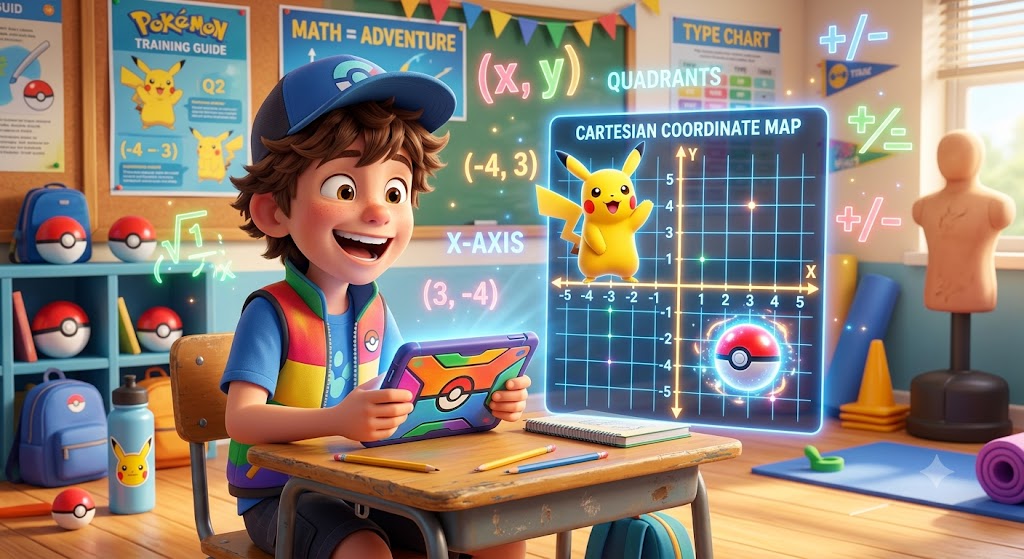
    The Cartesian Plane: It’s Just a Battle Map

    In Year 6, students must master the Cartesian plane across all four quadrants. If they struggle, it is usually because they are trying to memorize rules rather than understanding the space.

    Stop treating the grid as an abstract chart. Instead, teach your child to see the coordinate plane as a game map. The axes are just the North, South, East, and West boundaries of their playing field.

    When your child plots a point in the third quadrant, they aren’t “doing integers”; they are moving their character to a specific location on the map. By grounding these coordinates in a narrative context, the math becomes intuitive.

    Strategies for Four-Quadrant Mastery

    The “drill and kill” method fails because it bores the student and ignores their natural pattern-spotting abilities. Here is how to shift their mindset today:

    • Master the Quadrant Logic: Ensure they understand that the axes are simply lines. The x-axis is horizontal (left/right) and the y-axis is vertical (up/down). The signs determine the direction: positive is right or up, and negative is left or down.
    • Use Visual Anchors: If your child is stuck, draw the “plus sign” grid. Label the four sections clearly. Encourage them to physically trace the path from the origin (0,0) to the target coordinate with their finger.
    • Gamify the Practice: At EinstyAI, we create stories where coordinates represent locations of rare items or creatures. When math is the key to winning a game, anxiety disappears.

    Math isn’t a wall to hit; it’s a tool to build their own world. Don’t wait for the next homework frustration to start. Help your child visualize the math, and watch their confidence skyrocket.

    Practice Questions

    The Pokétraining Coordinate Challenge

    Question 1: The Starting Point

    A rare Pikachu is spotted at coordinate (-3, 2). Which quadrant is this Pokémon hiding in?

    A) Quadrant 1

    B) Quadrant 2

    C) Quadrant 3

    D) Quadrant 4

    Question 2: The Evolution Jump

    Your Charizard is located at (2, -1). You move it 3 units to the left and 4 units up to reach the gym. What are the new coordinates of your Charizard?

    A) (-1, 3)

    B) (5, 3)

    C) (-1, -5)

    D) (5, -5)

    Question 3: Finding the Berry

    A Sitrus Berry is buried at (-4, -4). To get there from the center (origin 0,0), how many units left and how many units down must you travel?

    A) 4 units left, 4 units up

    B) 4 units right, 4 units down

    C) 4 units left, 4 units down

    D) 4 units right, 4 units up

  • Unlock the Secrets of Geometry: Mastering the Protractor at Home

    Unlock the Secrets of Geometry: Mastering the Protractor at Home

    Does your child view geometry homework as a battlefield where tears are shed over plastic tools? If your Year 5 student struggles with math, you are not alone. Many parents assume their child simply “isn’t a math kid,” but this mindset is the real barrier to learning. Math anxiety often stems from abstract concepts lacking context, not a lack of innate ability. When we turn math into a story, the fear dissolves, replaced by curiosity.

    The Problem with Traditional Geometry

    Standard math sheets often present circles and lines as disconnected, boring shapes. Students stare at a page of disconnected angles and feel nothing. But geometry is the language of architecture, design, and art. In the Year 5 curriculum, students must learn to use protractors to measure angles in degrees. This requires precision and logic. If a student tries to guess, they fail. When they learn the strategy, they succeed.

    The “Protracting” Strategy for Success

    Mastering the protractor isn’t about memory; it is about a consistent three-step process. Teach your child these steps to remove the guesswork:

    • Align the Baseline: Place the protractor’s baseline exactly on one ray of the angle.
    • Center the Vertex: Ensure the small hole or crosshair at the bottom of the protractor sits perfectly on the angle’s vertex.
    • Check the Scale: Look at the scale starting at zero. If the angle opens to the left, use the outer scale. If it opens to the right, use the inner scale. Most students fail here by choosing the wrong scale and recording a 120-degree angle when they should have written 60 degrees.

    Transforming Math into a Fairytale

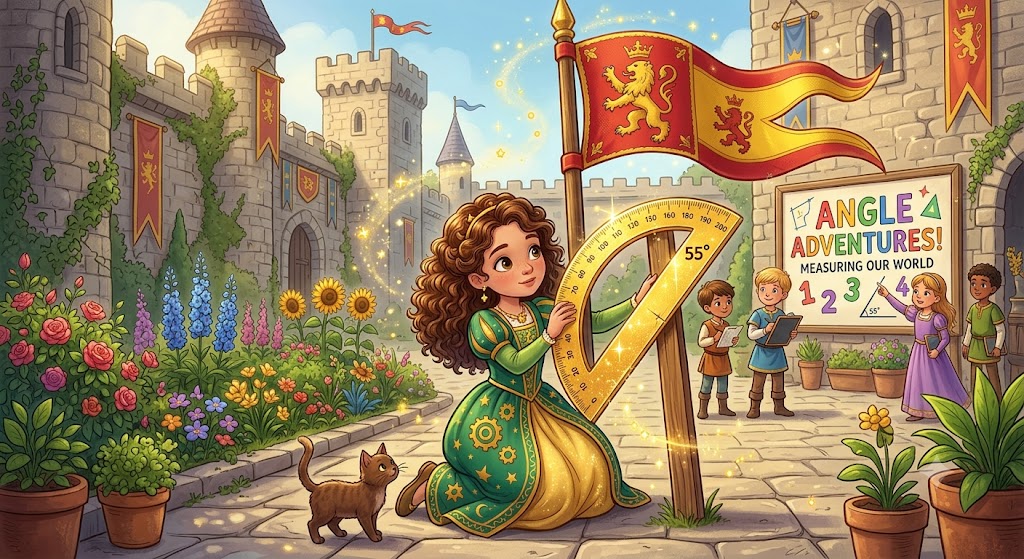
    At EinstyAI, we know that engagement drives mastery. Instead of forcing your child to measure generic floating angles, connect the skill to their world. Imagine a princess protecting her castle. The angle of the castle gate determines if the drawbridge can open. The angle of the tower roof ensures it can withstand heavy rainfall. By shifting the context from a worksheet to a quest, you bypass the “this is boring” wall and activate the brain’s engagement centers.

    Take Action Today

    Stop the nightly homework battles. Shift from being a “tutor” to being a “narrator” of their mathematical journey. Use the practice questions below to transform your next study session into a royal mission. Your child is capable of mastering these concepts—they just need the right map.

    Practice Questions

    The Royal Castle Geometry Challenge

    Question 1: The Drawbridge Angle

    Princess Clara is adjusting the heavy chain on the castle drawbridge. The bridge forms an angle of 45 degrees with the stone wall when lowered halfway. If she moves the chain to make the angle wider, which of these is a possible measurement for the new angle?

    A) 30 degrees

    B) 60 degrees

    C) 180 degrees

    D) 10 degrees

    Question 2: The Tower Roof Slope

    The royal architect is designing a new tower roof. To ensure the snow slides off perfectly, the roof must be an acute angle. Which of the following measurements should the architect choose for the roof’s peak?

    A) 90 degrees

    B) 105 degrees

    C) 40 degrees

    D) 180 degrees

    Question 3: The Dragon’s Wing Span

    A friendly dragon is resting in the courtyard. Its wing is folded at an obtuse angle so it fits inside the castle gates. Which of the following is a possible measurement for the dragon’s wing angle?

    A) 75 degrees

    B) 90 degrees

    C) 130 degrees

    D) 10 degrees

  • Stop the Tears: How to Help Your Child Master Angles at Home

    Stop the Tears: How to Help Your Child Master Angles at Home

    Why do so many students hit a wall when geometry homework arrives, convinced that math is simply not their thing? The truth is, math anxiety isn’t about ability; it’s about approach. When children see a page of numbers and shapes as a chore, they disengage. When they see a puzzle, they become detectives.

    At EinstyAI, we know that transforming dry practice into a story-based mission is the fastest way to overcome math anxiety. If your Year 4 student struggles with the Measurement and Space strand, the issue usually isn’t the concept—it’s the visualization.

    The “Math Kid” Myth

    Let’s be clear: there is no such thing as a “math kid.” Mathematical literacy is a skill, not a genetic trait. If your child struggles with angles, it’s because the abstract definitions haven’t been anchored to anything real.

    Stop focusing on rote memorization. Instead, focus on visual identification. We categorize angles based on their relationship to a perfect corner, and that is a skill any child can master with the right framework.

    The Angle Detective Strategy

    To master the classification of angles—acute, right, obtuse, straight, and reflex—give your child a “Detective’s Tool” to use every time they see a shape.

    The 5-Second Angle Test:

    • The Right Angle (90 degrees): This is the gold standard. Look for the “L” shape. If it looks like the corner of a square, it’s a Right Angle.
    • The Acute Angle (Less than 90): Think of an “a-cute” little angle. It’s smaller, sharper, and squeezed tight.
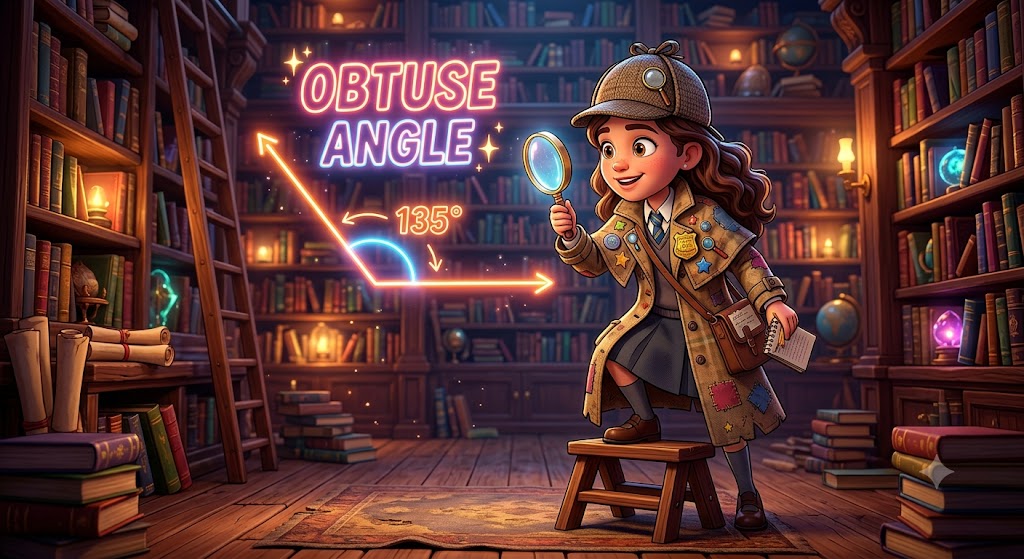
    • The Obtuse Angle (Greater than 90, less than 180): This one looks wide or lazy. It’s larger than a square corner but hasn’t gone flat yet.
    • The Straight Angle (Exactly 180 degrees): This is a perfectly flat line. The “Detective” knows a straight angle is just two right angles lying down.
    • The Reflex Angle (Greater than 180 degrees): The “outer” angle. This is the giant opening that wraps around the back of the shape.

    Teach your child to use their hand as a protractor. Open their thumb and index finger to match the angle on the page. If it’s smaller than a square corner, it’s acute. If it’s wider, it’s obtuse.

    Transform Practice into Play

    Math should not be a battle of wills. By gamifying the curriculum, you remove the pressure and replace it with curiosity.

    If your child is stuck, don’t force another worksheet. Instead, grab a flashlight and play “Angle Detective” around the house. Finding a right angle on a table or an obtuse angle on a laptop hinge provides the concrete experience needed to solve abstract problems.

    Ready to make math the highlight of their day? Explore our custom-tailored, curriculum-aligned stories at EinstyAI and turn their homework into a mystery worth solving.

    Practice Questions

    Welcome, Detective. A mysterious thief has left geometric clues scattered across the city. Your job is to classify these “angle clues” to identify the thief’s escape route.

    Question 1

    The thief left a mark on a brick wall that looks like a sharp “V” shape, smaller than the corner of a square. Detective, how do we classify this angle?

    A) Obtuse

    B) Acute

    C) Reflex

    D) Straight

    Question 2

    You find a laser beam grid blocking the hallway. You notice the beams meet perfectly to form a square corner. What type of angle is this?

    A) Right

    B) Acute

    C) Straight

    D) Obtuse

    Question 3

    The thief’s footprint is wide and lazy, measuring more than a square corner but less than a straight line. Which angle is this?

    A) Reflex

    B) Acute

    C) Obtuse

    D) Right

  • Mastering Angles: How to Make Geometry Click for Your Year 3 Student

    Mastering Angles: How to Make Geometry Click for Your Year 3 Student

    Is your child convinced that learning about angles is just dry, boring book work that has nothing to do with their real life? Many parents assume that math homework has to be a battleground, or that geometry is an abstract concept that only “math-minded” kids can grasp.

    The reality is that geometry is everywhere, especially in the world of gaming and digital movement. If your child loves video games, they are already an expert in angles—they just don’t know it yet.

    Angles are Not Just Shapes

    In Year 3, the curriculum moves away from static shapes and introduces angles as measures of turn. This shift is crucial. Instead of looking at a triangle, students need to think about how much an object rotates.

    Think of it like a game character performing a move. When a character spins to face an opponent, they are rotating through a specific angle. Whether it is a quick pivot or a full rotation, every move in a game relies on these geometric principles.

    The “Turn” Strategy

    To help your child master these concepts, teach them to visualize the “Quarter-Turn Technique.”

    • Quarter Turn: Think of this as a sharp 90-degree pivot. It is the movement a character makes to turn exactly to the left or right.
    • Half Turn: This is a 180-degree turn, like the character turning around to face the opposite direction.
    • Full Turn: This is a complete 360-degree spin, bringing the character back to their original position.

    By using this language, you strip away the fear of the word “geometry” and replace it with familiar gaming mechanics. Math becomes navigation, not just calculation.

    Make Math Part of the Play

    If you want to move beyond the struggle, integrate math into their interests. Encourage your child to describe their character’s movements in a game using terms like “quarter turn” or “half turn.”

    When they see that math is the engine behind their favorite games, the anxiety disappears. You can start building these skills today with our custom-tailored resources. If you need a more structured approach to help your child thrive, explore how EinstyAI transforms math practice into engaging stories.

    Practice Questions

    Instructions: Help the Esports champion “Pixel” navigate the arena by identifying the correct turn!

    1. Pixel needs to turn to face the Health Pack located directly behind him. What type of turn must Pixel make?
      A. Quarter turn
      B. Half turn
      C. Full turn
      D. No turn
    2. Pixel is facing North. He performs a quarter turn to the right. Which direction is Pixel now facing?
      A. West
      B. South
      C. East
      D. North
    3. During an esports match, Pixel spins in a complete circle to scan the entire room. How many degrees or what type of turn did he complete?
      A. A quarter turn
      B. A half turn
      C. A full turn
      D. A three-quarter turn

  • Is Your Child Scared of Randomness? Why Predicting Chance Builds Math Confidence

    Is Your Child Scared of Randomness? Why Predicting Chance Builds Math Confidence

    Why does your child freeze when you ask them, “What are the chances of that happening?”

    Many parents assume their child simply isn’t a “math kid” if they struggle with probability or data collection. They see frustration at the kitchen table and think the student lacks the innate talent for numbers. This is a myth. The truth is that math anxiety in Year 2 students usually stems from a disconnection between abstract concepts and real-world logic. When math is isolated from the real world, it feels like a chore, and the brain shuts down.

    Math is not about guessing; it is about interpreting the world.

    At this stage of the curriculum, we are moving children beyond rote memorization. We are teaching them to observe, organize, and predict. Whether they are sorting their toys or predicting the result of a coin toss, they are doing Statistics and Probability. To make these concepts stick, you must anchor them in a narrative.

    The “Story” Secret to Probability

    The fastest way to teach “likely” or “unlikely” outcomes is to remove the “math” label entirely. Don’t ask them to calculate percentages. Ask them to predict the next event in a space adventure.

    If a character needs to land on a planet made of green cheese, and there are 10 planets (9 of them are rock and 1 is cheese), teach them that landing on the cheese planet is “unlikely.” They don’t need a formula; they need to visualize the collection. By turning outcomes into story beats, the abstract logic becomes a tool they need to solve a narrative puzzle.

    Categorical Displays: Tallying the Chaos

    Before children can graph data, they must learn to gather it. Categorical displays, like picture graphs or simple tallies, are the ultimate tools for this.

    Key Takeaway: One symbol equals one item.

    When your child organizes data, encourage them to use the “one-to-one correspondence” rule. If they are counting alien spaceships, each drawing must represent exactly one ship. This turns a messy list into a clear visual representation.

    Stop the Homework Battle

    Math anxiety thrives on confusion. When math is embedded in a story, it becomes a mission. Stop fighting the curriculum and start using stories that make math feel like play. At EinstyAI, we transform dry curriculum outcomes into stories that stick, turning the “homework battle” into a moment of discovery.

    Ready to change the way your child learns? Stop teaching formulas and start teaching stories today.

    Practice Questions

    1. The Alien Invasion
    You are watching the sky for alien ships. You see 10 ships arrive. 9 of them are Silver and 1 is Neon Green. Based on this, is it likely or unlikely that the next ship you see will be Neon Green?

    A) Likely

    B) Unlikely

    C) Certain

    D) Impossible

    2. The Space Rock Tally
    You are collecting space rocks. You find 4 red rocks, 2 blue rocks, and 5 grey rocks. How many total rocks do you have?

    A) 10

    B) 11

    C) 9

    D) 12

    3. The Planet Explorer
    You have a bag with 3 Planet Cards: Mars, Earth, and Jupiter. You close your eyes and pick one. Which of these is true?

    A) Picking Jupiter is more likely than picking Mars.

    B) Picking Earth is impossible.

    C) Picking Mars is as likely as picking Jupiter.

    D) You are certain to pick Saturn.