Does your Year 6 student know their multiplication tables by heart but freeze the moment they see a negative number or a long string of operations? You are not alone. Parents frequently worry that their children lack “math ability,” but the real issue is rarely intelligence. It is a disconnect in logic.
In Stage 3 (B) of the NSW curriculum, students transition from simple arithmetic to structural thinking. This is where many students hit a wall. They treat math as a linear race—calculating from left to right without pause. When they encounter negative integers on a number line or complex equations requiring the order of operations (BODMAS), this “left-to-right” habit fails.
The “Math Isn’t a Race” Mindset
The biggest mistake parents make is focusing on speed. Speed encourages guessing. Instead, focus on structure. When your child sees a math problem, ask them to identify the “rules of the road” first.
BODMAS (Brackets, Orders, Division, Multiplication, Addition, Subtraction) is not just a mnemonic; it is a GPS. It tells the student exactly where to turn. Without this roadmap, a problem like 3 + 5 x 2 becomes a guessing game. By teaching students to pause and circle the “Order of Operations” first, you remove the anxiety of the unknown. They stop guessing the answer and start following the logic.
Negative Numbers are Real-World Concepts
Negative integers often cause panic because they are abstract. To a student, -10 is just a scary symbol. To a student who thinks of it as “10 degrees below freezing” or “10 meters below sea level,” it is a location.
When your child struggles with negative numbers, stop writing equations on a napkin. Use visual tools. Draw a vertical number line (like a thermometer or the ocean depth). Let them see that -5 is actually warmer than -10. Physicalizing the number line bridges the gap between abstract symbol and reality.
Practical Tips for Home
- Slow Down to Speed Up: Before solving, ask: “What does BODMAS tell us to do first?” If they can identify the operation (e.g., the multiplication inside the brackets), they have already won half the battle.
- Context is King: If the math is about debt, temperature, or depth, it becomes a story. Stories are memorable. Abstract numbers are forgettable.
- Use Tools: EinstyAI allows you to input these concepts and generate customized stories that turn these abstract challenges into engaging scenarios.
Stop battling over rote practice. Build the mental models now, and the results will follow. Start by asking, “What is the order, and where are we on the number line?”
Practice Questions
The Deep Sea Explorer Challenge
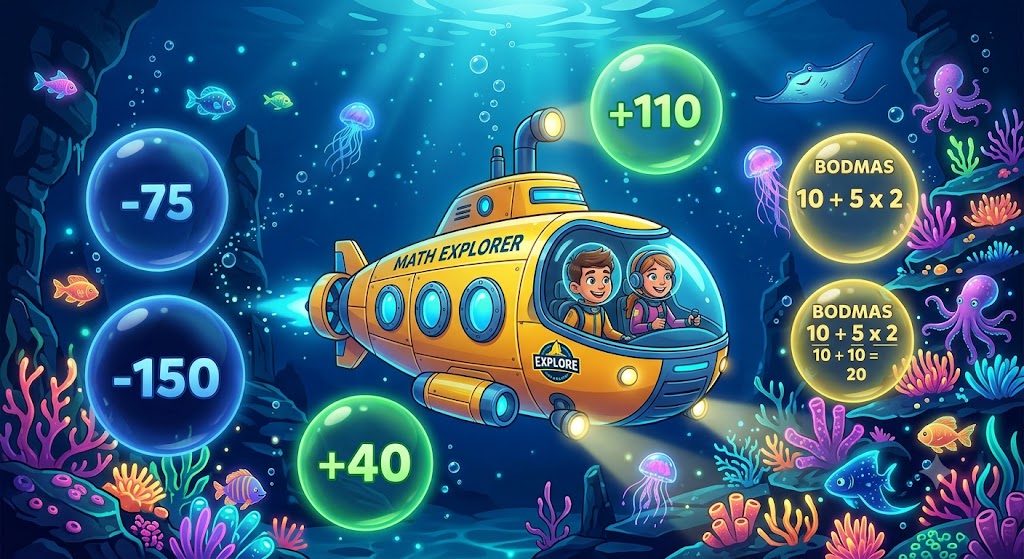
Welcome, Explorer! You are piloting the Abyss-1 submarine. To navigate the ocean floor safely and manage your oxygen levels, you must master the order of operations and understand your depth.
Question 1
Your submarine is at a depth of 150 metres below sea level (-150m). You rise 40 metres to avoid a coral reef. What is your new depth?
A) -190m
B) -110m
C) 110m
D) 190m
Question 2
The ocean temperature at your current depth is 4 degrees. A cold current drops the temperature by 7 degrees. What is the new temperature?
A) 11 degrees
B) 3 degrees
C) -3 degrees
D) -11 degrees
Question 3
Your ship’s computer needs to calculate oxygen pressure. The formula is 10 + 5 x 2. According to BODMAS, what is the correct pressure level?
A) 30
B) 20
C) 15
D) 25