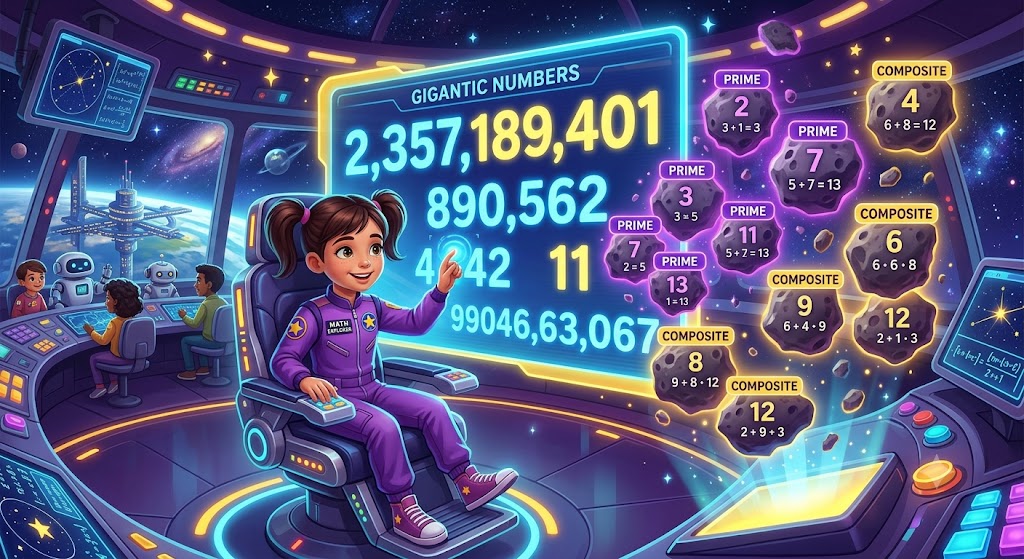
Many parents assume that by Year 5, math homework should be a silent, independent battle. We often think, “If they don’t get it by now, they just aren’t math kids.” This is a dangerous myth. Math anxiety isn’t about ability; it’s about context. When students encounter numbers in the billions or complex prime/composite classifications, they freeze because the numbers lack a story.
Numbers in the billions are abstract. Unless your child is managing a national budget or counting stars in a galaxy, a billion is just a “big number.” To help them, we must bridge the gap between abstract digits and real-world scale.
The Strategy: Decoding the Math Story
To tackle Year 5 NESA outcomes in Number and Algebra, your child needs to treat word problems like a detective case. Here are three tricks to teach them:
- Circle the Constants, Underline the Question: In problems involving billions, students get distracted by the zeroes. Teach them to underline exactly what the question asks for (e.g., “How many billions?” vs. “How many total units?”).
- The Factor Test: When identifying composite numbers, don’t just guess. Teach them the “Divisibility Rule.” If a number ends in 0, 2, 4, 6, or 8, it is divisible by 2. If the digits add up to a multiple of 3, it is divisible by 3. This saves time and builds confidence.
- Visualize the Scale: When working with billions, use comparisons. Use distance or population examples. If a local town has 10,000 people, how many towns would it take to reach 1 billion? This makes the number tangible.
Moving Beyond Homework Battles
The shift from primary to secondary math requires deeper conceptual understanding. Prime and composite numbers are the “building blocks” of mathematics. When a child understands that a prime number only has two factors (1 and itself), they are learning to see the underlying structure of all numbers.
Don’t let your child struggle alone. Use tools that translate these concepts into engaging narratives. At EinstyAI, we help students transform dry curriculum outcomes into personalized stories that stick.
Stop the battle at the kitchen table. Start building their confidence today.
Practice Questions: The Intergalactic Math Mission
1. The Fleet Deployment
The Galactic Federation is sending a rescue fleet to the Alpha-7 cluster. They are sending 5,000,000,000 (five billion) light-units of fuel. Which statement correctly identifies the value of the ‘5’ in this number?
A. Five hundred million
B. Five billion
C. Five thousand million
D. Fifty million
2. The Asteroid Sorters
You are sorting asteroids by their density level to clear the space lane. Which of the following numbers is a prime number?
A. 21
B. 27
C. 29
D. 39
3. The Colony Budget
A space colony project has a budget of $2,300,000,000. Another project has a budget of $2,003,000,000. Which inequality symbol correctly compares the two projects?
A. 2,300,000,000 < 2,003,000,000
B. 2,300,000,000 > 2,003,000,000
C. 2,300,000,000 = 2,003,000,000
D. 2,300,000,000 <= 2,003,000,000