Tag: Year 5

  • How “The 2-Tone Tally” Helped Mia Design Her Way to Math Confidence

    How “The 2-Tone Tally” Helped Mia Design Her Way to Math Confidence

    Mia sat at the kitchen table, her sketchbook of fashion designs pushed aside, tears welling up. In front of her lay a messy page of statistics homework—a wall of bar graphs that looked like a confusing jungle of lines. She had to compare two different fabric preferences across four clothing types, but the data just swam before her eyes.

    The Struggle with Abstract Data

    Parents know this scene all too well. It’s that precise moment when “math” stops being about numbers and starts being about frustration. Mia wasn’t bad at math; she was overwhelmed by the way the graph presented the data. The traditional approach—trying to read two different columns at once—felt like watching two different movies on the same screen. It caused instant panic because the visual relationship between the two categories was hidden behind confusing labels.

    The Guide & The 2-Tone Tally Trick

    To help Mia, we didn’t force her to “study harder.” We introduced a simple visual weapon: The 2-Tone Tally Trick.

    This strategy is simple: instead of viewing the column graph as a big, confusing mess, you treat the two categories as two distinct fashion seasons. You assign a specific color to each category (e.g., Blue for “Summer Fabrics” and Pink for “Winter Fabrics”). By physically color-coding the columns, the abstract data instantly transforms into a clear, comparative map.

    The Transformation

    Mia looked at her assignment again. She pulled out her highlighters. “Okay,” she said, “Summer fabrics are Blue. Winter fabrics are Pink.”

    Suddenly, comparing the data wasn’t about subtracting large numbers in her head anymore. She could see the gaps. She could see that the “Denim” columns had a much smaller gap between seasons than the “Silk” columns. The panic vanished, replaced by the logical satisfaction of a designer finding a pattern. By the time she finished, she had not just answered the questions—she understood the story the data was telling.

    Turn Homework Battles into Victories

    When math is dry, it’s a chore. When it’s part of a story, it’s a puzzle waiting to be solved. At EinstyAI, we transform curriculum-aligned math problems into personalized stories that resonate with your child’s interests—whether they love fashion, gaming, or dinosaurs. Stop fighting over the homework and start making math click.

    Visit EinstyAI today to create your first custom math story.


    PRACTICE QUESTIONS

    1. The Fabric Choice

    Mia surveyed 50 designers about their favorite fabrics for a summer collection versus a winter collection. The side-by-side graph shows Denim (Summer: 15, Winter: 5) and Silk (Summer: 5, Winter: 15). How many more designers preferred Silk in winter compared to summer?

    A) 5

    B) 10

    C) 20

    D) 25

    2. The Accessory Trend

    A graph compares the popularity of “Gold” accessories vs. “Silver” accessories over two months. If Gold has 20 units in Month 1 and 30 in Month 2, while Silver has 25 in Month 1 and 25 in Month 2, which statement is true?

    A) Silver is more popular overall.

    B) Gold increased in popularity while Silver stayed the same.

    C) Gold is always more popular than Silver.

    D) The total for Gold is 40.

    3. Pattern Preferences

    Mia compares the number of students who like “Polka Dots” versus “Stripes” across two classes. Class A has 10 Polka Dot votes and 15 Stripe votes. Class B has 15 Polka Dot votes and 10 Stripe votes. How many total votes did Stripes receive?

    A) 20

    B) 25

    C) 30

    D) 35

  • How the Benchmark Method Helped Ethan Score the Best Deals in Roblox

    How the Benchmark Method Helped Ethan Score the Best Deals in Roblox

    The kitchen table was silent, save for the rhythmic tapping of Ethan’s pencil. In front of him sat a math worksheet about calculating percentage discounts on “limited edition” Roblox skins. Tears were welling up in his eyes. For a Year 5 student, the abstract concept of “finding 25% of 400” felt like trying to decode a secret language without a cipher. The frustration wasn’t just about the numbers; it was about the disconnect between the math on the page and the world he understood.

    Many parents see this exact scene daily. 

    When children are taught to force numbers into traditional algorithms—like long division or complex multiplication—without a visual mental model, they freeze. Their brains panic because they cannot “see” what they are solving. They aren’t struggling with math; they are struggling with the lack of a bridge between the classroom and their reality.

    The secret to breaking this cycle is the Benchmark Percentage Method. 

    Instead of jumping straight into complex calculations, we teach children to find the easy “anchors” first: 10% and 50%. These benchmarks act as the building blocks for any discount. If Ethan can find 10% (by moving the decimal point one place to the left), he can instantly find 20%, 30%, or even 5% by scaling up or down. This turns a terrifying word problem into a logical, visual map.

    Let’s look at Ethan’s transformation. He was asked to find 25% off a rare Roblox item priced at 800 Robux. Instead of panicking, he paused. He found 50% first (half of 800 is 400), then found half of that to get his 25% (200). He realized the sale price was 600 Robux. The panic vanished, replaced by the satisfying “click” of understanding. He wasn’t just doing math; he was hacking the system to save his digital currency.

    Stop the homework battles and start the breakthrough moments. 

    At EinstyAI, we transform dry syllabus requirements into custom-tailored math stories that resonate with your child’s interests. Turn the kitchen table into a place of confidence, not conflict.


    Practice Questions: The Roblox Discount Challenge

    Question 1

    Ethan wants to buy a “Golden Dragon” cape originally priced at 400 Robux. There is a 10% discount for “Flash Sale” members. What is the discount amount in Robux?

    A) 4 Robux

    B) 40 Robux

    C) 400 Robux

    D) 10 Robux

    Question 2

    An “Epic Space Suit” costs 200 Robux. During the “Space Event,” it is marked down by 25%. What is the new price Ethan pays?

    A) 50 Robux

    B) 100 Robux

    C) 150 Robux

    D) 175 Robux

    Question 3

    A rare “Neon Sword” costs 600 Robux. The shop offers a 50% discount. How much is the item now?

    A) 60 Robux

    B) 300 Robux

    C) 550 Robux

    D) 50 Robux

  • Unlock the Secrets of Geometry: Mastering the Protractor at Home

    Unlock the Secrets of Geometry: Mastering the Protractor at Home

    Does your child view geometry homework as a battlefield where tears are shed over plastic tools? If your Year 5 student struggles with math, you are not alone. Many parents assume their child simply “isn’t a math kid,” but this mindset is the real barrier to learning. Math anxiety often stems from abstract concepts lacking context, not a lack of innate ability. When we turn math into a story, the fear dissolves, replaced by curiosity.

    The Problem with Traditional Geometry

    Standard math sheets often present circles and lines as disconnected, boring shapes. Students stare at a page of disconnected angles and feel nothing. But geometry is the language of architecture, design, and art. In the Year 5 curriculum, students must learn to use protractors to measure angles in degrees. This requires precision and logic. If a student tries to guess, they fail. When they learn the strategy, they succeed.

    The “Protracting” Strategy for Success

    Mastering the protractor isn’t about memory; it is about a consistent three-step process. Teach your child these steps to remove the guesswork:

    • Align the Baseline: Place the protractor’s baseline exactly on one ray of the angle.
    • Center the Vertex: Ensure the small hole or crosshair at the bottom of the protractor sits perfectly on the angle’s vertex.
    • Check the Scale: Look at the scale starting at zero. If the angle opens to the left, use the outer scale. If it opens to the right, use the inner scale. Most students fail here by choosing the wrong scale and recording a 120-degree angle when they should have written 60 degrees.

    Transforming Math into a Fairytale

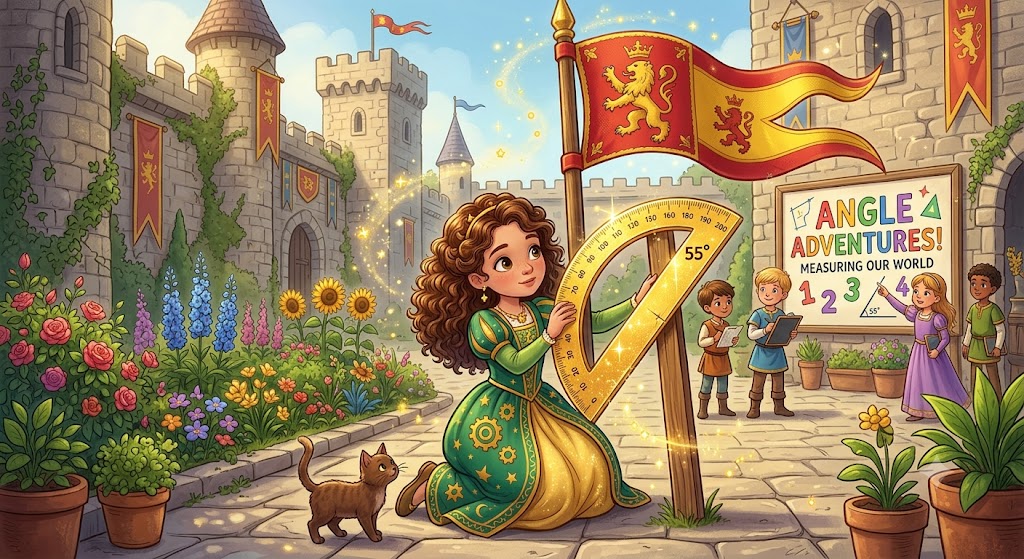
    At EinstyAI, we know that engagement drives mastery. Instead of forcing your child to measure generic floating angles, connect the skill to their world. Imagine a princess protecting her castle. The angle of the castle gate determines if the drawbridge can open. The angle of the tower roof ensures it can withstand heavy rainfall. By shifting the context from a worksheet to a quest, you bypass the “this is boring” wall and activate the brain’s engagement centers.

    Take Action Today

    Stop the nightly homework battles. Shift from being a “tutor” to being a “narrator” of their mathematical journey. Use the practice questions below to transform your next study session into a royal mission. Your child is capable of mastering these concepts—they just need the right map.

    Practice Questions

    The Royal Castle Geometry Challenge

    Question 1: The Drawbridge Angle

    Princess Clara is adjusting the heavy chain on the castle drawbridge. The bridge forms an angle of 45 degrees with the stone wall when lowered halfway. If she moves the chain to make the angle wider, which of these is a possible measurement for the new angle?

    A) 30 degrees

    B) 60 degrees

    C) 180 degrees

    D) 10 degrees

    Question 2: The Tower Roof Slope

    The royal architect is designing a new tower roof. To ensure the snow slides off perfectly, the roof must be an acute angle. Which of the following measurements should the architect choose for the roof’s peak?

    A) 90 degrees

    B) 105 degrees

    C) 40 degrees

    D) 180 degrees

    Question 3: The Dragon’s Wing Span

    A friendly dragon is resting in the courtyard. Its wing is folded at an obtuse angle so it fits inside the castle gates. Which of the following is a possible measurement for the dragon’s wing angle?

    A) 75 degrees

    B) 90 degrees

    C) 130 degrees

    D) 10 degrees

  • How Can I Help My Year 5 Student Master the Cartesian Plane and Perimeter?

    How Can I Help My Year 5 Student Master the Cartesian Plane and Perimeter?

    Why does your child view math problems as an unsolvable maze rather than a blueprint to build their own world? Many parents assume that math anxiety is an inherited trait—that some kids are simply “not math people.” This is a myth. When students struggle with Year 5 Measurement and Space concepts, it is rarely because they lack ability. It is because the abstract concepts feel disconnected from reality.

    The Problem: Math in a Vacuum

    In Year 5 (Stage 3), students are introduced to the Cartesian plane and the calculation of perimeters for composite shapes. Without context, a grid of coordinates and a series of lines are just numbers on a page. This is where disengagement starts. Children do not learn mathematics by staring at textbooks; they learn by interacting with their environment.

    The Solution: Building with Coordinates

    The Cartesian plane is essentially a map. If your child plays Minecraft, they are already using coordinate geometry. Every block placed in a Minecraft world occupies a specific x and y coordinate. When we shift the focus from rote memorization to spatial reasoning, the math becomes intuitive.

    To teach perimeter of composite shapes, stop asking for “perimeter” and start asking for the “fencing required to secure a base.” A composite shape is just two simple rectangles joined together. The secret trick is to treat the shape like a room layout. Instead of guessing the missing sides, break the complex shape into two smaller, simple rectangles. Calculate their perimeters individually, then subtract the shared wall. This prevents the common trap of counting interior lines.

    Master the Grid Today

    If your child struggles with math, stop the “drill and kill” homework sessions. Connect the curriculum to the games they love. When they calculate the perimeter of a virtual base, they aren’t just doing math; they are engineering. Math is not a battle to be won; it is a tool to be used.

    Practice Questions

    Theme: The Minecraft Architect Challenge

    Question 1: The Diamond Coordinates

    Steve is placing a rare Diamond Block on his base grid. The base starts at (0,0). Steve places the block exactly 3 units to the right and 4 units up from the starting point. What are the coordinates of the Diamond Block?

    A) (4, 3)

    B) (3, 4)

    C) (3, 3)

    D) (4, 4)

    Question 2: Protecting the Base

    Steve builds a rectangular crafting room that is 5 metres long and 4 metres wide. What is the total perimeter of this room?

    A) 9 metres

    B) 18 metres

    C) 20 metres

    D) 15 metres

    Question 3: The L-Shaped Lookout

    Steve builds an L-shaped lookout tower. The horizontal bottom is 6 metres wide. The vertical left side is 8 metres high. The top horizontal arm is 2 metres, and the vertical drop is 4 metres. The remaining two sides close the shape. Assuming all angles are right angles, what is the total perimeter of the lookout?

    A) 20 metres

    B) 24 metres

    C) 28 metres

    D) 32 metres

  • Why does my Year 5 student get stuck on multi-step math problems?

    Why does my Year 5 student get stuck on multi-step math problems?

    Every parent has faced the same wall: you sit down to help with homework, and the initial enthusiasm quickly dissolves into frustration. Why do students who are perfectly capable of adding and subtracting suddenly freeze when faced with a “word problem”?

    The answer is rarely about their ability to calculate. It is about their ability to translate. At the Year 5 Stage 3 level, math moves beyond simple arithmetic into Number and Algebra, where understanding the relationship between numbers is critical. When a child sees a multi-step word problem, they often see a wall of text that looks nothing like the neat equations in their textbook. They aren’t struggling with the math; they are struggling with the story.

    The mindset shift: Math is just a story

    Too many parents fall into the trap of thinking their child just “isn’t a math kid.” This creates a fixed mindset that labels a temporary struggle as a permanent character trait. In reality, math anxiety often stems from the disconnect between abstract numbers and real-world logic.

    By teaching students to break down complex problems into manageable steps, we lower that anxiety. At EinstyAI, we believe that if you can change the story, you change the result. When you frame a percentage calculation as a quest for rare loot in a game, the abstract concepts—like calculating 10%, 25%, or 50%—become tangible tools for success rather than chores to be completed.

    Mastering percentages and multi-step logic

    To solve multi-step problems, encourage your child to use the “Highlight and Pause” method.

    • Highlight the goal: What is the final question asking for?
    • Pause and plan: Before calculating, write down the known variables.
    • Divide and conquer: If the problem asks to find 10% of a total and then subtract it, that is two separate, solvable tasks. Treat them that way.

    When students learn to look for benchmarks like 10% (move the decimal one spot), 50% (divide by 2), and 25% (half of 50%), they stop guessing and start strategizing. These aren’t just tricks; they are foundational skills that make complex Number and Algebra tasks feel intuitive. Stop fighting the homework. Start building the story, and watch the math follow.

    Practice Questions

    Scenario: You are a top-tier gamer in the Roblox universe. Your success depends on your ability to manage your Robux and inventory to build the ultimate game world.

    Question 1

    You have 800 Robux. You decide to spend 50% of it on a new avatar skin and then use 10% of your remaining Robux to buy a special hat. How many Robux do you have left after these purchases?

    A) 400

    B) 360

    C) 440

    D) 320

    Question 2

    Your guild has collected 1,200 digital gems. You need to give 25% of the gems to the guild leader and then divide the remaining gems equally among 5 team members. How many gems does each team member receive?

    A) 180

    B) 240

    C) 300

    D) 200

    Question 3

    You are designing a map. You have 200 building blocks. You use 10% of your blocks for the floor and 50% of the remaining blocks to build a wall. How many blocks do you have left to build your tower?

    A) 90

    B) 100

    C) 80

    D) 110

  • How Can I Help My Year 5 Child Master Numbers Up to Billions and Prime Concepts?

    How Can I Help My Year 5 Child Master Numbers Up to Billions and Prime Concepts?

    Many parents assume that by Year 5, math homework should be a silent, independent battle. We often think, “If they don’t get it by now, they just aren’t math kids.” This is a dangerous myth. Math anxiety isn’t about ability; it’s about context. When students encounter numbers in the billions or complex prime/composite classifications, they freeze because the numbers lack a story.

    Numbers in the billions are abstract. Unless your child is managing a national budget or counting stars in a galaxy, a billion is just a “big number.” To help them, we must bridge the gap between abstract digits and real-world scale.

    The Strategy: Decoding the Math Story

    To tackle Year 5 NESA outcomes in Number and Algebra, your child needs to treat word problems like a detective case. Here are three tricks to teach them:

    • Circle the Constants, Underline the Question: In problems involving billions, students get distracted by the zeroes. Teach them to underline exactly what the question asks for (e.g., “How many billions?” vs. “How many total units?”).
    • The Factor Test: When identifying composite numbers, don’t just guess. Teach them the “Divisibility Rule.” If a number ends in 0, 2, 4, 6, or 8, it is divisible by 2. If the digits add up to a multiple of 3, it is divisible by 3. This saves time and builds confidence.
    • Visualize the Scale: When working with billions, use comparisons. Use distance or population examples. If a local town has 10,000 people, how many towns would it take to reach 1 billion? This makes the number tangible.

    Moving Beyond Homework Battles

    The shift from primary to secondary math requires deeper conceptual understanding. Prime and composite numbers are the “building blocks” of mathematics. When a child understands that a prime number only has two factors (1 and itself), they are learning to see the underlying structure of all numbers.

    Don’t let your child struggle alone. Use tools that translate these concepts into engaging narratives. At EinstyAI, we help students transform dry curriculum outcomes into personalized stories that stick.

    Stop the battle at the kitchen table. Start building their confidence today.

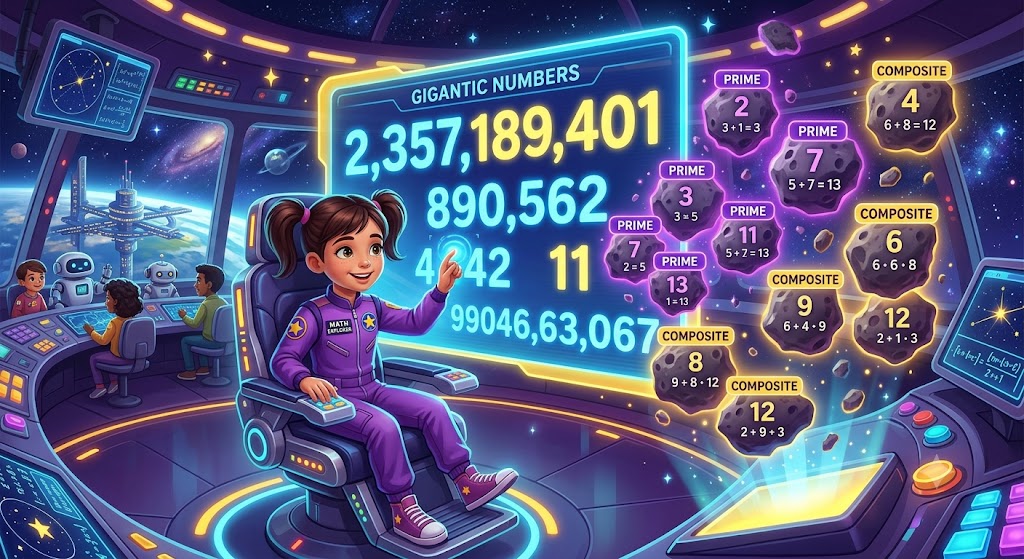
    Practice Questions: The Intergalactic Math Mission

    1. The Fleet Deployment

    The Galactic Federation is sending a rescue fleet to the Alpha-7 cluster. They are sending 5,000,000,000 (five billion) light-units of fuel. Which statement correctly identifies the value of the ‘5’ in this number?

    A. Five hundred million

    B. Five billion

    C. Five thousand million

    D. Fifty million

    2. The Asteroid Sorters

    You are sorting asteroids by their density level to clear the space lane. Which of the following numbers is a prime number?

    A. 21

    B. 27

    C. 29

    D. 39

    3. The Colony Budget

    A space colony project has a budget of $2,300,000,000. Another project has a budget of $2,003,000,000. Which inequality symbol correctly compares the two projects?

    A. 2,300,000,000 < 2,003,000,000

    B. 2,300,000,000 > 2,003,000,000

    C. 2,300,000,000 = 2,003,000,000

    D. 2,300,000,000 <= 2,003,000,000

  • Why Does My Year 5 Child Get Stuck on Multistep Math Word Problems?

    Why Does My Year 5 Child Get Stuck on Multistep Math Word Problems?

    Do you find yourself sitting at the kitchen table, watching your Year 5 student stare blankly at a word problem, only to give up because “it’s too hard”? You aren’t alone. Many parents assume that math ability is fixed—that some children are simply “math kids” and others are not. This is a myth. The reality is that most students don’t struggle with the math itself; they struggle with the language and the multi-layered logic of the question.

    In Stage 3 of the Australian curriculum, the jump in complexity is significant. Students are expected to move from simple arithmetic to solving multistep problems involving percentages. If your child struggles with this, they likely need a strategy to decode the story, not more repetitive drills. At EinstyAI, we help students transform this frustration into confidence by aligning math practice with stories they actually want to read.

    The Secret to Decoding Word Problems

    To help your child succeed with multistep problems—specifically calculating 10%, 25%, and 50%—teach them the “STOP-THINK-SOLVE” method.

    1. Stop and Underline Keywords:

    Ask your child to highlight the important numbers and the specific percentage they need to find. If the problem asks for 10% of a collection, circle “10%.” If it mentions “total” or “remaining,” highlight those. Ignoring keywords is the number one reason for errors.

    2. Think in “Easy Chunks”:

    Before jumping into complex division, use “friendly” percentages.

    • 50% is half: Just divide the number by 2.
    • 25% is half of a half: Divide by 2, then divide by 2 again.
    • 10% is a tenth: Just move the decimal point one place to the left (e.g., 10% of 80 is 8).

    3. Solve the Steps Separately:

    Multistep problems are just a series of small problems chained together. Teach your child to solve one part, write the answer down, and then use that answer to solve the next part. Never try to hold all the numbers in your head at once.

    Changing the Mindset

    Math homework doesn’t have to be a battleground. When you shift the focus from “getting the right answer” to “solving the mystery” within the story, anxiety drops. A Year 5 student who views a word problem as a puzzle to be cracked—rather than a test to be failed—will naturally develop better problem-solving stamina.

    Ready to put these strategies into practice with your child? Scroll down to download our latest story-based worksheet designed to make Stage 3 percentages manageable and fun.

    Practice Questions

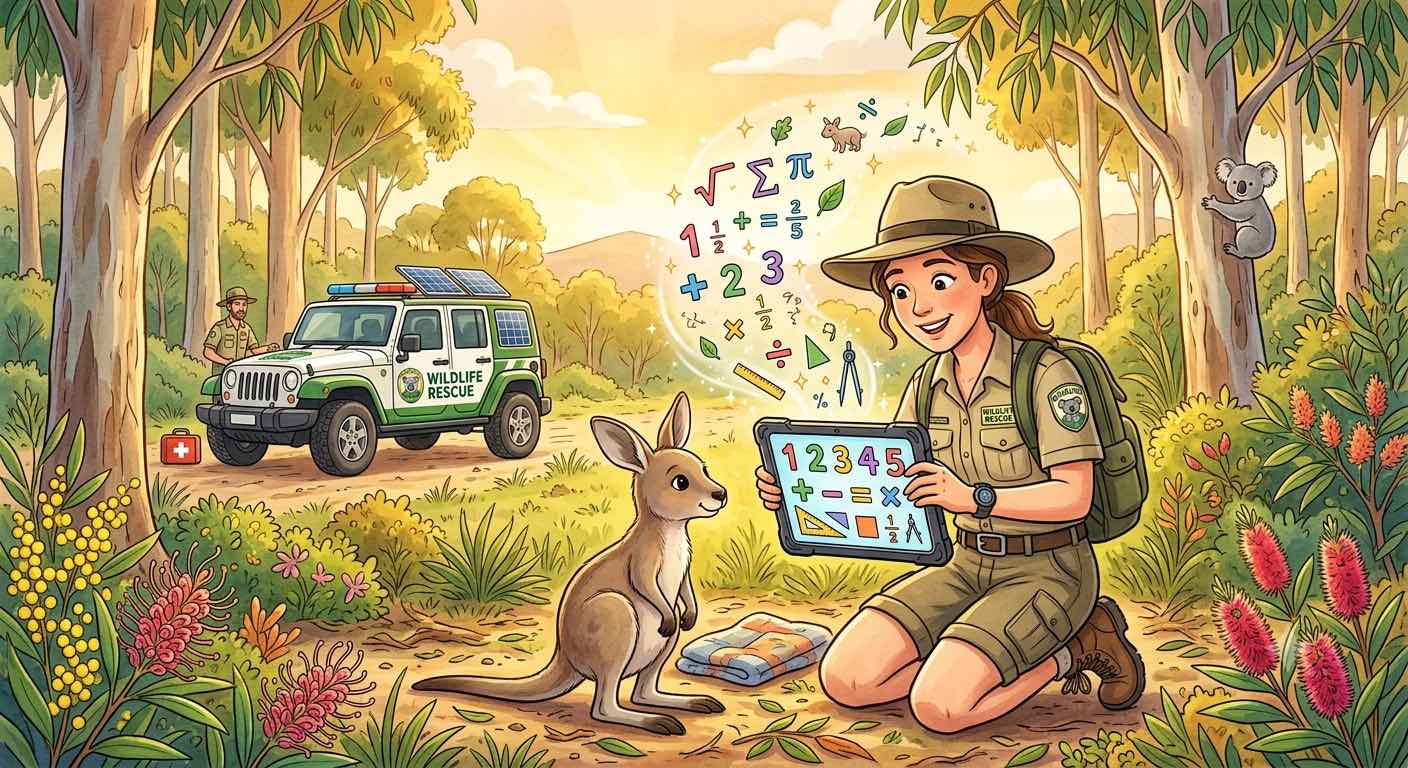
    The Great Outback Wildlife Rescue

    Help the ranger team save our native animals! Use your math skills to calculate the supplies needed for the rescue mission.

    Question 1

    The ranger team found 120 injured kangaroos in the bush. They need to give medicine to 25% of them immediately. How many kangaroos need immediate medicine?

    A) 20

    B) 30

    C) 40

    D) 60

    Question 2

    The rescue station has a stockpile of 400kg of eucalyptus leaves for the koalas. The team uses 10% of the stockpile for the morning feed. How much eucalyptus is left for the rest of the day?

    A) 40kg

    B) 300kg

    C) 360kg

    D) 390kg

    Question 3

    The team rescued 80 baby wombats. They decided to transport 50% of them to the main shelter and keep the rest at the field hospital. Later, 25% of the wombats at the field hospital were cleared to go home. How many wombats are still at the field hospital?

    A) 10

    B) 30

    C) 40

    D) 20