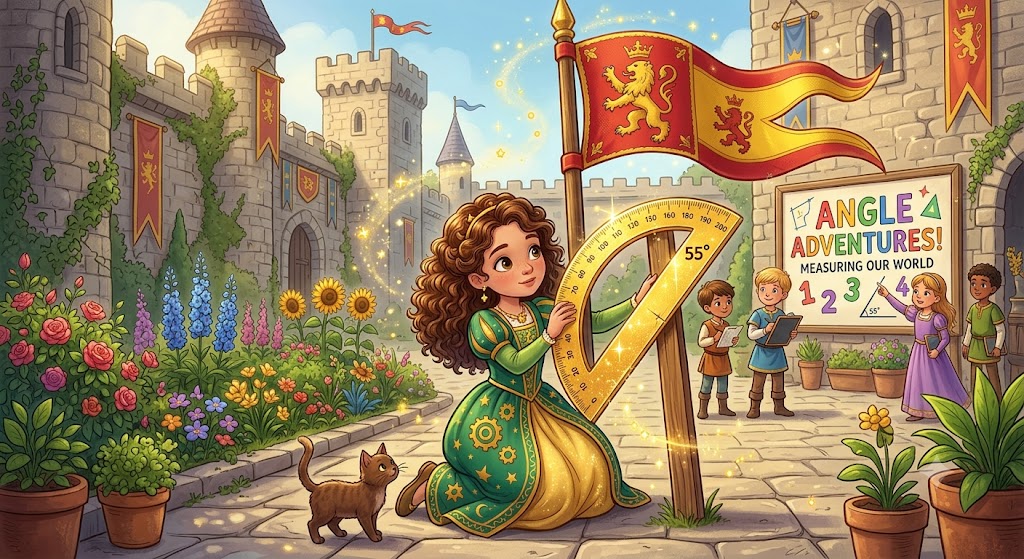
Does your child view geometry homework as a battlefield where tears are shed over plastic tools? If your Year 5 student struggles with math, you are not alone. Many parents assume their child simply “isn’t a math kid,” but this mindset is the real barrier to learning. Math anxiety often stems from abstract concepts lacking context, not a lack of innate ability. When we turn math into a story, the fear dissolves, replaced by curiosity.
The Problem with Traditional Geometry
Standard math sheets often present circles and lines as disconnected, boring shapes. Students stare at a page of disconnected angles and feel nothing. But geometry is the language of architecture, design, and art. In the Year 5 curriculum, students must learn to use protractors to measure angles in degrees. This requires precision and logic. If a student tries to guess, they fail. When they learn the strategy, they succeed.
The “Protracting” Strategy for Success
Mastering the protractor isn’t about memory; it is about a consistent three-step process. Teach your child these steps to remove the guesswork:
- Align the Baseline: Place the protractor’s baseline exactly on one ray of the angle.
- Center the Vertex: Ensure the small hole or crosshair at the bottom of the protractor sits perfectly on the angle’s vertex.
- Check the Scale: Look at the scale starting at zero. If the angle opens to the left, use the outer scale. If it opens to the right, use the inner scale. Most students fail here by choosing the wrong scale and recording a 120-degree angle when they should have written 60 degrees.
Transforming Math into a Fairytale
At EinstyAI, we know that engagement drives mastery. Instead of forcing your child to measure generic floating angles, connect the skill to their world. Imagine a princess protecting her castle. The angle of the castle gate determines if the drawbridge can open. The angle of the tower roof ensures it can withstand heavy rainfall. By shifting the context from a worksheet to a quest, you bypass the “this is boring” wall and activate the brain’s engagement centers.
Take Action Today
Stop the nightly homework battles. Shift from being a “tutor” to being a “narrator” of their mathematical journey. Use the practice questions below to transform your next study session into a royal mission. Your child is capable of mastering these concepts—they just need the right map.
Practice Questions
The Royal Castle Geometry Challenge
Question 1: The Drawbridge Angle
Princess Clara is adjusting the heavy chain on the castle drawbridge. The bridge forms an angle of 45 degrees with the stone wall when lowered halfway. If she moves the chain to make the angle wider, which of these is a possible measurement for the new angle?
A) 30 degrees
B) 60 degrees
C) 180 degrees
D) 10 degrees
Question 2: The Tower Roof Slope
The royal architect is designing a new tower roof. To ensure the snow slides off perfectly, the roof must be an acute angle. Which of the following measurements should the architect choose for the roof’s peak?
A) 90 degrees
B) 105 degrees
C) 40 degrees
D) 180 degrees
Question 3: The Dragon’s Wing Span
A friendly dragon is resting in the courtyard. Its wing is folded at an obtuse angle so it fits inside the castle gates. Which of the following is a possible measurement for the dragon’s wing angle?
A) 75 degrees
B) 90 degrees
C) 130 degrees
D) 10 degrees