Why does my child panic the moment a decimal point appears in their homework?
If you have ever watched your Year 6 student freeze up at a math problem, you are not alone. Parents often assume their child just isn’t a “math kid” or that they lack natural talent. The reality is usually simpler: they are missing the visual mental model for place value.
Math homework does not have to be a battle. When students view math as a set of rigid, confusing rules, they struggle. When they view it as a pattern-spotting game, they succeed.
The Secret: Stop Calculating, Start Sliding
The biggest mistake students make is trying to perform traditional multiplication or division when dealing with powers of 10. They try to line up numbers vertically and carry values, which leads to mistakes.
Instead, teach them the “Decimal Slide.”
The decimal point does not move; the digits move. When multiplying by 10, 100, or 1000, the digits of the number slide to the left into larger place value columns. When dividing, they slide to the right into smaller columns.
Using Storytelling to Make It Stick
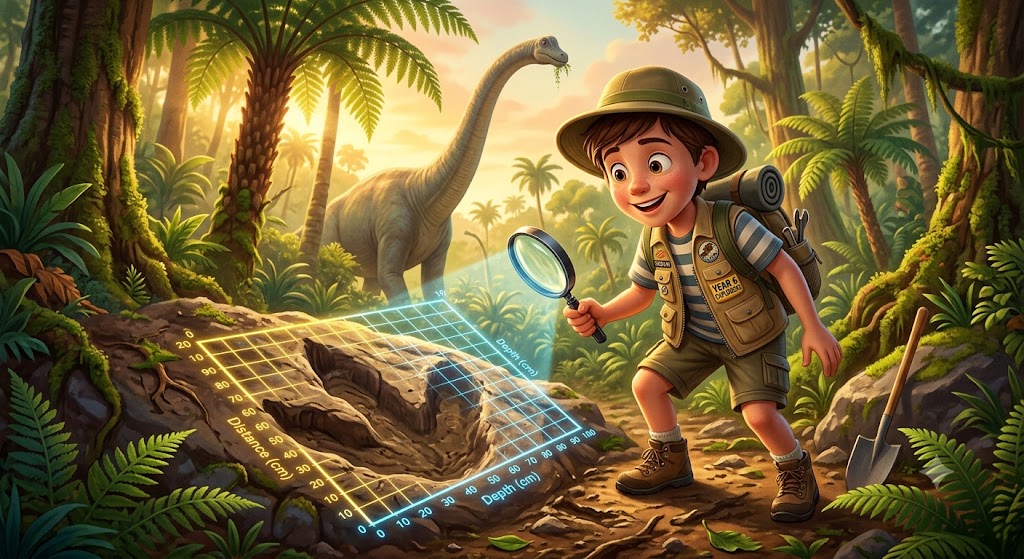
Abstract numbers are hard to remember. Prehistoric creatures are not.
If we talk about a T-Rex egg weighing 2.5 kilograms, students immediately picture the weight. If we then “multiply by 10” to see what a nest of 10 eggs weighs, the calculation becomes a tangible, visual narrative. By anchoring these concepts in stories—like those we build at EinstyAI—we remove the “math anxiety” barrier and replace it with engagement.
Master the Pattern Today
Do not rely on repetitive drills that bore your child. Help them visualize the movement of numbers.
Key Takeaways for Parents:
- Focus on Place Value: Remind them that the decimal point is just a marker for where the “ones” column ends.
- Use Visual Aids: If they get stuck, draw a place value chart with columns (Hundreds, Tens, Ones, . Tenths, Hundredths).
- Consistency is Key: Practice with real-world scenarios, not just dry equations on a page.
Want to see how this works in practice? See the “Prehistoric Decimal Hunt” worksheet below to turn your child’s next math session into an adventure.
Practice Questions
The Prehistoric Decimal Hunt: Worksheet
Instructions: Help our paleontologists solve these dinosaur discoveries by multiplying and dividing decimals!
Question 1
A baby T-Rex weighs 4.25 kg. After a month of eating ferns and forest snacks, its weight has multiplied by 10. What does the T-Rex weigh now?
A) 42.5 kg
B) 425 kg
C) 0.425 kg
D) 4.250 kg
Question 2
A Triceratops footprint is 350.5 cm long. To calculate the scale for a model footprint that is 1/10th the size, you must divide the length by 10. How long is the model footprint?
A) 3505 cm
B) 35.05 cm
C) 3.505 cm
D) 350.5 cm
Question 3
A Pterodactyl glides across a canyon measuring 1.25 km. If a map maker wants to convert this distance into metres, they multiply the value by 1000. What is the distance in metres?
A) 12.5 metres
B) 125 metres
C) 1250 metres
D) 12500 metres