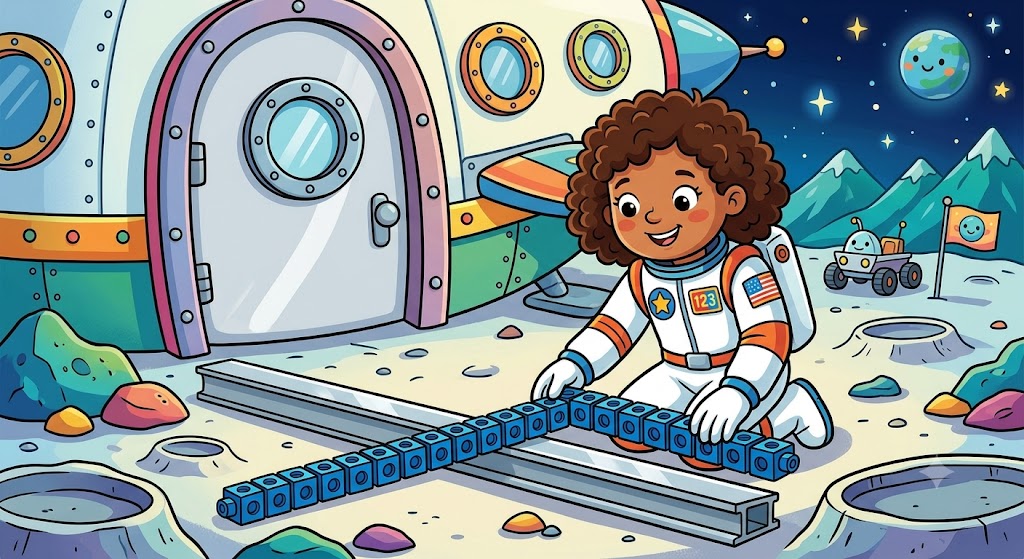
Does your Year 1 child freeze when asked to measure something? Many parents assume their child simply “isn’t a math kid” because they struggle with abstract concepts like rulers or centimeters. The truth is, your child doesn’t lack ability; they likely lack a physical bridge between the physical world and the numbers on a page.
Math isn’t just numbers on paper; it is a way to describe the world. Before we introduce formal tools like rulers, we must master the concept of informal units. This is where we measure objects using things like blocks, paperclips, or hand spans to understand what “length” actually means.
Why Informal Units Build Strong Foundations
When children start with formal units (centimeters/meters), they focus on the tool rather than the concept. By using informal units, students learn the End-to-End Rule. This ensures they understand that length is the total span of an object, not just a guess.
If your child struggles to measure, they are likely making the “Gap Mistake.” They leave spaces between their measuring units (like gaps between paperclips). To fix this, treat measuring like building a train. Every unit must touch the next one, with no overlaps and no gaps. If there is a gap, the measurement is wrong.
The Power of Narrative-Based Math
At EinstyAI, we replace dry drills with story problems because stories provide context. When a child measures a “spaceship wing” using “blocks,” they aren’t just doing math; they are solving a problem for a character they care about. This reduces anxiety and builds persistence.
Stop telling your child to “just measure it.” Instead, ask them: “If we use these blocks to measure the path for the space rover, how can we make sure the path is exactly the right length?”
Measurement is about precision. If they learn to align units perfectly now, they will naturally master formal measurement tools later. Start measuring household items today. Grab a handful of LEGO bricks and measure the length of a toy car. Focus on the alignment. Perfect alignment leads to accurate understanding.
Practice Questions
Math Mission: The Space Explorer’s Challenge
Your mission is to help the Space Explorers measure their equipment using “Moon Rocks” (a standard uniform unit) to ensure everything fits inside the storage pod.
Question 1
The Space Explorer needs to measure the length of a laser beam. They place Moon Rocks end-to-end to see how long it is. If the laser beam is 5 Moon Rocks long, which picture shows the correct way to measure?
A) Moon Rocks overlapping each other.
B) Moon Rocks with large gaps between each one.
C) Moon Rocks placed neatly end-to-end without gaps.
D) Moon Rocks scattered randomly around the laser.
Question 2
A small robot’s antenna is 4 space-pencils long. The robot starts measuring from the very bottom of the antenna. Where must the robot place the last space-pencil to finish measuring correctly?
A) It stops exactly at the tip of the antenna.
B) It places the pencil halfway past the antenna.
C) It stops before it reaches the top.
D) It can place the pencil anywhere near the antenna.
Question 3
The Explorer is measuring the distance of a crater edge using 6 small toy cubes. If they place them end-to-end and reach the end of the crater exactly, how many cubes long is the crater?
A) 4 cubes
B) 6 cubes
C) 8 cubes
D) It depends on how big the cubes are.