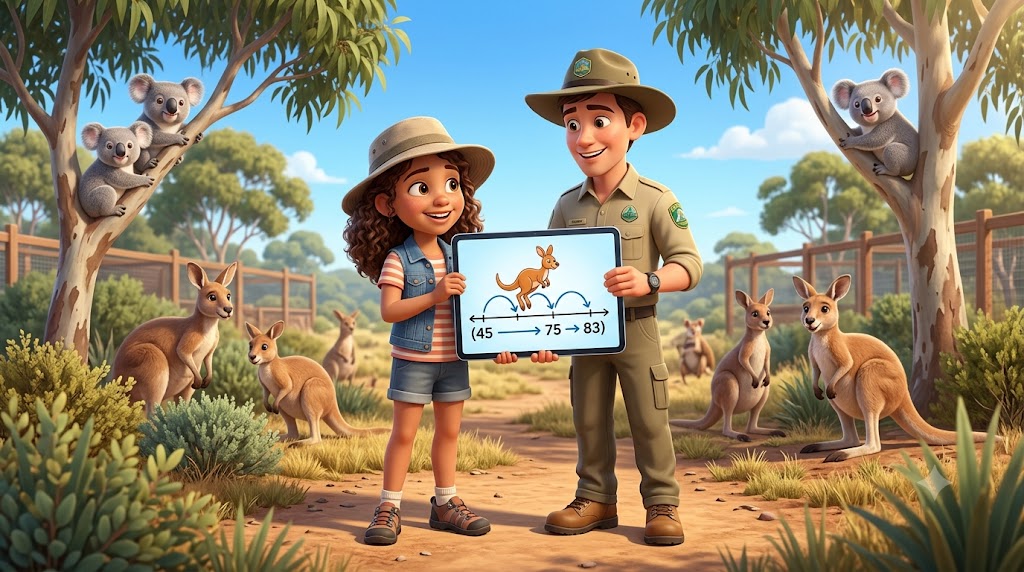
Eight-year-old Leo sat at the kitchen table, pencil gripped tightly in his hand, staring at his Year 3 homework sheet. He could easily tell you what $45 + 38$ was if you asked him out loud. But when those exact same numbers were hidden inside a story about rescuing kangaroos in the Australian bush, he completely froze.
The kitchen table had transformed into a battleground of tears, heavy sighs, and deeply erased paper.
Like most caring parents, his mother tried the usual playbook: force him to line up the digits vertically, write small little ones above the columns, and carry the numbers over. But to a frustrated eight-year-old, abstract vertical columns feel like arbitrary rules forced upon them by a cold system.
Enter the Guide: The Secret Weapon
Children do not fail at math word problems because they cannot compute; they fail because they cannot visualize the journey inside the story.
Instead of forcing rigid vertical columns, his mother introduced a simple visual weapon used by top educators: The Jump Strategy on an empty number line.
Instead of stacking numbers into tall towers, the Jump Strategy turns every math problem into a horizontal trail map across the page.
The Transformation: From Frozen to Fearless
That evening, Leo tackled a new story problem: “Ranger Sam has 45 kangaroos at the sanctuary and rescues 38 more. How many kangaroos are there now?”
Instead of panicking, Leo drew a simple horizontal line across his page and followed three clear steps:
- Land on the Starting Point: He wrote 45 on the far left of his trail.
- Make the Big Jumps: He broke 38 into 3 tens ($30$) and 8 ones. He drew 3 big arc jumps forward by ten: $45 \rightarrow 55 \rightarrow 65 \rightarrow 75$.
- Finish with the Small Hops: He drew 8 small hops forward to land softly on 83.
No column carrying. No erased paper. No tears. Within ten seconds, Leo looked up with a huge grin and announced, “There are 83 kangaroos, Mum!”
Write Your Child’s Success Story
When you give your child a visual map to navigate numbers, the “math monster” disappears, replaced by genuine curiosity and confidence.
At EinstyAI, we believe every child deserves to be the hero of their own learning journey. We transform dry curriculum standards into custom-tailored, interactive adventures featuring your child’s favorite passions—whether that’s wildlife rescue, gaming, or space exploration.
Head to EinstyAI today and create personalized story problems that turn homework battles into victories!
PRACTICE QUESTIONS
Year 3 Math Adventure: The Wildlife Rescue Center!
Instructions for Parents: Read these wildlife rescue stories with your child. Have them draw an empty number line on paper and use the Jump Strategy (jumping tens first, then hopping ones) to choose the correct answer.
Problem 1: Kangaroo Count
The Story: Ranger Sam cares for 45 eastern grey kangaroos at his sanctuary. A neighboring wildlife park transfers 38 more rescued kangaroos to his care.
- Question: How many kangaroos are at Ranger Sam’s sanctuary in total?
- A) 73
- B) 83
- C) 78
- D) 88
Problem 2: Hungry Koalas
The Story: Matilda the koala keeper collected 124 fresh eucalyptus branches in the morning. By sunset, the hungry koalas ate 46 of the branches.
- Question: How many eucalyptus branches are left for tomorrow morning?
- A) 82
- B) 168
- C) 78
- D) 88
Problem 3: Sea Turtle Nesting
The Story: Beach volunteers counted 156 sea turtle eggs in Nest A along the Queensland coast. Nest B had 67 fewer eggs than Nest A.
- Question: How many sea turtle eggs were in Nest B?
- A) 89
- B) 99
- C) 91
- D) 223