Tag: Stage 2

  • Why Is My Child Struggling With Fractions?

    Why Is My Child Struggling With Fractions?

    “Why does my child cry every time we open the math textbook?” If this sounds familiar, you are not alone. Many parents search for this answer because they watch their children go from confident learners to anxious students the moment fractions appear on the page.

    Here is the truth: Your child does not “hate math,” and they aren’t “bad at numbers.” They are simply reacting to a teaching method that prioritizes abstract rules over logical visualization.

    The Myth of the “Math Kid”

    We often hear the phrase, “Some kids just aren’t math kids.” This is a harmful assumption. Math is a language. When a child struggles with fractions, it is rarely a lack of ability; it is a lack of the right visual context. By aligning our approach with the Australian Curriculum standards, we can transform frustration into understanding. We don’t need to force memorization. We need to tell a better story.

    The Power of the Number Line

    When teaching unit fractions to Year 3 students, we must move away from just “drawing circles.” Circles are great, but they hide the relationship between numbers.

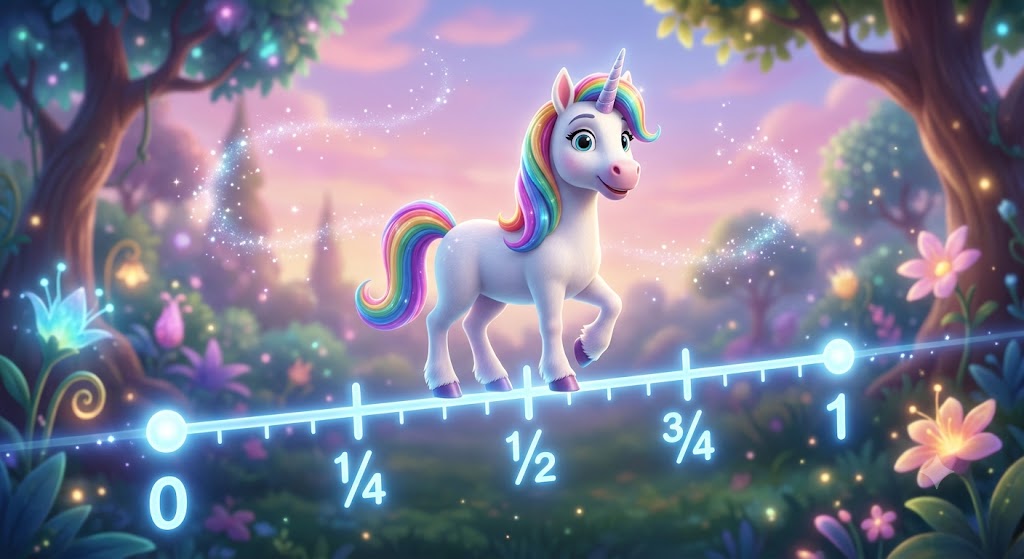
    The Number Line is the secret weapon for Stage 2 success. A number line provides a fixed, linear distance between 0 and 1. It turns a “fraction” into a physical journey.

    Here is the strategy:

    • Visualize the Path: Imagine the distance between 0 and 1 is a magical path.
    • Partitioning: If we want to show 1/4, we must split that path into 4 equal segments.
    • The Anchor: The fraction is simply the point where the first segment ends.

    By using this approach, students stop guessing which number goes on top. They see that the denominator tells them how many “jumps” to make to get to the destination.

    Your Action Plan

    Stop the homework battle tonight. Next time your child struggles with fractions, grab a ruler or draw a straight line on a piece of paper. Label the ends 0 and 1. Ask them, “If we need to place 1/3, how many equal jumps do we need to make to get to 1?”

    Visuals act as a bridge between the abstract concept and the real world. When children see the math, the anxiety disappears, and the logic takes over.

    For parents who want to turn these dry concepts into engaging, custom-tailored stories that align with the curriculum, visit EinstyAI to see how we make math a daily adventure, not a chore.

    Practice Questions

    Math Worksheet: The Magical Unicorn Journey

    Task: Help Sparkle the Unicorn navigate her magical forest. Use the number line below to find the correct spot for each fraction.

    Question 1

    Sparkle starts at 0 and needs to jump halfway to the Magical Meadow (1). Where should she land?

    A) The midpoint between 0 and 1

    B) At the number 1

    C) Before 0

    D) Past the number 1

    Question 2

    The path to the Rainbow Castle is marked in 4 equal parts. Where is 1/4 located?

    A) 3 jumps from 0

    B) 1 jump from 0

    C) 4 jumps from 0

    D) Exactly at 0

    Question 3

    Sparkle is collecting 1/3 of the Magic Gems on the path. The path is divided into 3 equal sections. Which point represents 1/3?

    A) The third mark near 1

    B) The last mark

    C) The first mark after 0

    D) The middle mark
  • How do I stop my Year 3 student from feeling overwhelmed by multiplication?

    How do I stop my Year 3 student from feeling overwhelmed by multiplication?

    Many parents tell us that math homework has become a nightly battleground. If your child struggles with the jump from basic counting to understanding numbers in the thousands and multiplicative fact families, you are not alone.

    There is a dangerous assumption that “some kids just aren’t math kids.” This is a myth. Math anxiety usually stems from teaching math as a set of rules to memorize, rather than a language to speak. When we introduce Year 3 students to larger numbers and multiplication, we must ground it in their reality—not just abstract grids on a page.

    The Leap to Thousands

    Year 3 represents a significant cognitive shift. Students move from working with simple two-digit numbers to understanding place value into the thousands.

    The strategy: Stop treating “thousands” as a bigger version of “ones.” Use visual models. If they understand that a packet of 10 candies is a “ten,” show them that 10 packets make a “hundred,” and 10 of those boxes make a “thousand.” Connecting the visual quantity to the numeral reduces the fear of large numbers.

    Mastering Fact Families (2, 4, 5, 10)

    Multiplication is just efficient addition. When students struggle with 2, 4, 5, and 10 fact families, they often try to memorize tables by rote. This is exhausting and ineffective.

    Try these tricks to make it stick:

    • The 10s rule: Remind them that multiplying by 10 is simply placing a zero on the end. It is the easiest bridge to understanding place value.
    • Doubling strategy: To multiply by 4, teach them to “double, then double again.” If they know 3 x 2 is 6, then 3 x 4 is just 6 doubled (12).
    • The Story Context: Turn the math into a narrative. If they are calculating how many alien legs there are on a spaceship (multiplied by 2), the math becomes a part of the adventure rather than a chore.

    Transform the Homework Routine

    We believe that learning math should be an engaging story, not a test of endurance. EinstyAI transforms standard curriculum requirements into custom-tailored stories that align with ACARA standards.

    When you replace the “battle” with a “narrative,” the math anxiety fades. Stop focusing on the result and start focusing on the story behind the numbers. If your child can visualize the problem, they can solve the equation.

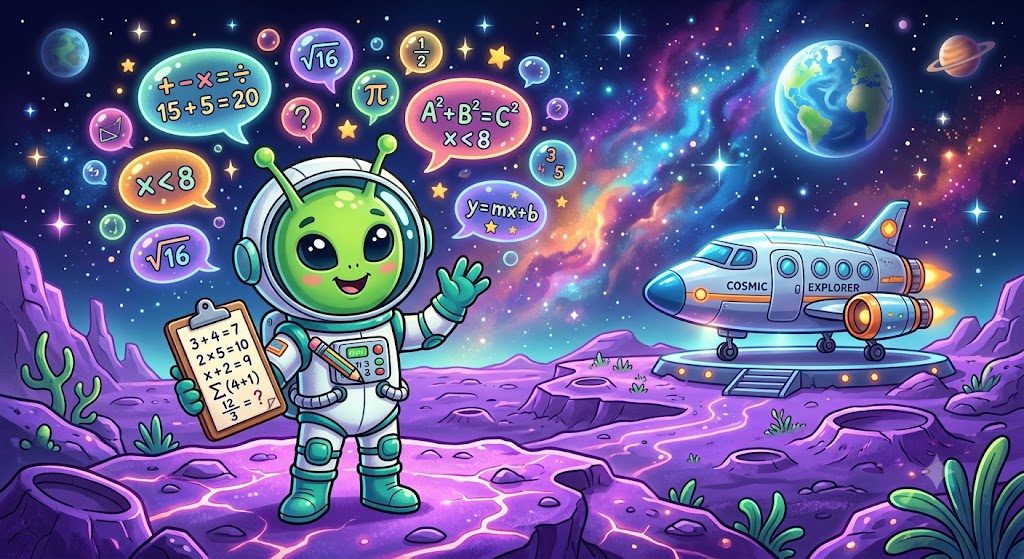
    Practice Questions (Space Explorer Edition)

    1. The Star-System Count

    Captain Zog is charting a course through the Andromeda sector. His ship’s computer identifies 3,000 stars in Sector A, 400 stars in Sector B, and 50 stars in Sector C. How many total stars did the computer identify?

    A) 3,450

    B) 3,045

    C) 3,405

    D) 345

    2. Alien Legs on the Mothership

    The ship lands on a moon where every creature has 2 legs. If there are 8 creatures waiting to greet the crew, how many legs are there in total?

    A) 10

    B) 16

    C) 12

    D) 18

    3. Moon Rock Collection

    The crew collects moon rocks in bags of 5. If they fill 7 bags, how many moon rocks have they collected?

    A) 30

    B) 45

    C) 35

    D) 25

  • How to Help Your Year 4 Child Master Decimals and Multiplication Without the Tears?

    How to Help Your Year 4 Child Master Decimals and Multiplication Without the Tears?

    Why does Year 4 feel like the moment math becomes “too hard” for so many students? It is a common frustration. Parents often assume their child simply lacks a “math brain,” but the reality is that the curriculum shifts dramatically during this year. Students move from basic arithmetic into the abstract world of decimals to hundredths and complex multiplication facts up to 10×10.

    Math is not a fixed talent; it is a learned language. When children struggle, it is usually because they are trying to memorize disconnected rules rather than understanding the story behind the numbers.

    The “Mental Math” Mindset Shift

    The biggest mistake parents make is focusing on rote memorization. Memorizing tables is useful, but understanding the “why” is transformative.

    For multiplication facts up to 10×10, teach your child to use the distributive property. If they are stuck on 7×6, encourage them to break it down into 7×5 plus 7×1. This simple trick reduces cognitive load and stops the “blank stare” that happens during timed tests.

    Visualizing Decimals to Hundredths

    Decimals often baffle students because they are taught as abstract symbols. Bring them into the real world. Use money (dollars and cents) or length (meters and centimeters) to make the concept of “hundredths” concrete.

    When a child sees 0.45 as 45 cents out of a dollar, they stop seeing decimals as confusing dots and start seeing them as parts of a whole.

    Stop the Homework Battle

    If math homework has become a battleground, stop. Math anxiety stems from high-pressure environments where errors are punished rather than explored.

    Instead of hovering, ask your child to explain the logic they used. If they get the wrong answer, ask, “How did you arrive at that?” instead of “No, that’s wrong.” This shift builds confidence and critical thinking.

    At EinstyAI, we specialize in transforming these dry, academic requirements into engaging, custom-tailored stories that align with the curriculum. You don’t need to be a math expert to support your child; you just need the right tools to turn practice into play.

    Take the first step today: Stop battling, start story-telling.

    Practice Questions

    Math Worksheet: The Deep Space Explorer’s Mission

    Theme: You are a Deep Space Data Analyst. Use your math skills to repair the navigation systems of the Starship Numerator.

    Question 1

    The ship’s scanner detected an asteroid at 0.52 kilometers away. The shield sensors are only active for objects closer than 0.5 kilometers. Is the asteroid inside the danger zone?

    A) Yes, because 0.52 is smaller than 0.5.

    B) No, because 0.52 is greater than 0.5.

    C) Yes, because 52 is a larger number than 5.

    D) No, because 0.5 is equal to 0.50.

    Question 2

    To boost the warp drive, you need to calculate 7×8. You have a “Distributive Shortcut” chip installed. Which of these is the correct way to solve this using your shortcut?

    A) Solve 7×4 and multiply the result by 2.

    B) Solve 7×5 and add 7×3.

    C) Solve 7×10 and subtract 7.

    D) Solve 7×6 and add 7×1.

    Question 3

    The alien fuel pod is currently filled to 0.08 of its total capacity. What is another way to represent this amount?

    A) 8 tenths.

    B) 8 hundredths.

    C) 80 hundredths.

    D) 0.8.