Tag: Whole numbers

  • Why is Year 1 math homework a battleground and how do you fix it?

    Why is Year 1 math homework a battleground and how do you fix it?

    Does sitting down for math homework with your Year 1 child feel like a daily negotiation? You are not alone. Many parents believe that some children just “aren’t math kids.” This is a myth. The struggle rarely stems from a lack of ability; it stems from a disconnect between how math is taught in the classroom and how it is practiced at home.

    The Australian curriculum has shifted away from rote memorization toward deep conceptual understanding. For Year 1 students, the pivot point is part-part-whole reasoning. If your child struggles with addition and subtraction within 20, they likely haven’t mastered this mental model yet.

    What is Part-Part-Whole Reasoning?

    Think of a number as a “whole” bucket. You can split that bucket into two smaller “parts.” For example, if the whole is 10, the parts could be 6 and 4.

    When children learn to see numbers this way, addition and subtraction become the same relationship viewed from different angles. Addition is putting the two parts together to find the whole. Subtraction is starting with the whole and removing one part to find the other.

    Key Takeaway: Stop teaching your child to “count up” or “count down” on their fingers. Start asking, “What is the whole, and what are the parts?”

    The “Story Problem” Trick for Success

    Children often panic when they see a number sentence like 12 – 5 = ? because it looks abstract. They don’t see the context. The secret to EinstyAI is transforming these dry numbers into meaningful stories.

    When helping your child at home, use the “Visual Story” technique:

    1. Give the numbers a job: Instead of “12 minus 5,” say, “There are 12 koalas in a tree. 5 jump down to get a drink. How many are left in the tree?”
    2. Draw the parts: Encourage your child to draw the 12 koalas. Then, have them circle the 5 that jump away. This creates a visual representation of the “whole” (12) being split into the “part” that left (5) and the “part” remaining (7).
    3. Translate to Math: Only after they solve the story should you write the number sentence (12 – 5 = 7).

    Actionable Strategy: Next time your child gets stuck, stop focusing on the answer. Ask, “What are the parts we know, and what is the whole we are trying to find?” This mindset shift builds confidence because it turns math from a guessing game into a puzzle they can solve.

    Stop battling over rote practice. Help your child build these mental models by using stories that make sense to them. Complete our Year 1 Math Worksheet below to start practicing part-part-whole reasoning today.

    Practice Questions

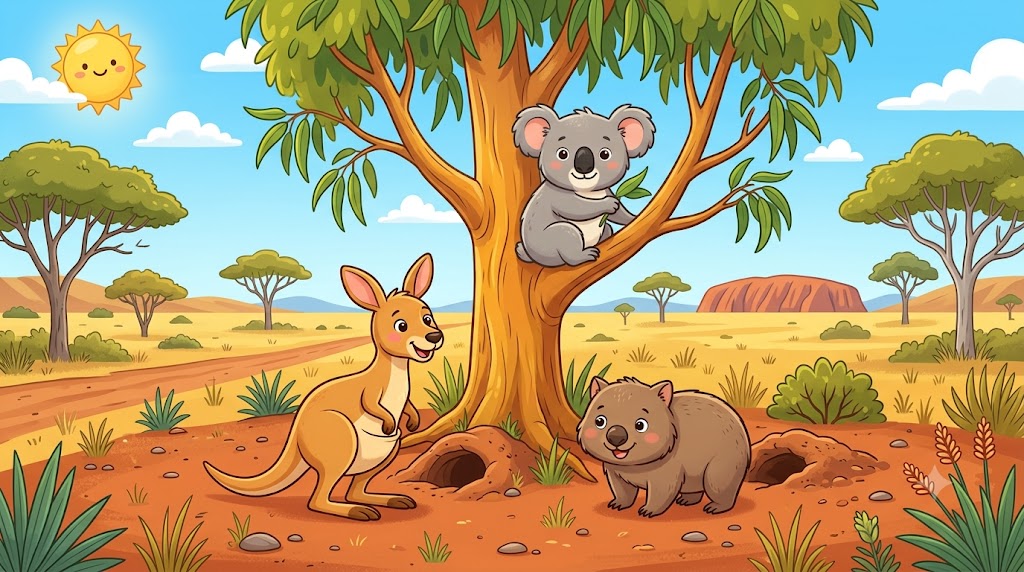
    The Great Outback Animal Rescue Challenge

    Welcome to the Outback Rescue! You are a Junior Ranger tasked with counting and caring for our native animals. Use your part-part-whole skills to ensure every animal is safe and accounted for.

    Question 1: The Kangaroo Hop

    A group of 14 kangaroos is resting in the shade. 6 kangaroos decide to hop away to find fresh grass. How many kangaroos are left resting in the shade?

    A) 6

    B) 7

    C) 8

    D) 20

    Question 2: The Wombat Burrow

    There are 9 wombats in a big burrow and 5 wombats in a smaller tunnel nearby. How many wombats are there altogether?

    A) 4

    B) 12

    C) 14

    D) 15

    Question 3: The Emu Egg Collection

    A ranger finds a nest with 18 eggs in total. If 9 eggs are in the main nest and the rest are in a hidden patch, how many eggs are in the hidden patch?

    A) 8

    B) 9

    C) 10

    D) 27
  • Mastering the 120 Barrier: Why Your Year 1 Student Needs More Than Just Rote Counting

    Mastering the 120 Barrier: Why Your Year 1 Student Needs More Than Just Rote Counting

    Do you ever feel like math time at home is just a battle against a calendar, waiting for the homework to end?

    Many parents believe that if their Year 1 child can count to 20 or 50, they are doing just fine. But when we treat math as a checklist of memorized numbers, we are missing the bigger picture. Students in Year 1, Stage 1 (A) are capable of much more than rote recitation. They are ready to master numbers up to 120 and understand the fundamental logic of odd and even numbers.

    The “120” Hurdle is a Mental Gateway

    Counting to 120 isn’t just about speed; it is about recognizing patterns in our Number and Algebra strand. When children move past 100, they often freeze. They see 101, 102, and 103 as individual, scary mountains.

    The trick? Teach them the structure of our number system. Use objects to show that 102 is just “one hundred” and “two.” When students visualize the base-ten structure, the anxiety vanishes. They stop memorizing and start seeing the logic.

    Why “Odd and Even” is a Life Skill

    Is math a boring chore or a way to understand the world? When you teach your child about odd and even numbers, you are teaching them about fairness. Even numbers are “fair”—everything has a partner. Odd numbers are “lonely”—one always remains.

    Bold Takeaway: If you can group it into pairs, it is even. If one is left over, it is odd.

    Bring this into your kitchen. Take 15 grapes. Ask your child, “Can we share these fairly between the two of us?” When they find that one grape remains, they have solved an odd-number problem using the real world. They are no longer memorizing rules; they are navigating reality.

    Stop the Battle, Start the Narrative

    Stop letting math be a battlefield in your living room. You don’t need more flashcards or repetitive worksheets that kill curiosity. You need strategies that transform numbers into adventures.

    When students see math as a puzzle to be solved rather than a test to be passed, engagement spikes. Your child doesn’t need to be a “math person” to succeed. They just need the right context.

    Ready to turn your child’s math practice into an adventure? Visit EinstyAI to transform your child’s learning journey into engaging, curriculum-aligned stories today.

    Practice Questions

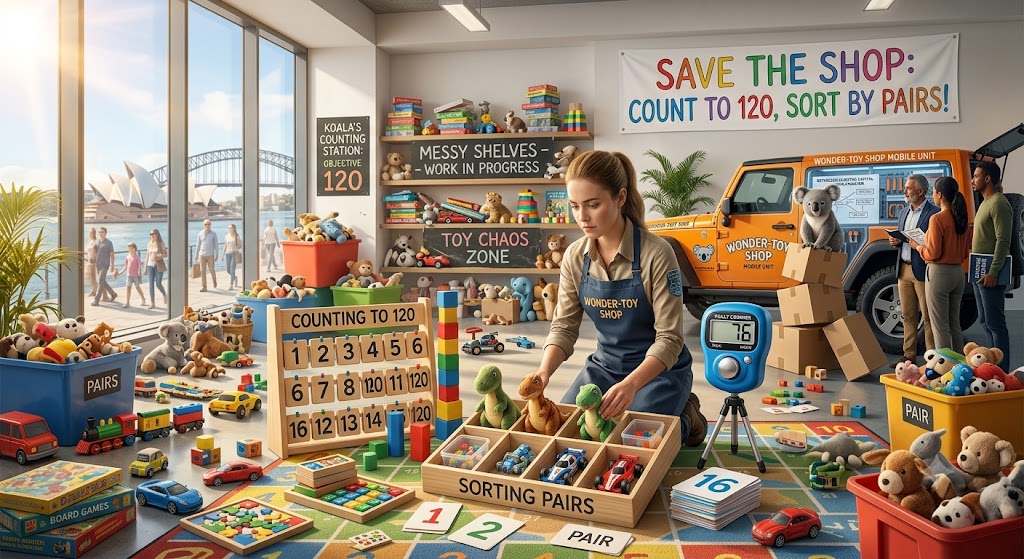
    The Great Toy Store Inventory: A Counting Adventure

    Mission Briefing: You have been hired as the Chief Inventory Officer for “Wonder-Toy Shop.” The shelves are messy, and the toys are everywhere! Use your skills in counting to 120 and sorting pairs to save the shop.

    Question 1: The Teddy Bear Parade

    The shop has a massive display of teddy bears on the shelf. You count them carefully, and you reach the number 105. Write down the next 5 numbers you would count to keep track of the rest of the bears.

    Question 2: The Sock Sorting Mystery

    We have a box of superhero socks. There are 14 socks in the pile. If you group them into pairs to put them on the shelves, will there be any socks left over? Is 14 an odd or an even number?

    Question 3: The Missing Aisle Marker

    The shop’s aisle markers follow a pattern. Aisle 110 is empty. Aisle 111 is empty. Aisle 112 has the board games. Aisle 113 is empty. What number is the next aisle, and is that number odd or even?