Tag: Stage 4

  • How the ‘Expansion Box’ Helped Sam Transform Math Panic into Puppy-Loving Confidence

    How the ‘Expansion Box’ Helped Sam Transform Math Panic into Puppy-Loving Confidence

    Sam sat at the kitchen table, tears welling up as a blank sheet of paper mocked him. He was supposed to expand and factorise linear expressions—part of his Year 8 curriculum in Algebra and Relationships—but all he saw were abstract letters and numbers that didn’t make sense. Beside him, a photo of his favourite shelter animals served as a reminder of the pet adoption drive he wanted to organize, but the math needed to plan the supply bags felt impossible. His parents felt that familiar sting of helplessness; they knew how to do the math, but explaining it without causing an argument was a different story.

    The issue isn’t the child; it’s the method. Forcing Year 8 students to jump straight into abstract symbol manipulation—like multiplying 2(x+3)—without a visual map is a recipe for anxiety. When kids try to memorise “rules” instead of understanding the geometry of numbers, they freeze the moment they encounter a sign change or a complex variable.

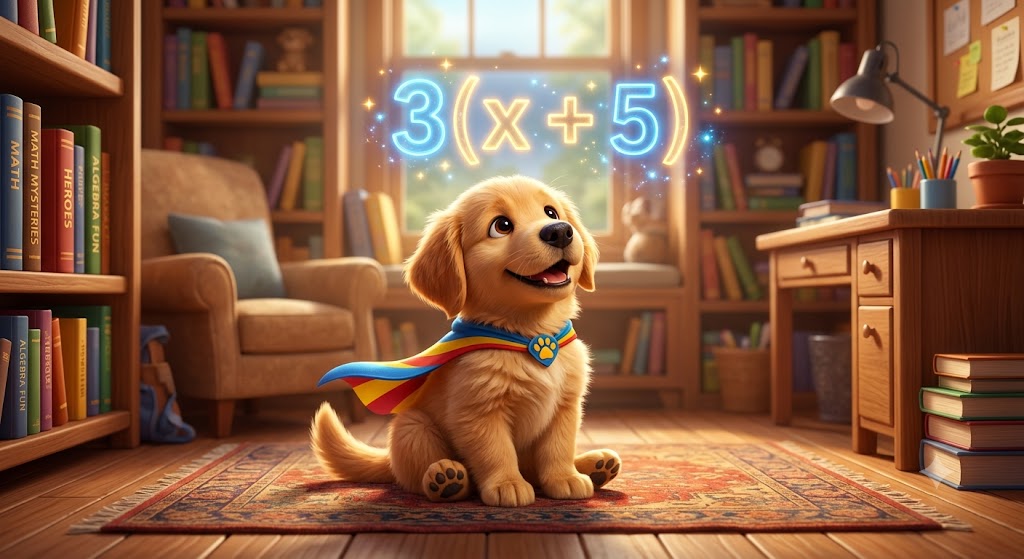
    Enter the Expansion Box (or Area Model), our secret weapon for conquering algebra. Instead of looking at expressions as scary strings of letters, we treat them as shapes. If Sam needs to organise supply bags for his Cute Puppies & Kittens charity event, he can view his algebra problem as physical boxes of treats.

    Here is the transformation: When Sam sees 2(x + 4), he draws a rectangle. The side of the rectangle is 2, and the length is split into x and 4. He fills the two smaller boxes: 2 times x is 2x, and 2 times 4 is 8. Adding them together gives 2x + 8. Suddenly, the abstract equation isn’t a riddle; it’s a picture of reality. Sam shifted from panic to pride, successfully mapping his supply needs on the Cartesian plane to visualize his event data.

    Stop the homework tears and reclaim your evenings. At EinstyAI, we transform dry math problems into engaging, custom-tailored stories that make sense to your child. Let’s turn math anxiety into mastery.

    Practice Questions

    1. Sam is organizing treat bags for a kitten adoption drive. Each of the 5 bags contains x treats and 2 toy mice. Which expression represents the total number of items if we factorise the distribution?
      A) 5x + 2
      B) 5(x + 2)
      C) 5x + 10
      D) 5 + 2x
    2. Sam needs to expand the expression 3(2x – 4) to calculate the total puppy food cups required. What is the correct expansion?
      A) 5x – 1
      B) 6x – 4
      C) 6x – 12
      D) 3x – 12
    3. On his Cartesian map, Sam plots the number of puppies (x) against the number of food bowls (y). If the relationship is y = 2x + 3, how many bowls are needed for 4 puppies?
      A) 7
      B) 9
      C) 11
      D) 10
  • How the Inverse Operation Method Helped Sam Banish the Unicorn Algebra Monster

    How the Inverse Operation Method Helped Sam Banish the Unicorn Algebra Monster

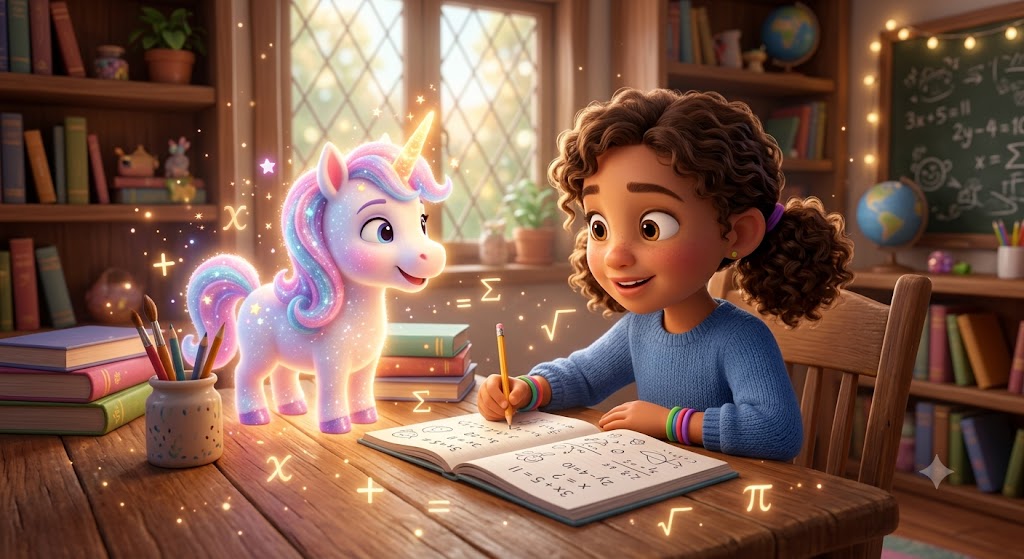
    Sam sat at the kitchen table, pencil hovering over a worksheet about “Pronumerals.” Between the tears and the crumpled paper, a unicorn-themed textbook lay open, but the numbers might as well have been in a foreign language. Sam wasn’t just struggling with Algebra; the frustration was palpable. The equation 3x + 4 = 19 looked like a riddle with no answer, and every attempt felt like a guess in the dark.

    The Guessing Game Trap

    Many students in Year 7 get stuck because they try to “guess” the value of the letter (the pronumeral). They look at an expression and try to mentally force a number into the ‘x’ slot. When that doesn’t work, they panic. This approach fails because algebra isn’t about guessing; it is about logic. When parents try to explain it using abstract rules, children often freeze. The math feels like a chore, disconnected from the logic they actually possess.

    The Guide: The “Inverse Operation” Method

    To master two-step linear equations, we stop guessing and start “un-doing.” Think of an equation like a balanced scale or a locked treasure chest. To find the secret number, we must apply the Inverse Operation Method. If the equation added a number, we subtract it. If it multiplied, we divide. By reversing the operations in the correct order, we peel away the layers until the ‘x’ stands alone.

    The Transformation: Solving for the Unicorn’s Treasure

    Let’s look at Sam’s homework problem: 3x + 4 = 19.

    1. Step 1 (The Subtraction): We see “+ 4”. To undo this, we subtract 4 from both sides. Now, 3x = 15.
    2. Step 2 (The Division): We see “3x” (which means 3 times x). To undo this, we divide by 3. Now, x = 5.

    Suddenly, Sam wasn’t staring at a scary “x”; Sam was cracking a code. The anxiety evaporated, replaced by the satisfaction of solving the puzzle.

    End the Homework Battle

    Don’t let your child feel like math is an unsolvable mystery. At EinstyAI, we transform dry curriculum outcomes into personalized stories that stick. By aligning abstract concepts like algebra with the topics your child loves—whether it’s unicorns, sports, or space—we turn the “homework battle” into a moment of discovery. Stop fighting the curriculum and start using stories that make math feel like play. Visit EinstyAI to find custom-tailored resources designed to help your child succeed.

    Algebra Practice: The Unicorn Enchantment

    1. The Magic Forest Trail

    A magical forest path requires 3 enchanted crystals plus an extra 5 magic pebbles to open. If the total cost to open the path is 20 items, how many crystals (c) do you need? (Equation: 3c + 5 = 20)

    A) 4

    B) 5

    C) 8

    D) 15

    2. Feeding the Unicorns

    You have 2 bags of star-dust plus 7 extra pouches of moon-beams to feed your unicorns. If the total number of items is 15, how many items are in each bag of star-dust (s)? (Equation: 2s + 7 = 15)

    A) 11

    B) 4

    C) 8

    D) 3

    3. The Wizard’s Potion

    To make a flight potion, you need 4 drops of liquid gold plus a 2-drop starter base. The total drops needed is 18. How many drops are in each liquid gold portion (g)? (Equation: 4g + 2 = 18)

    A) 4

    B) 5

    C) 6

    D) 4.5