Does math homework often turn into a battle of tears and frustration at your kitchen table? You aren’t alone, and the problem usually isn’t that your child “isn’t a math kid.” The disconnect often happens because we teach children to memorize isolated steps rather than visualizing numbers as physical objects.
Many parents assume that math success requires rapid calculation skills. In reality, the ACARA curriculum for Stage 1 (B) emphasizes conceptual fluency over raw speed. When children can partition three-digit numbers and use the jump strategy on empty number lines, they unlock the ability to visualize math instead of guessing.
What is the “Jump Strategy”?
The jump strategy is a visual technique for addition where we break numbers apart (partitioning) to make them easier to handle. Instead of trying to add everything in one go, your child starts on a number line and makes “jumps.”
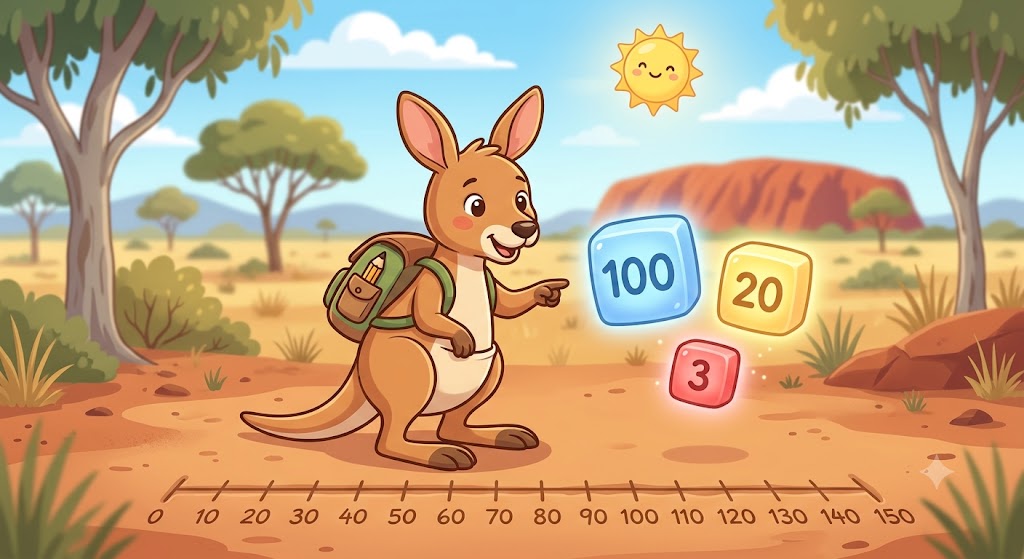
For a problem like 345 + 123, we partition the second number (123) into 100, 20, and 3. On the empty number line, we start at 345. We jump 100 to reach 445. Then, we jump 20 to reach 465, and finally, we jump 3 to reach the total of 468.
Why this method works
Partitioning turns abstract math into a story problem. It allows the brain to process one chunk of the number at a time, reducing the cognitive load. By placing these chunks onto a line, children can actually see the distance they are traveling.
Key Takeaway: Stop focusing on the “right answer” and start focusing on the “right path.” If your child can explain their jumps, they understand the place value, and the calculation will naturally follow.
Helping your child at home
Stop forcing rote memorization of sums. Instead, draw an empty number line on a piece of paper. Ask your child to mark the starting number on the left and show you how they would “jump” toward the answer.
If they get stuck, help them break the second number down into hundreds, tens, and ones. This builds the foundational number sense needed for higher stages of primary school.
At EinstyAI, we help children transform these concepts into engaging, custom-tailored, curriculum-aligned stories. When math becomes a story about characters rather than dry equations, the anxiety disappears, and confidence builds.
Ready to change the way your child learns? Grab a pencil, draw an empty line, and start jumping today.
Practice Questions
The Great Outback Animal Rescue: Worksheet
Join Kiki the Kangaroo and her friends as they help rescue lost animals in the Australian Outback. Solve these number problems using the jump strategy!
Question 1
Kiki found 234 lost wallabies. Later, she found 120 more hidden in a cave. Which partition shows how to break down the number 120 to help with the jump strategy?
A) 100 + 20 + 0
B) 100 + 2 + 0
C) 10 + 20 + 0
D) 120 + 0 + 0
Question 2
Emu Eddy is running to find water. He starts at 350 and needs to jump forward by 210. After his first jump of 200, where does he land on the number line?
A) 500
B) 550
C) 450
D) 650
Question 3
A hungry wombat has 425 berries. He collects 142 more from a bush. Using the jump strategy, what is the best sequence of jumps to solve 425 + 142?
A) Jump 1, then 4, then 2
B) Jump 100, then 40, then 2
C) Jump 10, then 40, then 20
D) Jump 140, then 2, then 0