
Tag: Perimeter

  • How Can I Help My Year 5 Student Master the Cartesian Plane and Perimeter?

    How Can I Help My Year 5 Student Master the Cartesian Plane and Perimeter?

    Why does your child view math problems as an unsolvable maze rather than a blueprint to build their own world? Many parents assume that math anxiety is an inherited trait—that some kids are simply “not math people.” This is a myth. When students struggle with Year 5 Measurement and Space concepts, it is rarely because they lack ability. It is because the abstract concepts feel disconnected from reality.

    The Problem: Math in a Vacuum

    In Year 5 (Stage 3), students are introduced to the Cartesian plane and the calculation of perimeters for composite shapes. Without context, a grid of coordinates and a series of lines are just numbers on a page. This is where disengagement starts. Children do not learn mathematics by staring at textbooks; they learn by interacting with their environment.

    The Solution: Building with Coordinates

    The Cartesian plane is essentially a map. If your child plays Minecraft, they are already using coordinate geometry. Every block placed in a Minecraft world occupies a specific x and y coordinate. When we shift the focus from rote memorization to spatial reasoning, the math becomes intuitive.

    To teach perimeter of composite shapes, stop asking for “perimeter” and start asking for the “fencing required to secure a base.” A composite shape is just two simple rectangles joined together. The secret trick is to treat the shape like a room layout. Instead of guessing the missing sides, break the complex shape into two smaller, simple rectangles. Calculate their perimeters individually, then subtract the shared wall. This prevents the common trap of counting interior lines.

    Master the Grid Today

    If your child struggles with math, stop the “drill and kill” homework sessions. Connect the curriculum to the games they love. When they calculate the perimeter of a virtual base, they aren’t just doing math; they are engineering. Math is not a battle to be won; it is a tool to be used.

    Practice Questions

    Theme: The Minecraft Architect Challenge

    Question 1: The Diamond Coordinates

    Steve is placing a rare Diamond Block on his base grid. The base starts at (0,0). Steve places the block exactly 3 units to the right and 4 units up from the starting point. What are the coordinates of the Diamond Block?

    A) (4, 3)

    B) (3, 4)

    C) (3, 3)

    D) (4, 4)

    Question 2: Protecting the Base

    Steve builds a rectangular crafting room that is 5 metres long and 4 metres wide. What is the total perimeter of this room?

    A) 9 metres

    B) 18 metres

    C) 20 metres

    D) 15 metres

    Question 3: The L-Shaped Lookout

    Steve builds an L-shaped lookout tower. The horizontal bottom is 6 metres wide. The vertical left side is 8 metres high. The top horizontal arm is 2 metres, and the vertical drop is 4 metres. The remaining two sides close the shape. Assuming all angles are right angles, what is the total perimeter of the lookout?

    A) 20 metres

    B) 24 metres

    C) 28 metres

    D) 32 metres
  • How do I explain area and perimeter to my Year 4 child without the tears?

    How do I explain area and perimeter to my Year 4 child without the tears?

    Is your kitchen table the nightly battleground for math homework? You are not alone. Many parents search for ways to simplify geometry, often assuming that math homework is naturally a battle. Here is the truth: Math doesn’t have to be a struggle. When you shift the mindset from “solving problems” to “solving stories,” the anxiety disappears.

    Perimeter vs. Area: The Simple Distinction

    Children often confuse perimeter and area because both involve shapes. To keep them clear, use the Fence and Grass analogy:

    • Perimeter is the fence. It is the distance around the edge. If your child were a skater, the perimeter is the metal rail they ride along.
    • Area is the grass. It is the space inside the shape. If your child is skating, the area is the concrete slab they roll across.

    The “Border and Fill” Trick

    To help students master these concepts, teach them to physically trace the shape before calculating.

    1. Trace the Border: Use a finger to outline the object. This is for Perimeter (measured in centimetres or metres).
    2. Fill the Space: Use a shading motion to cover the surface. This is for Area (measured in square centimetres or square metres).

    When students encounter a question, ask them: “Are we counting the fence, or are we tiling the floor?” This simple check prevents the most common mistake: adding the length and width instead of calculating the space inside.

    Bring Math to Life

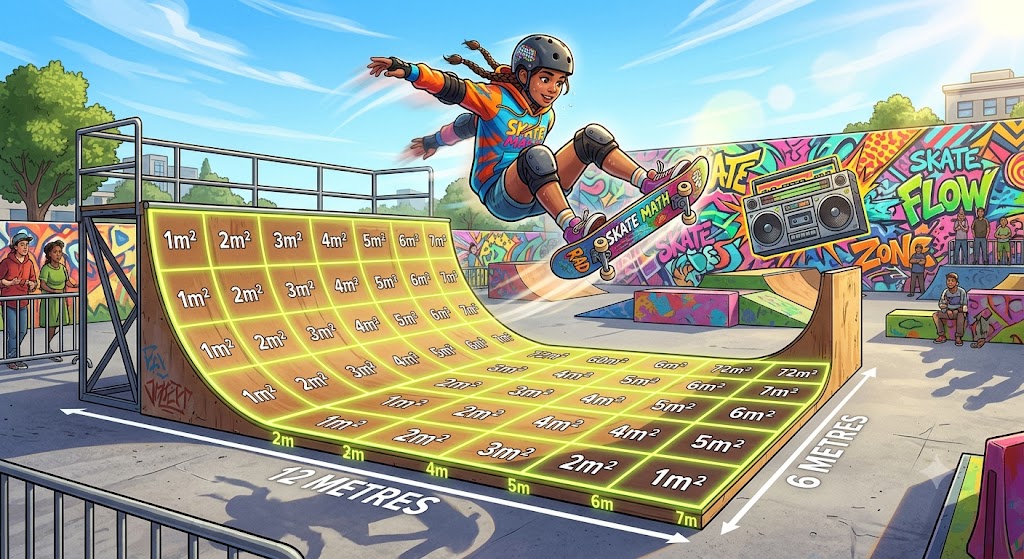
    The key to deep learning is context. If your child loves skateboarding, don’t force them to measure abstract rectangles in a workbook. Instead, have them design a dream skate park. Ask them to calculate the perimeter of a new ramp for safety fencing, or the area of concrete needed for a flat-bank section. By connecting abstract concepts like square centimetres to real-world objects, you move them from rote memorization to true understanding.

    If you are looking for ready-to-use math stories that turn these concepts into engaging adventures, check out EinstyAI. We help students conquer math anxiety by transforming dry curriculum requirements into compelling stories. Stop fighting over homework and start exploring.

    Practice Questions: The Skate Park Challenge

    1. The Grind Rail

    A new rectangular grind rail is 4 metres long and 1 metre wide. If we need to put rubber edging all the way around the rail, what is the total length of edging required?

    A) 4 square metres

    B) 5 metres

    C) 8 metres

    D) 10 metres

    2. The Concrete Pad

    You are designing a small concrete practice slab that is 3 metres long and 3 metres wide. How much surface area will this slab cover?

    A) 6 square metres

    B) 9 square metres

    C) 12 square metres

    D) 18 square metres

    3. The Half-Pipe Floor

    A skater needs to cover a section of the half-pipe floor with non-slip grip tape. The section is 5 centimetres wide and 4 centimetres long. What is the area of the grip tape needed?

    A) 9 square centimetres

    B) 18 square centimetres

    C) 20 square centimetres

    D) 25 square centimetres