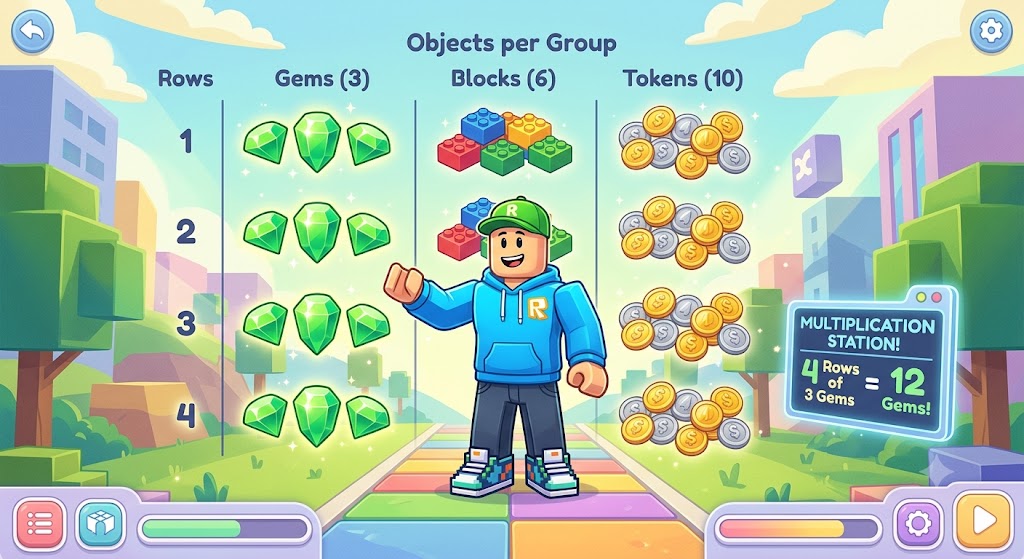
Why does Year 4 feel like the moment math becomes “too hard” for so many students? It is a common frustration. Parents often assume their child simply lacks a “math brain,” but the reality is that the curriculum shifts dramatically during this year. Students move from basic arithmetic into the abstract world of decimals to hundredths and complex multiplication facts up to 10×10.
Math is not a fixed talent; it is a learned language. When children struggle, it is usually because they are trying to memorize disconnected rules rather than understanding the story behind the numbers.
The “Mental Math” Mindset Shift
The biggest mistake parents make is focusing on rote memorization. Memorizing tables is useful, but understanding the “why” is transformative.
For multiplication facts up to 10×10, teach your child to use the distributive property. If they are stuck on 7×6, encourage them to break it down into 7×5 plus 7×1. This simple trick reduces cognitive load and stops the “blank stare” that happens during timed tests.
Visualizing Decimals to Hundredths
Decimals often baffle students because they are taught as abstract symbols. Bring them into the real world. Use money (dollars and cents) or length (meters and centimeters) to make the concept of “hundredths” concrete.
When a child sees 0.45 as 45 cents out of a dollar, they stop seeing decimals as confusing dots and start seeing them as parts of a whole.
Stop the Homework Battle
If math homework has become a battleground, stop. Math anxiety stems from high-pressure environments where errors are punished rather than explored.
Instead of hovering, ask your child to explain the logic they used. If they get the wrong answer, ask, “How did you arrive at that?” instead of “No, that’s wrong.” This shift builds confidence and critical thinking.
At EinstyAI, we specialize in transforming these dry, academic requirements into engaging, custom-tailored stories that align with the curriculum. You don’t need to be a math expert to support your child; you just need the right tools to turn practice into play.
Take the first step today: Stop battling, start story-telling.
Practice Questions
Math Worksheet: The Deep Space Explorer’s Mission
Theme: You are a Deep Space Data Analyst. Use your math skills to repair the navigation systems of the Starship Numerator.
Question 1
The ship’s scanner detected an asteroid at 0.52 kilometers away. The shield sensors are only active for objects closer than 0.5 kilometers. Is the asteroid inside the danger zone?
A) Yes, because 0.52 is smaller than 0.5.
B) No, because 0.52 is greater than 0.5.
C) Yes, because 52 is a larger number than 5.
D) No, because 0.5 is equal to 0.50.
Question 2
To boost the warp drive, you need to calculate 7×8. You have a “Distributive Shortcut” chip installed. Which of these is the correct way to solve this using your shortcut?
A) Solve 7×4 and multiply the result by 2.
B) Solve 7×5 and add 7×3.
C) Solve 7×10 and subtract 7.
D) Solve 7×6 and add 7×1.
Question 3
The alien fuel pod is currently filled to 0.08 of its total capacity. What is another way to represent this amount?
A) 8 tenths.
B) 8 hundredths.
C) 80 hundredths.
D) 0.8.