Tag: multiplication

  • How the Sharing Circle Strategy Helped Mia Save the Mermaid Kingdom

    How the Sharing Circle Strategy Helped Mia Save the Mermaid Kingdom

    It started with a splash of water and a puddle of tears. Mia, a bright Year 3 student, sat at the kitchen table, her pencil hovering over a math worksheet. The task: “Distribute 20 wizard potions into 4 equal mermaid treasure chests.”

    To Mia, this wasn’t just math; it was a puzzle she felt she couldn’t solve. The numbers felt cold and abstract. For many parents, this is the daily “homework battle”—watching your child freeze up when faced with a word problem that looks more like a foreign language than a math question.

    The Problem with “Just Divide”

    The mistake we often make is rushing children into abstract operations like formal long division. For a Year 3 student in Stage 2, forcing them to stack numbers without a visual bridge creates anxiety. When math is abstract, the brain shuts down. Mia didn’t need to learn a digit-by-digit process; she needed to visualize the story.

    The Magic Tool: The Sharing Circle Method

    We introduced the Sharing Circle Method. This is a visual weapon that turns a word problem into a physical map. Instead of staring at numbers on a page, we draw four circles (the treasure chests) and physically distribute the items (the potions) one by one.

    This strategy anchors the concept of “equal sets” in the physical world. It transforms abstract division into concrete, rhythmic action—”one for you, one for you”—until every potion is accounted for.

    From Panic to Confidence

    We took Mia’s worksheet: “Distribute 20 wizard potions into 4 equal mermaid treasure chests.”

    Instead of panic, Mia drew four circles. She started counting, placing a tally mark in each circle until she reached 20. She looked up, beaming. “Five! There are five potions in each chest.” By mapping the math, the division calculation became invisible, and the solution became obvious.

    Confidence in math isn’t about memorizing rules; it’s about having the tools to visualize the problem.

    Turn Homework Battles into Quests

    You don’t have to navigate these homework hurdles alone. EinstyAI specializes in transforming dry curriculum-aligned math into engaging, custom-tailored stories that help children overcome math anxiety. Visit EinstyAI today and turn your next math session into a victory.


    Practice Questions: The Mermaid Kingdom Quest

    Question 1

    In the Coral Palace, you have 15 healing kelp bundles to share equally among 3 sleepy baby seahorses. How many bundles does each seahorse get?

    A) 3

    B) 4

    C) 5

    D) 15

    Question 2

    The Mermaid Queen has 24 glowing pearls. She wants to place them into 4 display cases so each case has the same amount. How many pearls go into each case?

    A) 6

    B) 8

    C) 4

    D) 20

    Question 3

    Mia the Mermaid found 12 magic starfish. She wants to arrange them into 2 equal rows on the ocean floor to guide the school of fish. How many starfish are in each row?

    A) 2

    B) 4

    C) 10

    D) 6
  • Why does my Year 5 student get stuck on multi-step math problems?

    Why does my Year 5 student get stuck on multi-step math problems?

    Every parent has faced the same wall: you sit down to help with homework, and the initial enthusiasm quickly dissolves into frustration. Why do students who are perfectly capable of adding and subtracting suddenly freeze when faced with a “word problem”?

    The answer is rarely about their ability to calculate. It is about their ability to translate. At the Year 5 Stage 3 level, math moves beyond simple arithmetic into Number and Algebra, where understanding the relationship between numbers is critical. When a child sees a multi-step word problem, they often see a wall of text that looks nothing like the neat equations in their textbook. They aren’t struggling with the math; they are struggling with the story.

    The mindset shift: Math is just a story

    Too many parents fall into the trap of thinking their child just “isn’t a math kid.” This creates a fixed mindset that labels a temporary struggle as a permanent character trait. In reality, math anxiety often stems from the disconnect between abstract numbers and real-world logic.

    By teaching students to break down complex problems into manageable steps, we lower that anxiety. At EinstyAI, we believe that if you can change the story, you change the result. When you frame a percentage calculation as a quest for rare loot in a game, the abstract concepts—like calculating 10%, 25%, or 50%—become tangible tools for success rather than chores to be completed.

    Mastering percentages and multi-step logic

    To solve multi-step problems, encourage your child to use the “Highlight and Pause” method.

    • Highlight the goal: What is the final question asking for?
    • Pause and plan: Before calculating, write down the known variables.
    • Divide and conquer: If the problem asks to find 10% of a total and then subtract it, that is two separate, solvable tasks. Treat them that way.

    When students learn to look for benchmarks like 10% (move the decimal one spot), 50% (divide by 2), and 25% (half of 50%), they stop guessing and start strategizing. These aren’t just tricks; they are foundational skills that make complex Number and Algebra tasks feel intuitive. Stop fighting the homework. Start building the story, and watch the math follow.

    Practice Questions

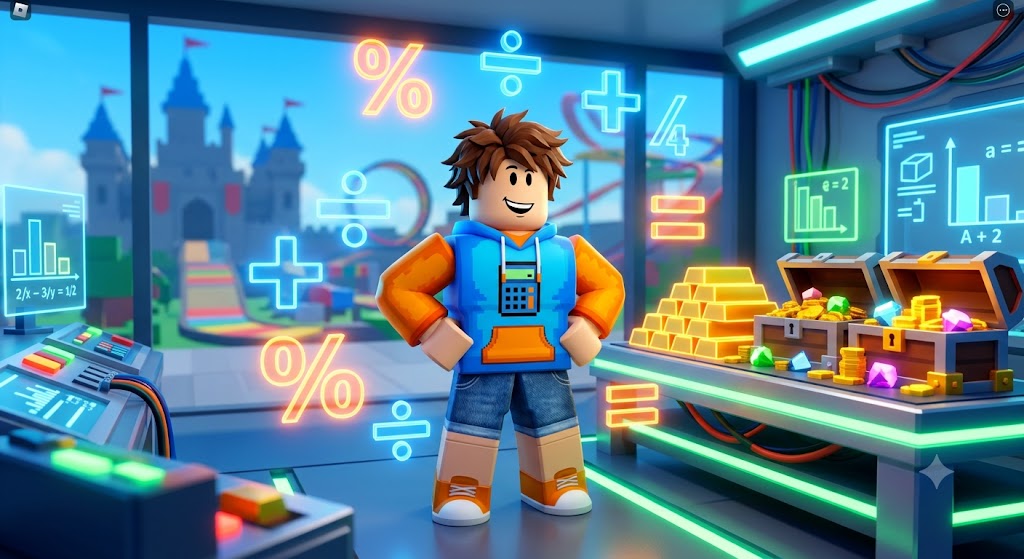
    Scenario: You are a top-tier gamer in the Roblox universe. Your success depends on your ability to manage your Robux and inventory to build the ultimate game world.

    Question 1

    You have 800 Robux. You decide to spend 50% of it on a new avatar skin and then use 10% of your remaining Robux to buy a special hat. How many Robux do you have left after these purchases?

    A) 400

    B) 360

    C) 440

    D) 320

    Question 2

    Your guild has collected 1,200 digital gems. You need to give 25% of the gems to the guild leader and then divide the remaining gems equally among 5 team members. How many gems does each team member receive?

    A) 180

    B) 240

    C) 300

    D) 200

    Question 3

    You are designing a map. You have 200 building blocks. You use 10% of your blocks for the floor and 50% of the remaining blocks to build a wall. How many blocks do you have left to build your tower?

    A) 90

    B) 100

    C) 80

    D) 110

  • How can I help my Year 4 child master mental multiplication without tears?

    How can I help my Year 4 child master mental multiplication without tears?

    Does your child freeze up when faced with multiplication facts like 7×6? You are not alone. Many parents search for ways to help their children overcome math anxiety, assuming that multiplication is just about rote memorization and endless flashcards.

    The truth is, math does not have to be a battle.

    Most children struggle with multiplication because they view it as a massive, intimidating wall of numbers. They try to memorize “7×6 = 42” without understanding the mechanics behind it. This creates a reliance on memorization that crumbles the moment they encounter a slightly larger or unfamiliar equation.

    The mental shift: Multiplication is flexible.

    At EinstyAI, we teach students to stop seeing numbers as static and start seeing them as building blocks. The secret weapon for Year 4 students is the Distributive Property.

    Think of the distributive property as the “divide and conquer” strategy of the math world. Instead of trying to solve 7×6 in one go, you break it into two smaller, easier chunks that you already know.

    How to teach the “Baking Hack”

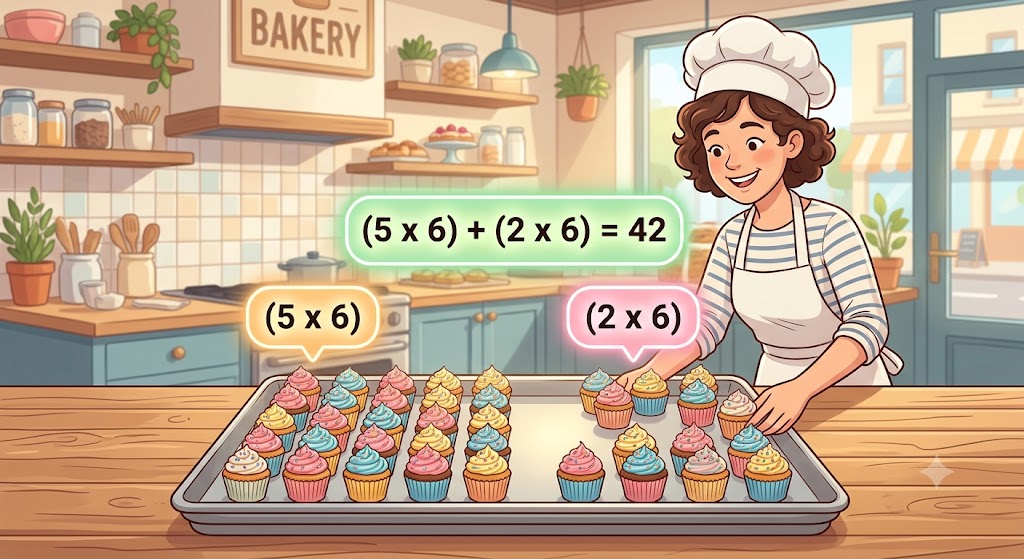
    Imagine you are baking cookies. If you need to arrange 7 rows of 6 cookies, don’t try to solve “7×6” immediately.

    1. Split the big number: Take that 7 and split it into 5 and 2.
    2. Solve the easy parts: Now you have 5 rows of 6 (which is 30) and 2 rows of 6 (which is 12).
    3. Bring them together: Add 30 and 12. You get 42.

    Why this works

    By using the distributive property, your child moves from “I don’t know this” to “I can build this.” This reduces math anxiety immediately because the child gains control over the problem. They aren’t guessing; they are calculating using known facts.

    Start your journey today

    Stop relying on rote memorization that fades under pressure. Give your child the tools to visualize numbers, solve problems creatively, and build lasting confidence.

    Download the practice worksheet below to help your child master multiplication through the art of baking. When math feels like a story, the numbers stop being scary.

    Practice Questions

    Baking Adventure: Mental Math Challenge

    Instructions: Help the bakery staff organize their orders by using the distributive property. Select the correct method or answer for each challenge.

    Question 1

    The bakery needs to arrange 8 trays of muffins, with 6 muffins on each tray. Which expression correctly uses the distributive property to help calculate the total?

    A) 8 x 6 = 8 + 6

    B) (4 x 6) + (4 x 6)

    C) (8 x 5) + 1

    D) 8 x 3 x 2

    Question 2

    You are decorating a large cake with 9 rows of 7 cherries. To calculate the total, you split 9 into 5 and 4. What is the calculation you perform?

    A) (5 x 7) + (4 x 7)

    B) (5 + 7) + (4 + 7)

    C) (5 x 9) + (4 x 9)

    D) (5 x 4) + (7 x 9)

    Question 3

    The shop has 6 boxes of donuts, and each box contains 8 donuts. How can you use your knowledge of the 5 times table to solve this?

    A) (5 x 8) + (1 x 8)

    B) (6 x 5) + (6 x 3)

    C) (5 x 6) + (8 x 6)

    D) 5 x 8 + 6