
Tag: Area

  • How the Super-Stacker Strategy Helped Kai Save the Hero HQ

    How the Super-Stacker Strategy Helped Kai Save the Hero HQ

    Does your kitchen table look like a crime scene every time Year 6 math homework comes around? You are not alone. Many parents tell us that their children treat math like a chore to be endured, especially when they move into the Stage 3 curriculum and start dealing with the abstract concepts of volume and cubic units.

    Recently, we met a parent whose son, Kai, was in tears over a simple worksheet on rectangular prisms. Kai is a bright kid who loves video games, but when he saw the grid-based volume problems, he froze. He tried to count every individual cube in the diagram, lost his place, and ended up guessing.

    The myth that “some kids aren’t math kids” is exactly that—a myth. Kai’s frustration didn’t stem from a lack of intelligence. It stemmed from a disconnect between the visual reality of his world and the dry, academic symbols on the page.

    The Common Mistake: Counting Cubes One-by-One

    Most students try to count every single cubic unit in a rectangular prism because they are taught to “find the volume” without being taught to “see the structure.” This creates massive cognitive load. When students try to count 24 or 30 cubes individually, they make errors, get tired, and eventually, decide that math is just too hard.

    The Guide: The Super-Stacker (Layering) Strategy

    Instead of counting every cube, we teach students to use the Super-Stacker Strategy.

    Think of a rectangular prism not as a solid block, but as a stack of flat layers, exactly like a stack of pancakes or a building’s floor plan.

    1. Identify the Base: Find the number of cubes in the bottom layer (the “floor”).
    2. Count the Height: Count how many layers (the “floors”) there are.
    3. Multiply: Multiply the base layer by the number of layers.

    This transforms a messy counting task into a simple multiplication problem.

    Kai’s Transformation: Saving the Hero HQ

    When Kai looked at the prism on his homework—a box 4 cubes wide, 3 cubes deep, and 2 cubes high—he didn’t panic. He visualized it as his superhero HQ.

    “Okay,” Kai said, “The floor is 4 by 3. That’s 12 cubes on the ground level.”

    Then he looked at the height. “And there are 2 layers total. So, 12 cubes times 2 layers… that’s 24 cubic units!”

    He didn’t just find the right answer; he understood why the answer was 24. The stress melted away, replaced by the satisfaction of solving a puzzle.

    Turn Homework Battles into Victories

    You don’t need to be a math expert to help your child. You just need to change the context. By grounding these concepts in visual logic—like building a superhero base—we help children see the patterns in the world around them.

    Stop the homework battles. Transform your child’s practice into an engaging story that aligns with their curriculum. Visit EinstyAI today to get custom, story-based math resources that make your child the hero of their own learning journey.


    PRACTICE QUESTIONS

    Theme: The Super-Stacker’s Mission to Save Hero HQ

    Mission: Calculate the volume of your secret base components using the Layering Strategy.

    Question 1

    Your secret headquarters has a foundation that is 5 cubes long and 4 cubes wide. If your HQ is 3 layers high, what is the total volume in cubic units?

    A) 20

    B) 60

    C) 12

    D) 40

    Question 2

    You are designing a super-shield box that is 2 cubes long, 2 cubes wide, and 4 cubes high. How many cubic units of space does the shield take up?

    A) 8

    B) 16

    C) 12

    D) 4

    Question 3

    The Villain’s Trap is a rectangular prism that is 6 cubes long and 2 cubes wide. It is 3 layers high. What is the volume?

    A) 11

    B) 18

    C) 36

    D) 24
  • How do I explain area and perimeter to my Year 4 child without the tears?

    How do I explain area and perimeter to my Year 4 child without the tears?

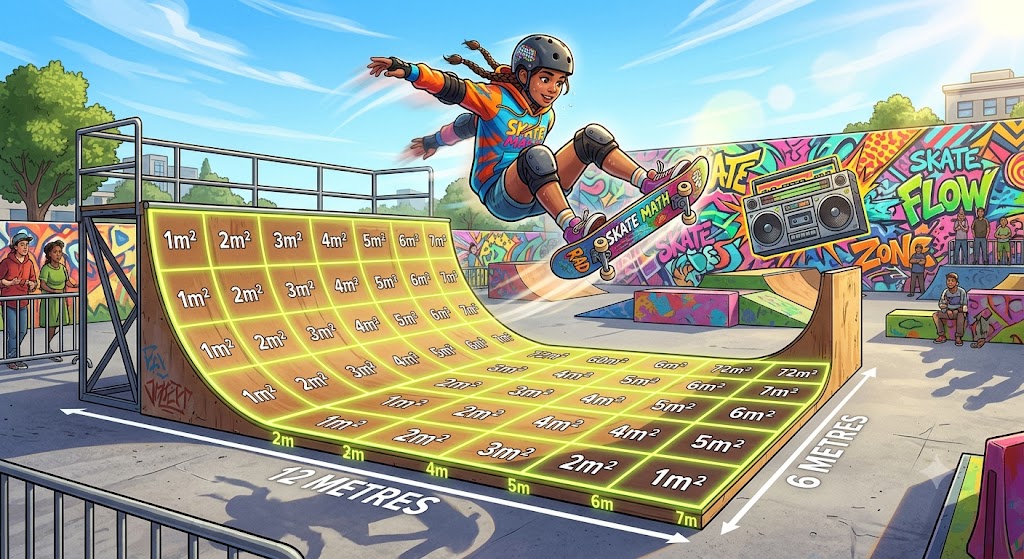
    Is your kitchen table the nightly battleground for math homework? You are not alone. Many parents search for ways to simplify geometry, often assuming that math homework is naturally a battle. Here is the truth: Math doesn’t have to be a struggle. When you shift the mindset from “solving problems” to “solving stories,” the anxiety disappears.

    Perimeter vs. Area: The Simple Distinction

    Children often confuse perimeter and area because both involve shapes. To keep them clear, use the Fence and Grass analogy:

    • Perimeter is the fence. It is the distance around the edge. If your child were a skater, the perimeter is the metal rail they ride along.
    • Area is the grass. It is the space inside the shape. If your child is skating, the area is the concrete slab they roll across.

    The “Border and Fill” Trick

    To help students master these concepts, teach them to physically trace the shape before calculating.

    1. Trace the Border: Use a finger to outline the object. This is for Perimeter (measured in centimetres or metres).
    2. Fill the Space: Use a shading motion to cover the surface. This is for Area (measured in square centimetres or square metres).

    When students encounter a question, ask them: “Are we counting the fence, or are we tiling the floor?” This simple check prevents the most common mistake: adding the length and width instead of calculating the space inside.

    Bring Math to Life

    The key to deep learning is context. If your child loves skateboarding, don’t force them to measure abstract rectangles in a workbook. Instead, have them design a dream skate park. Ask them to calculate the perimeter of a new ramp for safety fencing, or the area of concrete needed for a flat-bank section. By connecting abstract concepts like square centimetres to real-world objects, you move them from rote memorization to true understanding.

    If you are looking for ready-to-use math stories that turn these concepts into engaging adventures, check out EinstyAI. We help students conquer math anxiety by transforming dry curriculum requirements into compelling stories. Stop fighting over homework and start exploring.

    Practice Questions: The Skate Park Challenge

    1. The Grind Rail

    A new rectangular grind rail is 4 metres long and 1 metre wide. If we need to put rubber edging all the way around the rail, what is the total length of edging required?

    A) 4 square metres

    B) 5 metres

    C) 8 metres

    D) 10 metres

    2. The Concrete Pad

    You are designing a small concrete practice slab that is 3 metres long and 3 metres wide. How much surface area will this slab cover?

    A) 6 square metres

    B) 9 square metres

    C) 12 square metres

    D) 18 square metres

    3. The Half-Pipe Floor

    A skater needs to cover a section of the half-pipe floor with non-slip grip tape. The section is 5 centimetres wide and 4 centimetres long. What is the area of the grip tape needed?

    A) 9 square centimetres

    B) 18 square centimetres

    C) 20 square centimetres

    D) 25 square centimetres