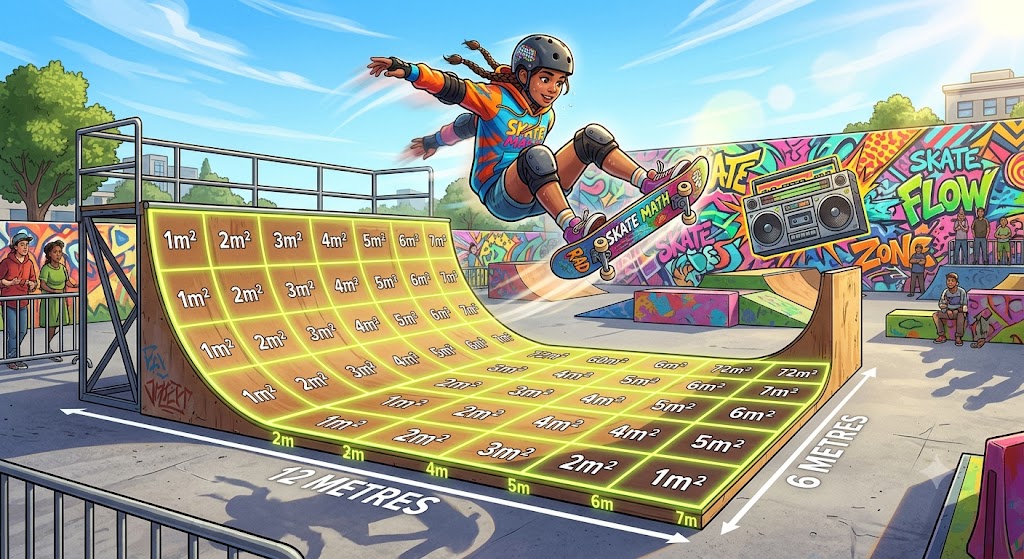
Is your kitchen table the nightly battleground for math homework? You are not alone. Many parents search for ways to simplify geometry, often assuming that math homework is naturally a battle. Here is the truth: Math doesn’t have to be a struggle. When you shift the mindset from “solving problems” to “solving stories,” the anxiety disappears.
Perimeter vs. Area: The Simple Distinction
Children often confuse perimeter and area because both involve shapes. To keep them clear, use the Fence and Grass analogy:
- Perimeter is the fence. It is the distance around the edge. If your child were a skater, the perimeter is the metal rail they ride along.
- Area is the grass. It is the space inside the shape. If your child is skating, the area is the concrete slab they roll across.
The “Border and Fill” Trick
To help students master these concepts, teach them to physically trace the shape before calculating.
- Trace the Border: Use a finger to outline the object. This is for Perimeter (measured in centimetres or metres).
- Fill the Space: Use a shading motion to cover the surface. This is for Area (measured in square centimetres or square metres).
When students encounter a question, ask them: “Are we counting the fence, or are we tiling the floor?” This simple check prevents the most common mistake: adding the length and width instead of calculating the space inside.
Bring Math to Life
The key to deep learning is context. If your child loves skateboarding, don’t force them to measure abstract rectangles in a workbook. Instead, have them design a dream skate park. Ask them to calculate the perimeter of a new ramp for safety fencing, or the area of concrete needed for a flat-bank section. By connecting abstract concepts like square centimetres to real-world objects, you move them from rote memorization to true understanding.
If you are looking for ready-to-use math stories that turn these concepts into engaging adventures, check out EinstyAI. We help students conquer math anxiety by transforming dry curriculum requirements into compelling stories. Stop fighting over homework and start exploring.
Practice Questions: The Skate Park Challenge
1. The Grind Rail
A new rectangular grind rail is 4 metres long and 1 metre wide. If we need to put rubber edging all the way around the rail, what is the total length of edging required?
A) 4 square metres
B) 5 metres
C) 8 metres
D) 10 metres
2. The Concrete Pad
You are designing a small concrete practice slab that is 3 metres long and 3 metres wide. How much surface area will this slab cover?
A) 6 square metres
B) 9 square metres
C) 12 square metres
D) 18 square metres
3. The Half-Pipe Floor
A skater needs to cover a section of the half-pipe floor with non-slip grip tape. The section is 5 centimetres wide and 4 centimetres long. What is the area of the grip tape needed?
A) 9 square centimetres
B) 18 square centimetres
C) 20 square centimetres
D) 25 square centimetres