
Tag: 2-digit multiplication

  • Why does my Year 5 student get stuck on multi-step math problems?

    Why does my Year 5 student get stuck on multi-step math problems?

    Every parent has faced the same wall: you sit down to help with homework, and the initial enthusiasm quickly dissolves into frustration. Why do students who are perfectly capable of adding and subtracting suddenly freeze when faced with a “word problem”?

    The answer is rarely about their ability to calculate. It is about their ability to translate. At the Year 5 Stage 3 level, math moves beyond simple arithmetic into Number and Algebra, where understanding the relationship between numbers is critical. When a child sees a multi-step word problem, they often see a wall of text that looks nothing like the neat equations in their textbook. They aren’t struggling with the math; they are struggling with the story.

    The mindset shift: Math is just a story

    Too many parents fall into the trap of thinking their child just “isn’t a math kid.” This creates a fixed mindset that labels a temporary struggle as a permanent character trait. In reality, math anxiety often stems from the disconnect between abstract numbers and real-world logic.

    By teaching students to break down complex problems into manageable steps, we lower that anxiety. At EinstyAI, we believe that if you can change the story, you change the result. When you frame a percentage calculation as a quest for rare loot in a game, the abstract concepts—like calculating 10%, 25%, or 50%—become tangible tools for success rather than chores to be completed.

    Mastering percentages and multi-step logic

    To solve multi-step problems, encourage your child to use the “Highlight and Pause” method.

    • Highlight the goal: What is the final question asking for?
    • Pause and plan: Before calculating, write down the known variables.
    • Divide and conquer: If the problem asks to find 10% of a total and then subtract it, that is two separate, solvable tasks. Treat them that way.

    When students learn to look for benchmarks like 10% (move the decimal one spot), 50% (divide by 2), and 25% (half of 50%), they stop guessing and start strategizing. These aren’t just tricks; they are foundational skills that make complex Number and Algebra tasks feel intuitive. Stop fighting the homework. Start building the story, and watch the math follow.

    Practice Questions

    Scenario: You are a top-tier gamer in the Roblox universe. Your success depends on your ability to manage your Robux and inventory to build the ultimate game world.

    Question 1

    You have 800 Robux. You decide to spend 50% of it on a new avatar skin and then use 10% of your remaining Robux to buy a special hat. How many Robux do you have left after these purchases?

    A) 400

    B) 360

    C) 440

    D) 320

    Question 2

    Your guild has collected 1,200 digital gems. You need to give 25% of the gems to the guild leader and then divide the remaining gems equally among 5 team members. How many gems does each team member receive?

    A) 180

    B) 240

    C) 300

    D) 200

    Question 3

    You are designing a map. You have 200 building blocks. You use 10% of your blocks for the floor and 50% of the remaining blocks to build a wall. How many blocks do you have left to build your tower?

    A) 90

    B) 100

    C) 80

    D) 110
  • Why Does My Year 5 Child Get Stuck on Multistep Math Word Problems?

    Why Does My Year 5 Child Get Stuck on Multistep Math Word Problems?

    Do you find yourself sitting at the kitchen table, watching your Year 5 student stare blankly at a word problem, only to give up because “it’s too hard”? You aren’t alone. Many parents assume that math ability is fixed—that some children are simply “math kids” and others are not. This is a myth. The reality is that most students don’t struggle with the math itself; they struggle with the language and the multi-layered logic of the question.

    In Stage 3 of the Australian curriculum, the jump in complexity is significant. Students are expected to move from simple arithmetic to solving multistep problems involving percentages. If your child struggles with this, they likely need a strategy to decode the story, not more repetitive drills. At EinstyAI, we help students transform this frustration into confidence by aligning math practice with stories they actually want to read.

    The Secret to Decoding Word Problems

    To help your child succeed with multistep problems—specifically calculating 10%, 25%, and 50%—teach them the “STOP-THINK-SOLVE” method.

    1. Stop and Underline Keywords:

    Ask your child to highlight the important numbers and the specific percentage they need to find. If the problem asks for 10% of a collection, circle “10%.” If it mentions “total” or “remaining,” highlight those. Ignoring keywords is the number one reason for errors.

    2. Think in “Easy Chunks”:

    Before jumping into complex division, use “friendly” percentages.

    • 50% is half: Just divide the number by 2.
    • 25% is half of a half: Divide by 2, then divide by 2 again.
    • 10% is a tenth: Just move the decimal point one place to the left (e.g., 10% of 80 is 8).

    3. Solve the Steps Separately:

    Multistep problems are just a series of small problems chained together. Teach your child to solve one part, write the answer down, and then use that answer to solve the next part. Never try to hold all the numbers in your head at once.

    Changing the Mindset

    Math homework doesn’t have to be a battleground. When you shift the focus from “getting the right answer” to “solving the mystery” within the story, anxiety drops. A Year 5 student who views a word problem as a puzzle to be cracked—rather than a test to be failed—will naturally develop better problem-solving stamina.

    Ready to put these strategies into practice with your child? Scroll down to download our latest story-based worksheet designed to make Stage 3 percentages manageable and fun.

    Practice Questions

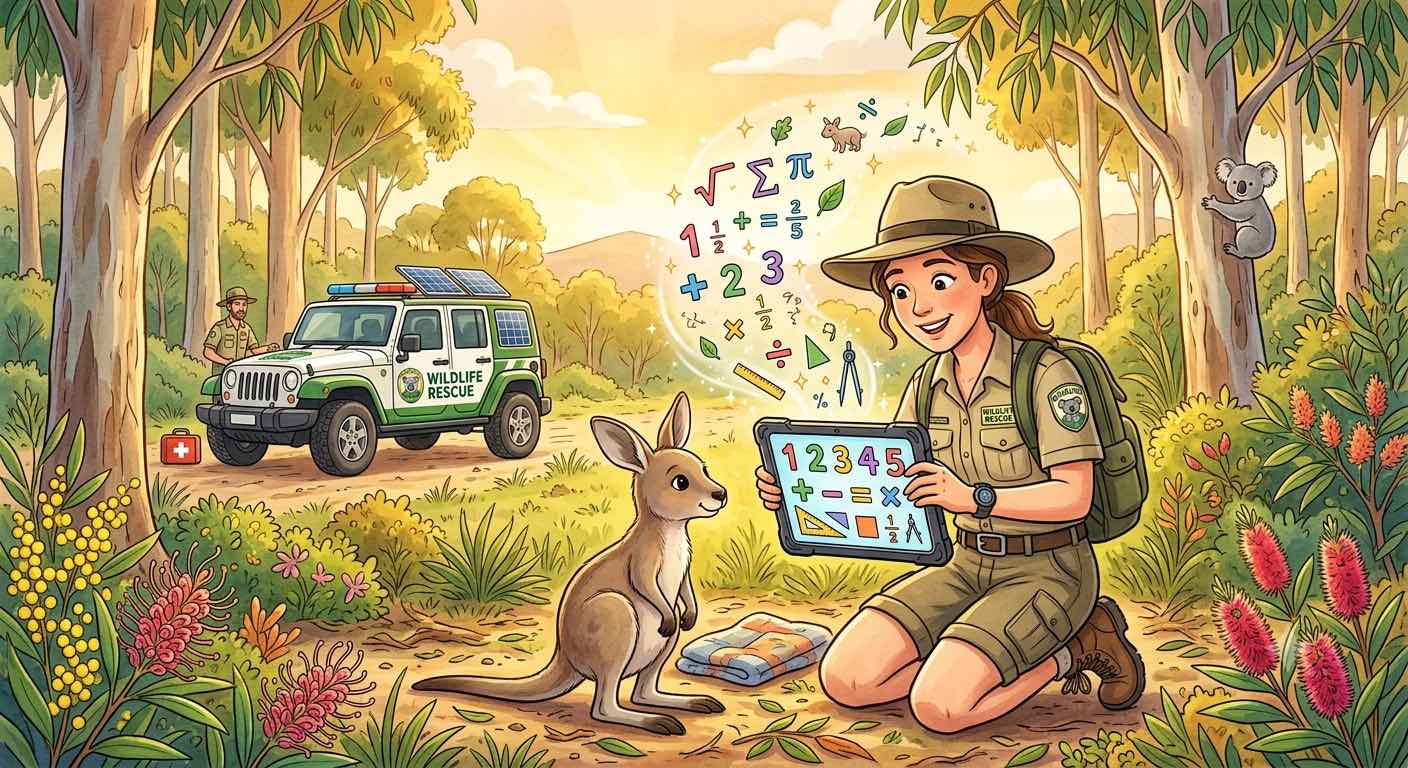
    The Great Outback Wildlife Rescue

    Help the ranger team save our native animals! Use your math skills to calculate the supplies needed for the rescue mission.

    Question 1

    The ranger team found 120 injured kangaroos in the bush. They need to give medicine to 25% of them immediately. How many kangaroos need immediate medicine?

    A) 20

    B) 30

    C) 40

    D) 60

    Question 2

    The rescue station has a stockpile of 400kg of eucalyptus leaves for the koalas. The team uses 10% of the stockpile for the morning feed. How much eucalyptus is left for the rest of the day?

    A) 40kg

    B) 300kg

    C) 360kg

    D) 390kg

    Question 3

    The team rescued 80 baby wombats. They decided to transport 50% of them to the main shelter and keep the rest at the field hospital. Later, 25% of the wombats at the field hospital were cleared to go home. How many wombats are still at the field hospital?

    A) 10

    B) 30

    C) 40

    D) 20